Domain appraisals can vary by huge amounts depending on where they are done. Whether using a professional service like Moniker or Sedo, or asking for a free appraisal on a domain forum, the amount of the various appraisals can vary by tens of thousands of dollars and huge percentages. People often wonder if appraisals are motivated by outside factors – either by people wanting to buy a domain name, so the appraisal is much less than they sincerely believe, or they want to sell someone a domain name by convincing them the name is worth much more than name would actually fetch.
For the sake of curiosity, I would like to know how much deviation there is when domain investors look at one name and place a value on it. I am reaching out to you to give me an appraisal on my DebtCollectors.com domain name. I don’t plan to publish the appraisals (or post the names of the appraisers), but I will give the average and the outliers. I know how much I paid for it recently, and I have an idea about how much it would sell for if I would put it in auction.
I know there are various factors that can play into a domain’s sales price, including the buyer, the seller, the market conditions and the venue, but I am looking for a single dollar figure. Not only do I want to test my own ability to value a name, but I want to see what others think in an unbiased venue.

Domain Appraisals: What's The Value?
New Registration: Diamond in the Rough
I dont register many new domain names. I prefer to focus on strategic aftermarket acquisitions when I buy, as I believe the payoff can be greater. However, just like almost every other domain investor, I like to register new domain names every once in a while. Hunting for domain names is fun, and it feels great to find a gem in the rough – although one person’s gem may be someone else’s waste. I think everyone would agree that a gem of a new registration is a name that earns its annual registration fee and more, without any marketing effort.
In March, after doing some keyword research related to the outdoors and hunting, I registered MountedHeads.com (no link to avoid violating TOS). Although the Overture wasn’t strong, I felt the name was unique and in an interesting niche. Of course, “mounted heads” is related to taxonomy, where hunters pay to have their animal heads mounted. There are currently over 18,000 Google results for the term, “mounted heads,” and although it isn’t typical that a parked page is ranked so high, this one ranks #5 out of 18,000.
From the time I bought the name, I have had it parked on Fabulous. Between March and September, I received almost no visitors at all. I started receiving traffic in October, and I have been averaging about 20-25 visits per month, not too bad for a newly registered domain name. The name is also seeing a 40% CTR and rising, now that I made some minor keyword adjustments and used the Fabulous+ program to customize the layout based on landing page testing.
The name has made more than twice the registration fee, and it has earned 9o% of that revenue since it started receiving more traffic in October. While this wouldn’t be considered a great name for the biggest portfolios, it’s a gem of a new registration. Based on just a 10 year revenue multiple (using $4/month), this is close to a $500 domain name. Not bad for paying $6.95 for it less than a year ago.
Great Domain Name Strategy: Vacations To Go
Travel planning company Vacations To Go employs one of the finest domain strategies I have seen. The company owns some fantastic niche travel domain names, allowing them to avoid paying high pay per click costs. While they seem to avoid the very expensive one word generic domain names (like Cruises.com), they do own a ton of great second tier travel domain names that probably receive some traffic. Just a few of the highly targeted domain names owned by Vacations To Go include:
AcapulcoCruises.com
AthensTours.com
LowCostCruise.com
LowPriceCruises.com
MexicanCruises.com
ItalyCruise.com
Showing their vast domain knowledge, Vacations To Go even owns some fantastic typo domain names, including:
BahamasCrusie.com
CheapCruies.com
Norweigan.com
The smartest thing about this strategy is that instead of paying $.50 – $10.00+ per visitor’s click on Yahoo or Google, they own all visitors to their domain names, and only pay around $7/year for each domain name. All of their names are forwarded to their main site, with a subfolder tracking how the visitor reached the main page. If a customer books just one cruise or vacation after landing on a domain name, they’ve almost certainly paid off the domain name for life (and then some).
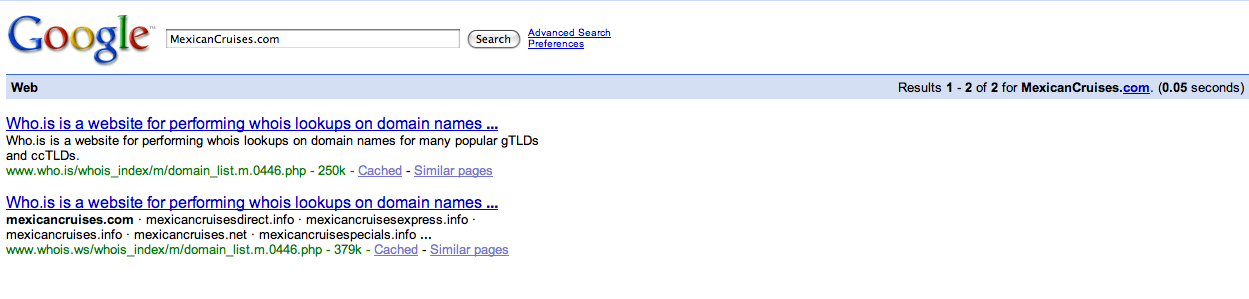
One major issue I see is that many of the domain names owned by Vacations To Go don’t seem to be listed in Google. As you can see in the screenshot below, MexicanCruises.com isn’t listed in Google when the exact domain name is entered into the search bar. This isn’t good, as it means if a customer tries to directly navigate to the site using Google instead of the internet browser bar, they won’t even see the domain name. On some of the names where this is an issue, Vacations To Go attempts to alleviate this by buying the keyword of the domain name, but that is costing them money.

There are many reasons why Google could have removed the names, but it may have had nothing to do with anything Vacations To Go did. To rectify this, I would suggest that someone from Vacations To Go enters all of their domain names into Google, and take note of the names that do not show up in the results. They should then request reconsideration from Google. By doing this, Vacations To Go will have their domain names put back into Google, saving them from having to pay per click every time a consumer types the domain name as a search.
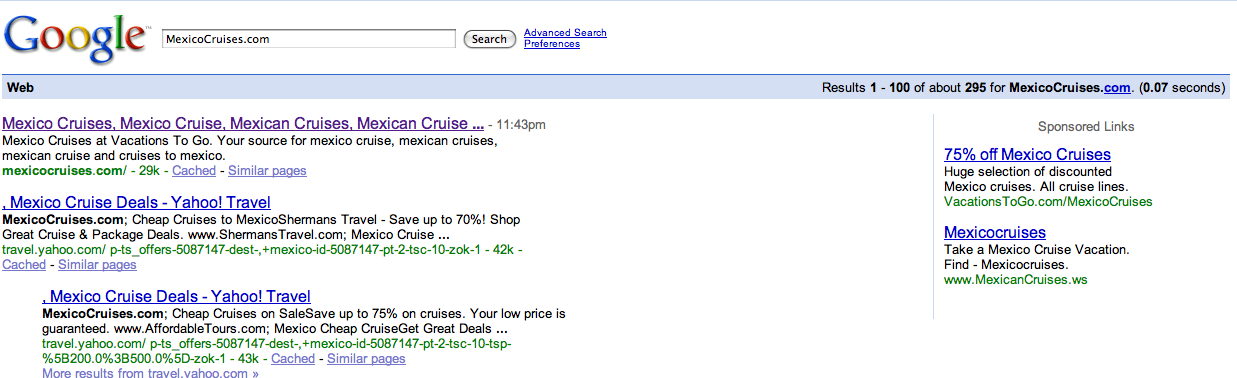
On other domain names, such as MexicoCruises.com, the domain name is listed in Google at the top. If a visitor accidentally types this domain name into Google instead of their navigation bar, they will see it as the top natural result, and they may click on this listing rather than on the paid search listing. Vacations To Go has protected itself by paying for Adwords keywords, which is another smart move.

Vacations To Go certainly has one of the best domain strategies I’ve seen. Not only are they building value for their brand, they are also building value for each of the domain names they own. If they were to ever sell the company, they could provide a traffic, click through and ROI for each domain asset they own, adding tremendous value to their portfolio. I give high praise to Alan Fox and his team at Vacations To Go.
States Advertising Generic Domain Names
In the past week, I saw two states advertising great generic .com domain names, and I was impressed that their national campaigns included an intelligent domain name strategy. The South Carolina Department of Parks, Recreation, and Tourism operates SouthCarolinaParks.com and SouthCarolinaGolf.com among many others (137 according to Registrant Search), and they used the golf domain name in their television commercial. This domain name redirects to DiscoverSouthCarolina.com, the main website of the SCPRT.
VermontVacation.com is another website I saw advertised this past week. The domain name is owned and operated by the Vermont Department of Tourism and Marketing, who also owns BestFoliage.com and GreatFoliage.com, with both names pointed to VermontVacation.com. There may be better domain names to own related to the state of Vermont (VermontSkiing.com for example), but it was a smart move to purchase and brand a sensible .com domain name.
It’s great to see states using these great generic domain names to advertise their tourism departments. Generic domain names in the .com extension are easy for television viewers to recall, and when a state organization spends tens of thousands of dollars on advertising campaigns, it is nice to see that they didn’t skimp on the domain names.
Many organizations think that just by creating a commercial and setting up a website, people will find them. As I blogged about the USPS FakeChecks.org campaign a while ago, this is not always the case. The USPS learned this the hard way, and they purchased FakeChecks.com after their FakeChecks.org campaign was launched, presumably after learning that consumers were confused and typed in the .com name in error. Owning an easy to recall .com generic domain name is essential when advertising in mainstream media.
My Thoughts on Domain Development
While I think domain parking is a great option for domain names that haven’t been developed yet, I believe domain owners should begin making plans to develop their domain names soon. I wrote a guest post on Sahar’s Conceptualist Blog about why I think now is the time domain owners should develop their domain names.
Please check out my guest post when you have a few moments.
Making a Reasonable Offer for a Domain Name
Usually when I want a domain name, I place a value on it to my portfolio, and I make the owner an offer that is within my value range. While I may end up paying more than I could have paid, it virtually guarantees that I will receive a response. These days, it is difficult to pay too much for a great category killer generic domain name. There are so few available for sale, the prices continue to rise.
Domain owners receive dozens of emails for their valuable domain names daily, weekly or yearly. For the most part, unless it isn’t a top tier name, chances are very good that your offer isn’t the first, nor the last offer that will be made on a particular name. If you send a lowball offer, the owner will likely delete it like all the others – or send you an email telling you to get lost (or some unprintable variation of “get lost”). If you make a reasonable offer, you are much more likely to get a favorable (or at least some sort of) response.
I know there are many people out there who would tell me they bought a great name for a tenth of the value simply by making a low offer for it. Well, I think that is mostly due to lucky timing, and it certainly doesn’t happen often – especially with software that allows people to send out massive amounts of inquiry emails. If you have no idea how much a domain name is worth to you, then it probably isn’t advisable to even be making offers until market research is done.
From my own experience, if you want to acquire a name that you believe is worth $20,000 – $30,000, you will have much more luck by offering close to $20,000 rather than $2,000. Most motivated domain owners would probably thank me for the offer, and ask me to increase it, assuming that if I start there, I am willing to go higher. My approach is to either increase the offer just a bit (if I have room) or tell the owner that’s my final offer – and I stick to it. If the domain owner is inclined to sell for that price but wanted to see if I was willing to offer more, he will probably accept my offer, lest he regret declining a fair offer. Owners want to receive the most for their names, but most won’t turn down a reasonable offer if he knows its the best he will get.
I know there are plenty of stories to counter this strategy, but as more people enter the industry, the more important it is to make your first offer an impressive offer. You should get a better response rate and end up owning better domain names. You may pay more, but you will close more deals.