Subscribe

Domain Psychology

If others are like me, they probably find themselves searching for domain names based on events going on in their life. Lately, I’ve been spending quite a bit of time searching for wedding, pet, and real estate domain names. I do some keyword research via Keyword Discovery in addition to the “real world” research that I am constantly doing. I also look-up category killer names on iWhois.com.
Exploring new areas can

Reader Question: Owning .org But Not .com

0

From one of my readers:

“Elliot, whats your take on MatchMaker.org (made up name) and how badly the lack of .com will affect it? I am already established idea of what i want to do with that, it will be similar to your model of lowell, giving them basic [listings] for free but frills and reviews of business will come with price tag.
Basic premise of concept: Break down matchmakers by state, and maybe cities as sub category of states? I am thinking of putting everyone in for free with basic contact info (email) and just a name of company, and then notifying them that their page is up and about extra features they can get. So everyone gets a free page but after that comes extra features. While they can pay for frills of being reviewed, to add link to site, add write up about them self and what they do, background check. (due to .org directory, in public eyes reviews will seem more credible, even more then if it was .com or another category)
Whats your thoughts on monetization of it? How lack of .com will affect it or other extension affecting it?”

Depending on the industry you are in, owning the .org can sometimes be better than the .com. In the dating industry, I think the .com is much better and holds more credence, as people know it to be a for-profit industry. However, if you would form an organization of “matchmakers,” the .org wouldn’t necessarily be bad, but I think you would have to offer more than just a directory. You might have to sponsor events or offer tools to the match makers who would want to join the organization.
In terms of branding, I discussed something similar when the USPS nationally branded a .org and didn’t own the .com. People have short memories, and many will automatically assume it’s the .com – or they won’t even realize the .com and .org are different, so they just went to the .com. The USPS eventually bought the .com, but they probably got lucky because the name wasn’t what I would consider a premium generic name. I am sure they paid much more when the bought it after the fact, but the premium was only because they needed it due to traffic loss, and not name value.
With your example, the .com would already be considered a premium generic dating name (I know the actual name but refrained by request). Because of this, the .com already has inherent value, so if you brand the .org and lose traffic to the .com, it will only serve to increase the value of the already valuable .com. If you plan to grow the business and significantly fund it, I would advise buying the .com. If you plan to run it like an organization of “match makers,” where you are providing a valuable service, you may be ok with the .org, but you will still end up losing traffic to the .com.
The more you brand the .org, the more traffic you are probably sending to the .com, thus increasing the price to acquire it. My best advice would be to speak with the owner of the .com (knowing that its a parked page), and see if you can buy that. It will help you brand your business now, and will save you lots of money down the road. If he is unwilling to sell, I would also recommend making a lease to own offer, so you can hedge your bets if you decide to exit the business or rebrand. You will pay more, but at least the price of the .com won’t increase due to your branding efforts.
In your industry, there will always be “burn down value” for the .com, and much less for the .org. It can only enhance the value of your business if you have the .com, and it will prove that you own the market.


TreatmentCenters.com – $100k Domain to $1Million Website

TreatmentCenters.com is a great example of a company buying the domain name they needed and building it into a million dollar website. TreatmentCenters.com was sold for $100,000 by Afternic/BuyDomains as reported in DNJournal. This domain name informs visitors about exactly what they will find when they type it in to their browser, and it doesn’t disappoint upon arrival. For this business model, there probably aren’t any better domain names out there.
Using a directory model, TreatmentCenters.com provides paid and unpaid listings for various health and mental treatment centers and counselors throughout the country. Visitors can search by condition, by state or by provider name to find what they need. When a website like this is able to provide names, addresses, contact information, and data on the topic of interest to the searcher, it builds stickiness, and the searcher will probably return. This provides a positive experience for the visitor, and it also provides an ROI for the advertiser.
Kudos to the people behind TreatmentCenters.com! This is an aesthetically pleasing, well-functioning website, and it looks like a million bucks! I hope to emulate it with some of my entries down the road – including Lowell.com.

Great Domain Name Strategy: Vacations To Go

Travel planning company Vacations To Go employs one of the finest domain strategies I have seen. The company owns some fantastic niche travel domain names, allowing them to avoid paying high pay per click costs. While they seem to avoid the very expensive one word generic domain names (like Cruises.com), they do own a ton of great second tier travel domain names that probably receive some traffic. Just a few of the highly targeted domain names owned by Vacations To Go include:
AcapulcoCruises.com
AthensTours.com
LowCostCruise.com
LowPriceCruises.com
MexicanCruises.com
ItalyCruise.com
Showing their vast domain knowledge, Vacations To Go even owns some fantastic typo domain names, including:
BahamasCrusie.com
CheapCruies.com
Norweigan.com
The smartest thing about this strategy is that instead of paying $.50 – $10.00+ per visitor’s click on Yahoo or Google, they own all visitors to their domain names, and only pay around $7/year for each domain name. All of their names are forwarded to their main site, with a subfolder tracking how the visitor reached the main page. If a customer books just one cruise or vacation after landing on a domain name, they’ve almost certainly paid off the domain name for life (and then some).
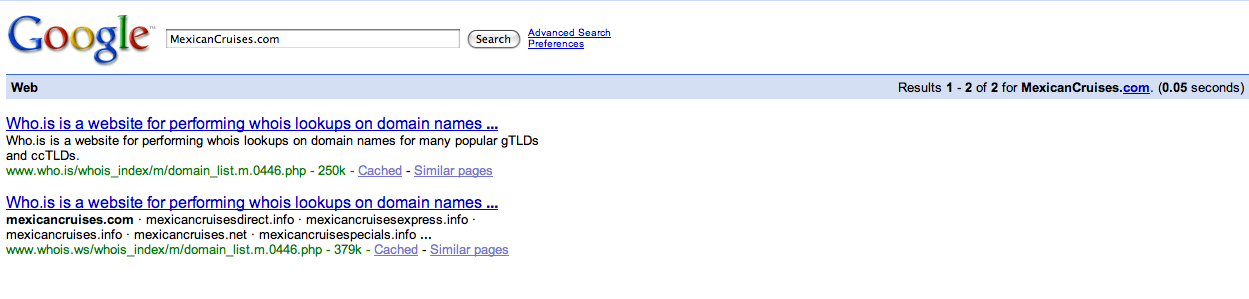
One major issue I see is that many of the domain names owned by Vacations To Go don’t seem to be listed in Google. As you can see in the screenshot below, MexicanCruises.com isn’t listed in Google when the exact domain name is entered into the search bar. This isn’t good, as it means if a customer tries to directly navigate to the site using Google instead of the internet browser bar, they won’t even see the domain name. On some of the names where this is an issue, Vacations To Go attempts to alleviate this by buying the keyword of the domain name, but that is costing them money.
MexicanCruises.com
There are many reasons why Google could have removed the names, but it may have had nothing to do with anything Vacations To Go did. To rectify this, I would suggest that someone from Vacations To Go enters all of their domain names into Google, and take note of the names that do not show up in the results. They should then request reconsideration from Google. By doing this, Vacations To Go will have their domain names put back into Google, saving them from having to pay per click every time a consumer types the domain name as a search.
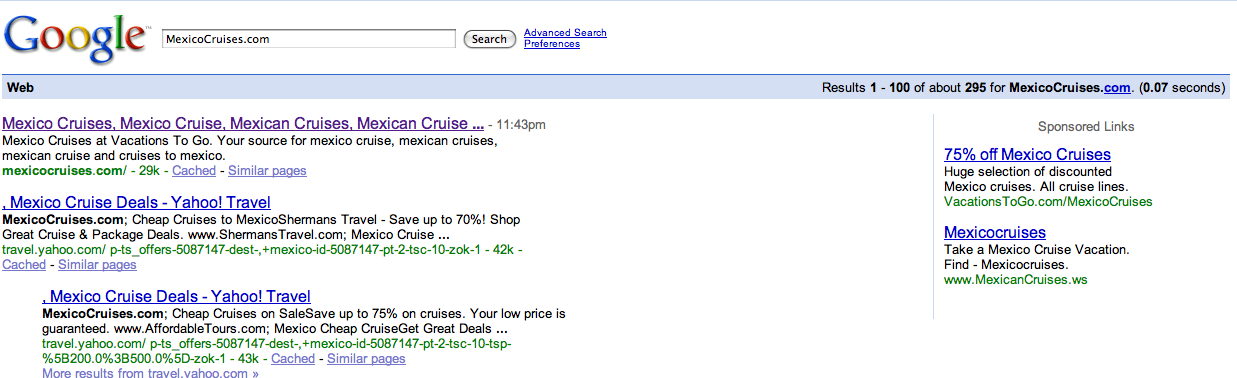
On other domain names, such as MexicoCruises.com, the domain name is listed in Google at the top. If a visitor accidentally types this domain name into Google instead of their navigation bar, they will see it as the top natural result, and they may click on this listing rather than on the paid search listing. Vacations To Go has protected itself by paying for Adwords keywords, which is another smart move.
MexicoCruises.com
Vacations To Go certainly has one of the best domain strategies I’ve seen. Not only are they building value for their brand, they are also building value for each of the domain names they own. If they were to ever sell the company, they could provide a traffic, click through and ROI for each domain asset they own, adding tremendous value to their portfolio. I give high praise to Alan Fox and his team at Vacations To Go.

Making a Reasonable Offer for a Domain Name

0

Usually when I want a domain name, I place a value on it to my portfolio, and I make the owner an offer that is within my value range. While I may end up paying more than I could have paid, it virtually guarantees that I will receive a response. These days, it is difficult to pay too much for a great category killer generic domain name. There are so few available for sale, the prices continue to rise.
Domain owners receive dozens of emails for their valuable domain names daily, weekly or yearly. For the most part, unless it isn’t a top tier name, chances are very good that your offer isn’t the first, nor the last offer that will be made on a particular name. If you send a lowball offer, the owner will likely delete it like all the others – or send you an email telling you to get lost (or some unprintable variation of “get lost”). If you make a reasonable offer, you are much more likely to get a favorable (or at least some sort of) response.
I know there are many people out there who would tell me they bought a great name for a tenth of the value simply by making a low offer for it. Well, I think that is mostly due to lucky timing, and it certainly doesn’t happen often – especially with software that allows people to send out massive amounts of inquiry emails. If you have no idea how much a domain name is worth to you, then it probably isn’t advisable to even be making offers until market research is done.
From my own experience, if you want to acquire a name that you believe is worth $20,000 – $30,000, you will have much more luck by offering close to $20,000 rather than $2,000. Most motivated domain owners would probably thank me for the offer, and ask me to increase it, assuming that if I start there, I am willing to go higher. My approach is to either increase the offer just a bit (if I have room) or tell the owner that’s my final offer – and I stick to it. If the domain owner is inclined to sell for that price but wanted to see if I was willing to offer more, he will probably accept my offer, lest he regret declining a fair offer. Owners want to receive the most for their names, but most won’t turn down a reasonable offer if he knows its the best he will get.
I know there are plenty of stories to counter this strategy, but as more people enter the industry, the more important it is to make your first offer an impressive offer. You should get a better response rate and end up owning better domain names. You may pay more, but you will close more deals.

Responding to a Domain Name Offer

Like nearly any piece of property or other asset, almost all domain names are technically for sale for the right price. There aren’t many domain owners who would pass up on a high seven figure cash offer for a domain name, with the exception of developed businesses or very few exceptional domain names. If you sincerely have the ability to pass up on a $5,000,000 for a domain name, I congratulate you, and you can probably stop reading this post and go back to your bottle of 1926 Macallan.
For those of you who have more of a Budweiser taste, please continue.
The problem I see is the way some UDRP proceedings have gone recently, where domain owners can potentially be penalized if they receive an offer and attempt to negotiate a better deal. It seems that some UDRP panels consider an owner’s contemplation of selling a domain name a sign of bad faith. This is dangerous for domain owners, and I know it causes many people to think twice whenever an offer or solicitation is received. Just about everything in this world has some sort of price, and simply because a person would consider selling a possession doesn’t mean that they owned the possession for the sole purpose of selling it.
That said, I think domain owners might be well suited to respond to certain domain email inquiries and offers with an agreement to waive the right to file a UDRP or lawsuit if anything about the domain name is discussed. The person making the inquiry or offer would have to waive his rights to any future legal action before ANY discussion about the name can take place. Any person who is interested in buying the name should be willing to sign, and if someone isn’t willing to sign, it probably means they have ulterior motives, or perhaps they are just kicking the tires.
I am not an attorney, so this isn’t a legal opinion, but the point of this post is to discuss the question of whether this type of agreement would protect domain owners and if it would be a legally binding agreement. Since most domain owners would be willing to sell names in their portfolio for a price (even though that price could be sky high), it might be something worth considering before future negotiations.