



Direct Marketing via Parked Domain Name

1

At NYU, I was taught that Direct Marketing is a one on one communication with a consumer where the reaction (or lack of) can be tracked, and a return on investment can be calculated. Direct marketers use specific calls to action to encourage consumers to respond, providing a trackable and measurable result.

Generic domain names that are parked at companies like Fabulous or SmartName provide the perfect direct marketing test bed. You have a trackable medium (using web analytics), with a call to action in the form of related links of enticing offers. If a visitor clicks through, that’s the response, and the revenue generated from the click is part of the return on the investment. If there isn’t a click-through, the domain owner knows the content wasn’t of interest to the visitor.

Using web analytics, the domain owner can determine whether the advertising links are relevant to what consumers want when they navigate to his site. He has the ability to test many different variables (keywords, images, colors, layout…etc), which is also a hallmark of direct marketing. I seem to remember a mantra of “test everything.” Using some parking programs (like Trafficz), the owner can even write content to offer information that may also invite the consumer to click through and/or return.

Parked domain names can be a great precursor to development. Before investing thousands of dollars into a domain name, the owner can see what visitors want and what isn’t of interest. Using my Customs.com as an example, based on the CTR and clicks, I can determine whether people are looking for customs clearance information, customs lawyers, custom cars, or possibly even Halloween costumes due to a typo.   Based on the analysis I’ve done, it’s pretty clear that they are looking to find passport, travel, and other information associated with customs clearance and requirements.

“Gonna Party Like its 1999”

Pardon me for stealing a line from Prince’s “1999,” but I think it is relevant for the topic of whether Internet companies are currently suffering from Irrational Exuberance, creating an Internet bubble similar to the one in 1999 and bursting the following year.

“Dot-com fever stirs sense of déjà vu,” an written by Brad Stone and Matt Richtel featured today in the International Herald Tribune, discusses the idea that a great deal of Internet companies are overvalued, similar to the conditions that existed just before the .com bubble burst in 2000.    

Up until the bubble’s sudden burst, investors valued fledgling Internet companies at much higher revenue multiples than they could possible ever realize, effectively creating unsustainable valuations.    Investors were buying into unproven concepts, and unproven company founders were spending their newfound wealth unwisely. The article points out many similarities between pre-bubble 1999 to the conditions seen in today’s markets. The naysayers believe that today is different because many of the successful Internet companies are generating positive cashflow now, however, it seems like they are spending it recklessly on new startups without regard to potential revenue.

Like the original Kings of the Internet who wasted billions of dollars on unnecessary luxury items, the new Internet Titans should remember the failures of the past. A business is only as strong as its revenue and growth, and based on the experience of people in the online adult entertainment business, viewers don’t necessarily bring revenues. As Aaron Kessler of Piper Jaffray said in the article, Internet companies “are buying users instead of revenue and profitability.”

Missed Opportunity: Subdirectory Direct Navigation


picture-3.png
Owners of generic domain names know the value of direct navigation traffic, but a quick review of some popular websites leads me to believe they aren’t considering subdirectory direct navigation on their websites. Briefly, a subdirectory is the word or phrase that follows a backslash after the extension on a domain name. In the following example, Boston.com/RedSox, “RedSox” would be the subdirectory.

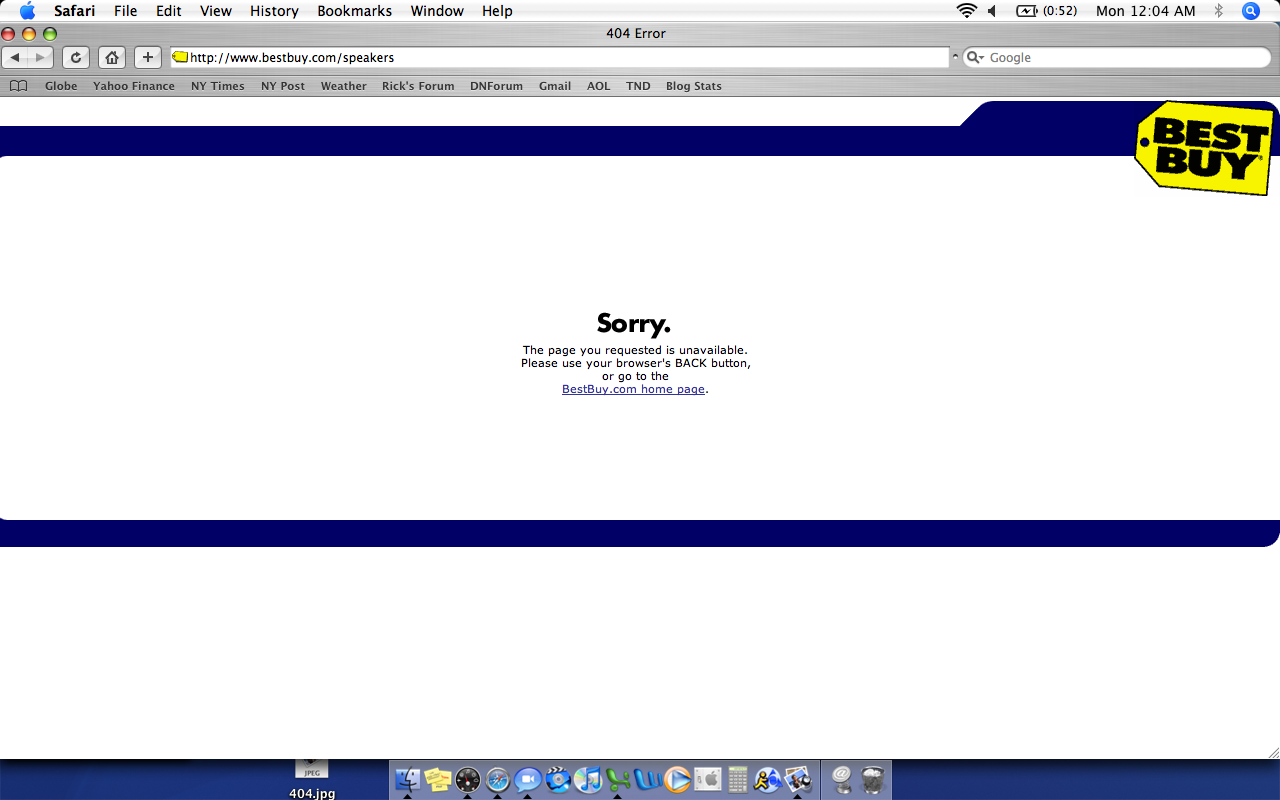
I frequently navigate to a subdirectory hoping to avoid the front page. In my Red Sox example, I often directly navigate to the Boston Globe’s Red Sox page to save time. If I do this on the Globe’s website, I am sure there are other people who do the same thing on other websites. Oftentimes, a 404 Error page is displayed when directly navigating to subdirectories, proving that many website owners aren’t considering this type-in traffic. Below are a few examples of websites that take subdirectory traffic into consideration:

CNN.com/Sports (forwards to Sports Illustrated)
ESPN.com/Soccer (forwards to ESPNsoccernet.com)
Google.com/Mail (forwards to Gmail)
Yahoo.com/Finance (forwards to Yahoo Finance)

However, there are plenty of ecommerce websites that don’t take this into consideration, possibly to their detriment.
BestBuy.com/Speakers (404 Error)
CircuitCity.com/Speakers (The page requested was not found)
Ebay.com/Speakers (Page Not Found)

Just as some people directly navigate to specific domain names, I believe there are some people who directly navigate to the subdirectories. Although these browsers may not leave the website if they encounter a 404 error page, I think it would be an easy fix to give browsers what they are looking for if they do directly navigate to a subdirectory. It seems that many news websites anticipate this direct navigation, so I think ecommerce websites should consider this traffic as well.

Growth Challenge

How does a domain investor grow his business? The biggest challenge facing many domain investors is branching out once success is found in the business of buying a selling names for a profit. This is especially difficult if the person has a good business acumen but lacks the technical know how to develop his domain names.

I have had the good fortune of being involved with some nice domain sales. I also have the good fortune of owning some top quality domain names (such as Devices.com, FlightDiscounts.com, and a recent acquisition that will be published next week). The biggest challenge I am facing right now is growing this from a hobby into a business.

In my opinion, there is still time left to buy good domain names at reasonable prices and make money selling them for a profit. Eventually, this market will dry up, and it will be difficult to be successful with this as the primary business plan.

I believe that the best way to grow my company is by developing some of the gems I own. Building an actual business is the key to development (as Darren Cleveland posted on Sahar’s Blog). Instead of using our domain names as parking lots, we are going to have to start building apartment buildings, stores, houses…etc

The challenge will be finding the right partners (web architects, if you will) to help me build some of my parking lots into beautiful virtual businesses. I have my eye on a couple of domain names that I want to buy. I have the business plan in place if I can reach an agreement with the owner. Now, I just need to find the right team.

.NV.com Addresses – Subdomaining Success

‘nv.com’ addresses draw strong response
I believe we are going to see subdomain sales more and more in the future. Owners of prime domain names similarly broad like nv.com may look to increase their potential revenue streams in the coming months and years. If a great generic domain name isn’t yielding the ppc revenue desired, why not sell subdomains? I am not a technical expert, so I don’t know how much work is involved in creating and managing subdomains, but I am sure it is “doable.”Not only is the domain registry generating $50/year in registration revenue (with a 2 year minimum commitment), there are plenty of upsell opportunities – hosting services, web development/design services, email accounts…etc. They can essentially print their own money since there are countless subdomain opportunities with each extension.

I have a couple of suggestions to help the .nv registry grow even bigger:

1) Incentivize owners to develop their subdomains. The more successful, developed websites there are in the .nv.com extension, the more other companies will want their own. Offering discounted web design services, long-term registration discounts or registration rebates may do the trick.

2) Open an office in Nevada and make it even easier for people to buy their subdomain names. Believe it or not, a majority of the people out there don’t know how to register a domain name – let alone manage it. If they make buying a subdomain a simple process with an easy to reach account manager, more people might sign up. Also, it would make more sense for the “Nevada Registry” to be located in Nevada.

3) Hire a staff of sales people to sell the subdomains door-to-door. Equip each of them with a laptop and wireless access to allow registrations on the fly. Set-up a sales booth at malls, fairs, or anywhere else that people may congregate in order to get the word out. The primary target audience is businesses in Nevada, but the sub-target should be citizens of Nevada.

The one downside to subdomains that I see is that doing this is a long-term commitment to this type of business plan. Once people begin buying their subdomains, it may be very difficult for the owner to change direction without litigious implications. However, if the ownership nv.com wanted to do this, it could conceivably develop NV.com into something else while maintaining the subdomains for their customers.

TheaterTickets.com Goes Live

TheaterTickets.com Goes Live! New Premium Broadway, Las Vegas and US Ticket Service

Congratulations to Ira Zoot on the launch of his TheaterTickets.com. The site looks great and is very intuitive. I know Ira has a nice collection of ticket-related domain names, and I wish him much success with the launch of this great website.