Launching an Email Service on Your Domain Name

10

Over the past couple of years, a number of people have asked me for my opinion on starting an email service on one of their domain names. Most of the time, these domain names are either very short or brandable in the sense that people would want to have the vanity email address. While an email service can be good to increase page views, brand recognition, and stickiness, I generally don’t recommend doing this for a few reasons.

As a service provider – especially a service as vital as email has become, you will be held responsible for any service outages or interrupts. Of course you can blame Google or whatever application you decide to use if something goes down, but as the face and contact for your company, people will look to you for answers. I get frustrated when my email service goes down – as infrequently as that is. Imagine if you have 1,000 frustrated people emailing you from other email services!

Maintaining the privacy of millions of emails, logins, passwords…etc can be a very big responsibility. While in theory it shouldn’t be too difficult, constant hacker attacks, worms, and other malicious attempts to crack your servers can cause problems for you. It can also be expensive to hire a company to watch this for you. Not only can you expect bad PR if someone hacks into your email system, but there could be legal liability as well.

Another reason is that I believe it can encumber a domain name if the owner ever wants to sell it. Whether the owner is charging for email service or not, if he has opened it up to allow others to use the domain name for email, the owner could potentially be required to host the email for an extended period, and many buyers won’t want to have to deal with these ramifications – unless they are driving serious revenue. I am no legal expert, so consult with an attorney on this.

I know of one person who launched an email service and regretted it, and I want to give advice to those who are considering it. I personally wouldn’t advise doing it.

Think About Your Domain Name End Game

5

When you are buying a domain name, whether it’s a newly registered domain name or a domain name in the aftermarket, it’s important to think about your end game for this particular domain name. Some of the most likely things that   domain investors   think about when buying include:

  • I am going to build this website into a…
  • XXXXXX company would want to use this for…
  • This would make a great website for…
  • Some day, some company will want to buy this…

Based on how you answer this, your actions with the domain name should reflect this strategy. Think about this for all of your domain names at the time of registration, and take action to see it through.

Either map out a website and build it, contact potential buyers with reasons that they should buy it from you, contact potential partners on development, or put up an appropriate landing page to announce your intentions.

With a little bit of effort, your success rate – whatever that may be – will improve.

Why I Like GeoDomains

As I mentioned before, I am in the process of writing a series about geographic domain names (geodomains), and I plan to discuss everything from acquiring geodomain names, developing geodomains, and monetizing geodomains. I don’t know how many posts the series will be, nor do I know how far apart they will be posted, but I hope this series is helpful to people who are interested in learning more about the industry. I welcome and look forward to visitor comments, as I think those will probably be even more beneficial than what I contribute.

I think the best place to start the series is to discuss why I like geographic domain names, and there are several reasons.

1.) People always want information
When people are looking to find a business in a city, take a vacation, go on a business trip, or move to a particular city, they generally do quite a bit of research beforehand, much of which is done online. Often times, these people will use a search engine to specifically key in what they want + the city/region (New York Restaurants) for example. Having the city/region domain name gives you a strong advantage in search engine optimization, especially for longer tail keywords.

2.) No inventory
Geographic domain names do not have any type of product or inventory. People who visit are typically looking for information related to the geographic area, or in the case of keyword geodomains (NewYorkDoctors.com), they are looking for specific information. I live in an apartment and have no space for any type of product. I also don’t have much of a technological background, so I am not comfortable about hosting an e-commerce site using a drop shipper. Because of this, I can provide visitors what they want without having to worry about inventory or fulfillment.

3.) Type-in traffic
I’ve always found that my pure city .com domain names get type-in traffic, and much of the time the traffic is fairly significant, especially when compared to my generic category defining domain names. People are accustomed to typing in the keyword, and they assume the city .com is a developed site. When I buy a geodomain name, my goal is to provide whatever they want that is related to the city.

4.) City Loyalty
People tend to be very loyal to cities of importance to them. This is very similar to specific brands at the supermarket or drugstore. These people care about how “their” city is projected online, and many will offer their opinions about the website. Loyalty is good to drive return visitors to your site. Also, I have found that businesses want to be associated with a geodomain name.

5. Content Galore!
There is a TON of information for just about every state, city, town, and region available online and in local libraries. This information can be used as a research tool to build unique content on your website. There are also a lot of local websites and businesses who are happy to share their unique content to build your site while enhancing their visibility.


Double Dumb Domain Mov(i)e

I just saw a commercial for a new Paramount movie called “State of Play,” staring Russell Crowe, Ben Affleck, and Rachel McAdams. The URL chosen by Paramount was StateofPlayMovie.net. First off, Paramount is forgiven for not buying or leasing StateofPlay.com because it’s owned by a company of that name.

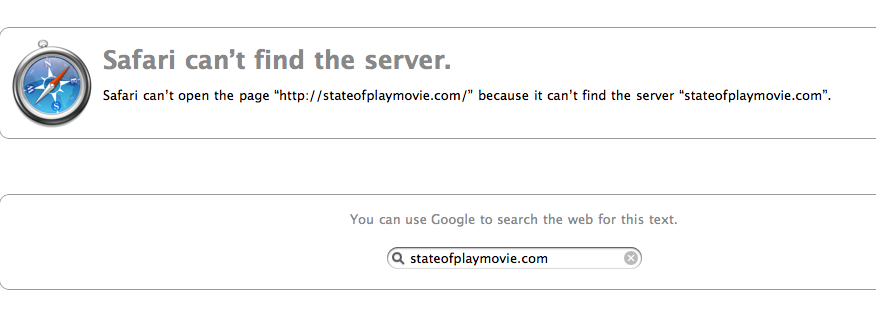
However, I don’t know why they chose the .net of a second class domain name.   They did buy the .com (StateofPlayMovie.com), but that domain name doesn’t resolve.   Jeeze… if you are going to brand the .net and you own the .com, at least forward it to your active website.

It’s 2009, and some companies don’t get the basics… DUMB x 2!

picture-1

Researching Source of Offer

It’s important that you do as much research on the source of your domain offers for a variety of reasons to see why the person wants to buy your domain name.   I think most of the reasons are obvious, but as ccTLDs continue to increase in popularity, there is one more thing to check before replying to the offer or inquiry.

If your .com domain name ends in a popular ccTLD extension, you should look to see if the ccTLD is developed, as many domain owners realize the importance of owning the corresponding .com domain name. Bit.ly is a very popular URL shortening service. Not only do they own the Liberian ccTLD (.LY), but they also own Bitly.com for protective purposes.

While many entrepreneurs on a shoestring budget will be happy to launch on a ccTLD that is more vanity than anything to do with the ccTLD, most will realize that they are losing traffic. In Bit.ly’s case, people continued to refer to the company as “Bitly” so visitors who think in .com as a default simply visited Bitly.com, which they are fortunate to own.

If your company owns a name like XXXXXXXXin.com or something like that, and you receive an inquiry, don’t just check USPTO, Google and other common places. You should also check the Whois for XXXXXXXX.in as well.

Quick Hits for the Weekend

Time for some random thoughts and notes for the week.

I think some gTLDs like .NYC are going to be very successful. Businesses are going to want to buy them to distinguish themselves as New York companies, much like many European businesses buy ccTLD domain names. I think there will be trouble selling some gTLD extensions, but it really depends on the audience and marketing, and I have a feeling .NYC will be a winner.

After spending a few days in Lowell, I realize how important a city .com domain name is. People who hadn’t visited Lowell.com were very interested in learning more about it and how they can be on it. Getting a sales person on the ground in the area will be key to really generating revenue.

Aftermarket.com is now accepting domain submissions for the Domain Roundtable show in June.

Every day, I seem to find out something new about Google and how it can be used to increase awareness on my developed websites. Take some time to look at the main Google accounts page and check out all of the links. Almost all of the applications can be beneficial to a small company doing business online.

General domain sales may be down across the board for most domain investors, but there are still a lot of companies buying ultra premium domain names. Many companies realize there is little overhead required when buying a category defining domain name, and it can pay major dividends to do so in terms of traffic and trust. Buying a domain name in these tough times can be much better than acquiring a business, which comes with significant overhead.

Have a happy Easter, Passover, or weekend.