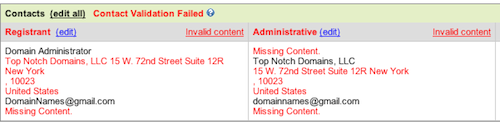
After transferring several domain names from Moniker to Go Daddy recently, I noticed that the Whois lookup looked funky on these names, and after further investigation, I found that Godaddy was reporting a contacts error inside my control panel. It probably wouldn’t have caused any problems for the domain names, but it’s not good to have incorrect Whois information.
A couple of days ago, I received a notice from Go Daddy’s Nick Fuller informing me that the issue has been resolved. When I posted the article, the company was in the process of getting its parsing updated on transferred Moniker domain names, and that process has been completed.
The company may still be working on the parsing script for transfers from other registrars (like Network Solutions), but it is something that is being fixed as we speak. If you find this error on transfers that are completed from now on, please post a comment here to let the company know. It will be helpful to know the losing registrar and transfer date.