



Home Blog Page 1099

Invalid Whois Problem at Go Daddy

It’s an ICANN rule that Whois information for domain names must be kept accurate. If a domain name is found to have inaccurate or false Whois information, the domain name can be suspended. This obviously could be problematic for a domain owner, especially if the Whois data is inaccurate due to issues out of his control.

I transferred a number of domain names from Moniker and Network Solutions to Go Daddy a couple of weeks ago, and I want to share a problem I encountered to prevent you from having the same issues. I thought the issue might be isolated to one registrar, but I believe it impacted all of the domain names I transferred from both registrars.

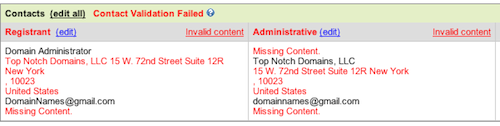
For some reason, my contact information was transported upon the transfer, but it didn’t all get carried over to the correct fields. For instance, my company name appeared on the address line. In my Godaddy control panel, there was an error message that said, “Contact Validation Failed” and “Invalid content,” as you can see in the screenshot above.

I don’t know if this type of error would be enough to have a domain name suspended if it was reported, but having a problem like this isn’t good, especially when it appears the domain owner needs to manually correct each domain name rather than making a change for the entire account.

One other issue I encountered was that there was nothing I saw in the account manager to tell me which names have Whois issues. I had to go to the individual domain names in my control panel to see. I am concerned that there may be other names I previously transferred that have invalid Whois data. If you know of a way to find out globally in my account, please let me know.

This is something you need to be aware of when transferring domain names to Godaddy.

Weekend Updates – Daylight Savings Time

9

I want to share some updates and tips with you. Don’t forget, daylight savings time starts tomorrow in most places in the United States. Hope you have a good weekend.

  • If you buy domain names from larger companies in the aftermarket, I find it better to save groups of names of interest as you find them. Inquire about several names at once, maybe once a month or every couple of months. Generally speaking, you’ll get better deals when you buy in bulk. You might also consider adding names you don’t want to the list to disguise the names you do want.
  • Don’t forget this handy tip to find a buyer for your domain name. Search Google for your domain name, and contact the companies who use your keyword domain name in their domain name. For instance, a company that uses FinancialPlanners.com or EventPlanners.com could possibly want to shorten their url to Planners.com. There are many companies that use “Brand”Category.com, and if you own Category.com, they might want to upgrade.
  • It was nice to see Domain Name Sales’ infographic on Mashable last week. I think the infographic is a great visual to show why a company would want to buy a descriptive domain name. I also think Edwin’s comment was on the money.
  • Would anyone be up for an NCAA tournament bracket contest? Maybe something along the lines of a $10 entry fee to participate? If there’s interest from more than a few people, I will set something up.
  • A few of my public recent auction purchases: RaceNights.com, BiomedicalSupply.com, MaritalHelp.com, CapitolRealEstate.com, and CounselingCenters.com

Marksmen CEO Shares Domain Valuation Techniques for Buying and Selling

Ken Taylor is the CEO of Marksmen, a company that bills itself as “a world leader in trademark investigation services, including domain acquisition and online brand protection.” Many domain investors have done business with this company that generally acts on behalf of trademark owners in domain negotiations, but also represents domain investors in sales to its clients.

Mr. Taylor was a speaker at DomainFest last month, and I thought his discussion on domain valuation would be interesting to watch if you weren’t at DomainFest (or missed this panel).

There Should Be a Penalty for RDNH

13

I agree with many in the trademark contingency that cybersquatting is a big problem that plagues big brands. I believe there are many grey areas when it comes to domain names, but similarly, I believe there are a lot of shades of grey in trademark law.

For the most part, I think the UDRP is a fair way for trademark holders to dispute domain names that infringe on their marks. In addition, with egregious cases, United State trademark holders can certainly use the ACPA (Anticybersquatting Consumer Protection Act) to litigate against trademark infringers.

One thing that really, really frustrates me when it comes to UDRP filings is to see cases of Reverse Domain Name Hijacking (RDNH). If you aren’t familiar with RDNH in a UDRP, it’s when “the Panel finds that the complaint was brought in bad faith, for example in an attempt at Reverse Domain Name Hijacking or was brought primarily to harass the domain-name holder, the Panel shall declare in its decision that the complaint was brought in bad faith and constitutes an abuse of the administrative proceeding.”

When a domain owner receives a notice of UDRP for a descriptive domain name, he generally must hire an experienced  domain attorney to defend his domain name from being awarded to the complainant. I have heard this can cost anywhere from $5,000 or more depending on certain variables. Some people may opt to file a defense on their own, but that’s a big risk for someone who isn’t experienced.

In addition to the legal fee, the attorney may recommend that the domain owner pay for a 3 person panel for a better shot at winning, and I believe  this will cost $2,500 (complainant pays $1,500 and respondent pays an extra $2,500 for the 3 person panel). With these two costs, you are close to spending $7,500+ just to defend your right to own the domain name.

As it stands right now, there is no penalty for companies who are found to have attempted a Reverse Domain Name Hijacking. In essence, a company with a legal staff on retainer can take a gamble and spend $1,500 on a UDRP to get a descriptive domain name, and their only risk is a slap on the hand (if that) for a RDNH finding. Many people/lawyers don’t even seek RDNH findings since there aren’t any repercussions for them.

In my opinion, a company should have some sort of penalty for filing a UDRP that is determined to be RDNH. If a financial penalty can’t be given, perhaps a company found guilty of RDNH should be precluded from filing a UDRP for a year. They have legal recourse if they wish to use it, but they will risk losing the ability to use the UDRP forum for defense of their marks.

I am not a legal expert nor do I have any legal experience. I am just frustrated to see friends have UDRPs filed against them on domain names that are found to be descriptive. It increases the risk and cost of domain ownership.

What are your thoughts?

Congratulations to Bob Mountain

I want to extend congratulations to Bob Mountain on his very recent promotion to Senior Vice President of Business Development at NameMedia. The news was announced in a press release this afternoon.

Long before Afternic was an advertiser on my blog, I was a customer of NameMedia, buying 6 figures in domain names from  BuyDomains  over the course of a couple years. When Bob was first hired by NameMedia, he reached out to me to learn how I operate my business and to see how he could help grow my company’s relationship with NameMedia properties.

Bob works tirelessly for the company, and he is a presence at conferences and other events where domain investors and potential domain buyers are present. Bob’s role with the company is important because he is often the person who promotes the importance of the acquisition of good domain names to end user clients. These people then visit marketplaces such as BuyDomains and Afternic where they purchase our domain names we have listed for sale.

Congratulations to Bob on this well deserved promotion. I’ll drink a glass (bottle) of sake in his honor.

Press release below:

Dofo Aggregates Domain Lookup Tools

I don’t know if the site goes by DoFo or Dofo or whatever, but I saw a link to it, tried it out, and want to share it with you in case you haven’t seen it or used it yet.

Working in conjunction with DomainTools, you can easily do a Whois search using Dofo. Obviously you can do that anywhere, so here’s what’s neat about Dofo. Instead of visiting a host of other websites to check out various analytics, you can do it all there on the same screen via framed redirected.

Some of the tools self-contained within Dofo include:

  • Screenshots.com and Archive.org results so you can see iterations of the site over time
  • Hosting and Nameserver history
  • Email blacklist information
  • Search engine backlink and indexed page results
  • Valuate appraisal tool

I don’t know if Dofo stands for something that I missed or if it’s just an easy brand name to remember, but it’s a neat little time saving tool you might want to try out the next time you are researching a domain name or website acquisition.