



Home Blog Page 1022

Value of gTLD-Related Domain Names Contingent on What They Will Be Called

12

What Will gTLDs Be Called?

I own just a couple of gTLD-related domain names – gTLDBroker.com and gTLDDomainNames.com. Neither of these domain names is worth very much (if anything), but they were speculative hand registrations, and I’ve lost more on a hand of blackjack than I’ll lose if I keep these names for several years without selling them.

I’ve seen many people buying and selling gTLD-related domain names, and I don’t think it’s such a wise idea.

While these TLDs are being called gTLD on the technical side (ICANN, consultants, investors…etc), the consumer side is what will probably drive the most value for these domain names. How domain registrars market these new TLDs will be important in determining whether gTLD domain names are worth anything because the “gTLD” moniker may disappear once they are on the market.

If consumers (buyers) and users call them gTLDs, these types of names may have more value, obviously depending on the keywords. If domain registrars call them “new TLDs” (like eNom is currently doing) they will probably not be referred to as gTLDs, rendering gTLD-related domain names worthless or worth much less.

My opinion is that registrars will not market them as gTLDs because most consumers don’t even know what TLD means let alone gTLD. My bet is registrars simply call them new domain names or maybe new TLDs. That’s a big reason why I haven’t done much speculating in this area…. that and domain investors are cheap when it comes to being end users 🙂

As always, I welcome your thoughts on the topic.
Don’t Try to Sell Deceptive Domain Names

The other day when pitching a domain name to a potential buyer, he asked me to verify that the domain name I was selling was the actual keyword .com domain name. I was a bit taken aback by the question and confirmed that it was in fact the actual keyword domain name.

He later followed up his strange question to let me know that someone had tried to sell him what looked like a great domain name, but a number was in place of the letter, rendering it just about worthless (for example but not the one that was discussed, L0SERS.com).  I don’t think the seller tried to pass it off as the real deal, but it was certainly not explained to this potential buyer until he copied and pasted it in his browser and he was able to see that it wasn’t the real keyword domain name.

This type of business is bad. First off, it’s deceptive if the potential buyer doesn’t realize what the seller is pitching. Secondly, when the number is added to a word, especially in the middle, Google and Bing will see it’s a number and make it much more difficult to rank for the keyword. It’s just about the same as a totally unrelated word since that’s essentially what it is.

Whether a seller is trying to be deceptive or not, selling a domain name that looks like one thing but is really something else is not the right thing to do. I personally wouldn’t touch a domain name like that, let alone try to get someone else to buy it. That is just asking for trouble.

Social Media Tips for Domain Companies

2

Several years ago, Moniker pretty much ruled the roost when it came to the preferred domain registrar of domain investors. The company was known for its security, but I think the primary reason for its popularity was because of the personal care company founder Monte Cahn gave to his clients. The underlying feeling was that if there was ever an issue, you could call or email Monte directly and the issue would be resolved ASAP.

I was thinking about this when I discussed Voodoo customer support, and it got me thinking about the types of connections we have today. In addition to meeting account representatives and executives at conferences, I think relationships can be forged using social media options like Twitter and Linkedin.

There are a number of companies that have great social media outreach, and I want to share some tips other companies may be able to use to connect with their customers on a more personal level and establish a relationship.

  • Follow customers on Twitter – from official accounts and personal accounts
  • Connect with customers on LinkedIn
  • Reach out to customers when you see something (good or bad) about your company and ask for private contact information to resolve in private
  • Retweet to show you care about what they care about
  • Respond to tweets and messages directed to your attention and even those directed to the company if you can solve them
  • Offer introductions when you can’t resolve an issue

With prices being so competitive and security fairly comprehensive  at just about all domain registrars, it’s often a personal connection that gets customers to continue doing business. It’s no surprise that the majority of my domain names are registered at Enom and Go Daddy right now since I have account reps that have worked with me for years.

Establishing and maintaining relationships is a critical part of this business, and companies should be using social media to engage with clients.

Update on Little Frank’s Pizza

3

I wanted to provide an update to an article I wrote yesterday about Go Daddy’s Website Builder sample website for the fictitious business,  Little Frank’s Pizza.

A reader emailed me at 4:30am to let me know Go Daddy was advertising its Website Builder program on its home page and showed a graphic that included a domain name. When the reader visited that domain name (LittleFranksPizza.com), instead of a seeing a slick website, there was a standard GoDaddy ppc landing page. When I visited that url several hours later, I saw the same thing and wrote an article about it.

Later on in the day, LittleFranksPizza.com was resolving to a fun website instead of the standard Go Daddy landing page. Not only is it a nice looking website, it also contained good information about how the Website Builder program could be used by a SMB to build a functional website.

Nobody asked me to follow up with this article, but I gave them a little bit of a ribbing because the domain name wasn’t operational, and I wanted to follow up on it. Perhaps my article made them realize the site wasn’t working, or perhaps it was a brief glitch that caused the website to not appear. Whatever the case is, put simply, the website was created by Go Daddy exactly how it should have been developed to help promote its Website Builder program.

[Updated] Go Daddy Website Builder Marketing: Smart Strategy, Poor Execution

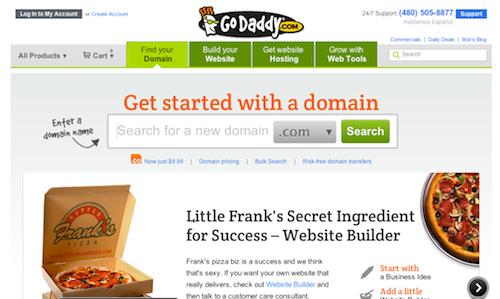
Go Daddy wisely promotes its Website Builder product to small businesses. In fact, as you can see above, the company is currently giving its most valuable home page real estate to this product, with a large graphic and accompanying video showing “Little Frank’s Secret Ingredient for Success – Website Builder.”

The graphic shows a pizza box with the url LittleFranksPizza.com. As you might have expected, Go Daddy is the registrant of that domain name, so it’s unclear whether Little Frank’s Pizza is actually a customer or used to be illustrative of what customers can do with the Website Builder product.

There is one major problem though. When you visit LittleFranksPizza.com, which some people might do to see what a Website Builder website looks like, there is a standard Go Daddy landing page. People unfamiliar with these landers might assume that this page is what a Website Builder website looks like, and that would be bad for the company, especially since the PPC links advertise other businesses.

Go Daddy should take a cue from How I Met Your Mother’s Bro Bibs website and set up a real website using the Website Builder tools. Obviously they can’t make a real pizza website, but at least they can have some fun with the company’s product and show customers what a website can look like after using its Website Builder product.

This is a good lesson for any company using a fake url in a commercial or other visible spot. Make sure you develop it or at least redirect it!

H/t to Bram for sending this.

**UPDATE*** It looks like there is now a website operating on the domain name.  

Voodoo Support Tickets Closed in Under an Hour

9

I am almost always monitoring my business, whether it’s from my computer or my phone. When someone asks me a question, inquires about a domain name, or has an issue with one of my websites, I am very quick to respond.

It’s probably because of my own speedy response time that I expect the same from companies with whom I do business. Unfortunately, most companies try to respond to support tickets within a day or two rather than within a few minutes or hours.

I read something interesting on NamePros regarding the service time at Voodoo.com, and I thought it was interesting. According to Voodoo.com founder Donny Simonton, the “average time to close a ticket no matter when it’s received is 38 minutes over the past 30 days.”

I don’t know what types of issues Voodoo’s support team sees, but having an average response time of under an hour is fantastic. Not only that, but Donny said it’s the time it takes to close a ticket, as in resolve a customer’s issue, and not simply responding to support requests.

I have stopped doing business with some companies because of customer support issues, and I think it’s pretty cool to see a company that understands the needs of its domain investor clients. It’s not end of the world if a ticket takes a bit longer to resolve, but it’s great to see that there is some great customer support in this business.
