Home Blog Page 1093

Using a Domain Broker RFP

Not all domain brokers and brokerages were created equal. Some brokers will use a newsletter to sell a domain name, and others will personally pitch end users via email or phone. Some brokers have significant experience selling specific types of domain names, and others don’t specialize in a vertical. Different brokers charge different commission rates for different sales efforts.

There are many differences between the various brokers and brokerages in the domain industry.

When people have emailed me in the past to ask for advice about working with a domain broker, I’ve generally recommended that they issue a RFP (request for proposal) to their top 3 or 5 brokers and brokerages. The purpose of the RFP is to see how the broker will go about selling a domain name and how much it will cost you if the domain name is sold.

I am looking to sell CallCenters.com, and I am going to take  issue an informal RFP to the companies I intend to engage. I want to share the questions I plan to ask, so you can see how I set up a RFP. Feel free to recommend other questions or ask why I am asking something, and I will address it.

1) Have you sold similar domain names, and if so, what names and what were the sales prices?

2) If you are given the exclusive contract, what marketing activities will you undertake in order to sell the domain name (phone calls, press releases, emails, mailing list newsletter, placement on your website…etc)?

3) What is your valuation of this domain name and where would you price it?

4) What is your commission rate and exclusivity period?

Is WIPO “Advising” Complainants?

29

This is a post written by contributor,  Paul Raynor Keating. Paul is an attorney specializing in domain names and related matters. He lives and works in Barcelona, Spain.

I was recently surprised to read the following WIPO notice received by a friend of mine the other day:

“Dear Complainant,
Further to our Acknowledgement of Receipt of Complaint, as required by Paragraph 4(a) of the Rules for Uniform Domain Name Dispute Resolution Policy (the Rules) and Paragraph 5 of the WIPO Arbitration and Mediation Center (the Center) Supplemental Rules for Uniform Domain Name Dispute Resolution Policy (the Supplemental Rules), we have reviewed your Complaint to verify whether it satisfies the formal requirements of the Uniform Domain Name Dispute Resolution Policy (the Policy), the Rules and Supplemental Rules.

In accordance with Rules, Paragraph 4(b), you are hereby notified of the following formal deficiency with your Complaint:

(1) The text below section (C) of the Complaint, with the emboldened heading “Bad Faith in the Domain Name Use”, does not appear to describe why the domain name should be considered as having been registered and being used in bad faith.

Please note that paragraph 4(a)(iii) of the Policy and paragraph 3(b)(ix)(3) of the Rules require a complainant to describe why the domain name(s) should be considered as having been registered and being used in bad faith.”  (Emphasis in original).

Procedural requirements as the form of a complaint are specified in the UDRP and Supplemental Rules and compliance with matters of form are appropriate. Thus, for example, checking to verify that the name of the respondent comports with the WHOIS is a procedural matter because of the notice requirements in the UDRP. Other examples of form verification are the presence of a mutual jurisdiction selection and the required “verification”.

It is entirely inappropriate, however, for an ADR provider to conduct a substantive review of the complaint to verify that the complainant has included sufficient argument and evidence to sustain its burden of proof. There is no requirement in the UDRP or any of the Supplemental Rules stating that a complainant must provide argument and evidence in order to file a UDRP complaint. They only describe the substantive content needed to prevail. ADR providers are supposed to be neutral.

Notices such as the above effectively give the complainant a second bite at the apple because they are being advised to review and correct substantive issues pertaining to their burden of proof. They turn the ADR provider into an editor working for the benefit of the complainant. The proper course would be to refrain from any such apparent impropriety and let the panelist deal with the matter – the consequences of which must be reserved to the parties.

I question the propriety of the above notice for the simple reason that it evidences a substantive review of the complaint on the part of WIPO to correct a “deficiency” which would otherwise have led to a denial of the complaint.

Perhaps I shouldn’t be surprised. But I am continually disappointed at the ever expanding ways in which ADR providers assist complainants in the UDRP process. I have long objected to the constant stream of “reminders” sent to complainants about deadlines and the like, particularly those from NAF reminding complainants to correct complaints that have been rejected for filing. I have never once seen a “reminder” forwarded to a respondent. ADR providers must avoid the appearance of impropriety so as to protect the overall system from criticism and legal attack. ADR providers are supposed to be neutral. Matters of proof are the exclusive realm of panelists and WIPO is crossing the line.

The “deficiency” process is further marred by the way respondents are treated in the process. The domain is locked the minute the ADR provider receives a filing. The lock remains in place during the 5-day correction period. However, respondent is not permitted to see a copy of the complaint that had been submitted with the argument being that the UDRP has not “commenced”. My response is that the domain should then remain unlocked until the complaint is accepted for filing. The fact that the ADR provider maintains the lock and refuses to provide respondent with a copy of the “defective” complaint is merely an exercise to limit any possible advance notice to the respondent.


Preview The New Escrow.com Website

Last year, Escrow.com modernized its logo and color scheme, although it only published the new logo on its Facebook and Twitter pages, as well as its advertising banners. This is the first change to the Escrow.com logo in many years.

Because of the nature of its business, Escrow.com needs to be sure customers recognize its website, so  implementation  of a new website with a different color scheme, logo, and layout needs to be done gradually. To date, the company has not modified its active website.

The company just announced that a preview of the new Escrow.com home page is now available to view. Although the preview is still connected entirely to the current operational website, you can have a look at what the new site is going to look like once it’s re-launched.

In my opinion, it looks much more modern that the current site, and I am looking forward to seeing the new site implemented in its entirety. The company welcomes comments about the design and colors on its Facebook page:  https://www.facebook.com/EscrowService

Domain Entrepreneur Justin Godfrey Has Twins (Nearly a Month Early)

Justin Godfrey  is well known in the domain investment space as an investor, broker, and web developer. He and his wife Katie were expecting twins in about a month, but the twins had another idea.

Noah Benjamin Godfrey was born on March 20th (4 lb 14 oz, 18.25″) and Madyson Lynn-Lavonne Godfrey was born two minutes later (4 lb 12 oz, 18″). The Godfrey babies were born at 33 weeks, which is about a month early for twins (single pregnancies go 40 weeks). The twins are doing well in NICU (neonatal intensive care unit), and Katie is also doing well after giving birth.

You can see first photos of the twins on Justin’s public Facebook page: facebook.com/snowmobilers. I asked Justin if he and Katie have a baby registry, and they said in lieu of baby gifts,  donations can be made to the non-profit www.projectnightnight.org.

I want to wish the Godfrey family good wishes and good health.

Monsanto Buys Channel.com

A little over ten days ago, Sedo sold Channel.com for $125,000, as first reported by Hybrid Domainer and then by Mike Berkens on TheDomains.com. There was some speculation about who bought Channel.com, but it doesn’t look like anyone guessed the buyer correctly.

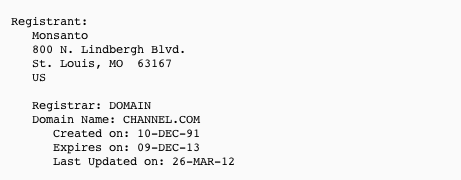
I received a domain monitor alert from DomainTools this morning informing me that a Whois change had taken place on Channel.com. The domain name appears to have been acquired by Monsanto, a publicly traded agriculture and seed company trading on the New York Stock exchange under the symbol MON.

Monsanto operates a brand called Channel, and according to the Monsanto website, “Channel ® is a premier seed brand specializing in corn, soybean, sorghum and alfalfa. Channel offers high performing genetics that are sourced globally, tested locally and supported year-round by a team of Channel Seedsmen who walk their customers’ fields and learn their challenges.”

This seems like a wise acquisition for the company, especially since it’s a nice upgrade from its current url,  ChannelBio.com.

Sedo: Compensation Has Taken Place Today

0

One final follow up on the DDoS attack that impacted Sedo parking clients  a couple of weeks ago. Sedo promised to make clients whole for any losses sustained as a result of the DDoS attack, and the company has made good on that promise.

In an email sent to clients this morning, Sedo informed them that “compensation for affected customers has taken place today.” The company has updated statistics in customer accounts to reflect the revenue that was earned during this time. In addition, “the total compensation amount will be added to the March “Corrector”* and can be consulted in the “Payments” tab of the “Parking Reporting” section.”

Full email from Sedo is below