



NameJet Bidding: I Wish There Was a Reminder Email

20

I was outbid on the NameJet auction for VisitSouthAfrica.com, and I didn’t want to bid higher until the final moments of the auction. I figured that I would end up having a better chance to get the name at a better price if I was bidding incrementally in the closing minutes rather than showing my interest ahead of time. With an hour and a half to go, I decided to run a couple errands and come back to the auction.

Unfortunately, I didn’t remember to re-visit the auction and it ended before I could place another bid. Th domain name sold for a very reasonable $3,523. Perhaps I would have won it had I come back, or perhaps the winning bidder would have bid more. Maybe even someone else would have become involved with bidding after seeing closing action. Whatever the case is, the auction would have yielded a higher result had I bid again.

In any case, I want to propose an additional feature to NameJet. Perhaps there can be an option to send a reminder email when the auction is in its waning moments, maybe a 30 minute reminder or something along those lines. I receive emails when I am outbid, but if I am not a high bidder, I only receive the daily email notice at the end of the day. I suppose I could set my own auction reminders in my calendar, but it would be easier if I received an email instead of having to do extra work, especially if I think I am going to be right here but end up getting distracted.

When I am actively bidding on several auctions, it’s easier to stay focused and bid on the names I want. However, when it’s just one or two names I am looking at during the day, it’s easy to lose track of time and forget to come back to an auction. It might make sense to add a reminder notification auction to NameJet auctions.

Invalid Whois Problem at Go Daddy

It’s an ICANN rule that Whois information for domain names must be kept accurate. If a domain name is found to have inaccurate or false Whois information, the domain name can be suspended. This obviously could be problematic for a domain owner, especially if the Whois data is inaccurate due to issues out of his control.

I transferred a number of domain names from Moniker and Network Solutions to Go Daddy a couple of weeks ago, and I want to share a problem I encountered to prevent you from having the same issues. I thought the issue might be isolated to one registrar, but I believe it impacted all of the domain names I transferred from both registrars.

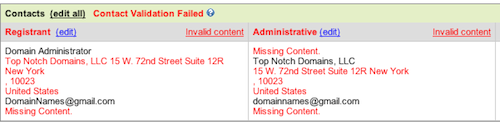
For some reason, my contact information was transported upon the transfer, but it didn’t all get carried over to the correct fields. For instance, my company name appeared on the address line. In my Godaddy control panel, there was an error message that said, “Contact Validation Failed” and “Invalid content,” as you can see in the screenshot above.

I don’t know if this type of error would be enough to have a domain name suspended if it was reported, but having a problem like this isn’t good, especially when it appears the domain owner needs to manually correct each domain name rather than making a change for the entire account.

One other issue I encountered was that there was nothing I saw in the account manager to tell me which names have Whois issues. I had to go to the individual domain names in my control panel to see. I am concerned that there may be other names I previously transferred that have invalid Whois data. If you know of a way to find out globally in my account, please let me know.

This is something you need to be aware of when transferring domain names to Godaddy.

Marksmen CEO Shares Domain Valuation Techniques for Buying and Selling

Ken Taylor is the CEO of Marksmen, a company that bills itself as “a world leader in trademark investigation services, including domain acquisition and online brand protection.” Many domain investors have done business with this company that generally acts on behalf of trademark owners in domain negotiations, but also represents domain investors in sales to its clients.

Mr. Taylor was a speaker at DomainFest last month, and I thought his discussion on domain valuation would be interesting to watch if you weren’t at DomainFest (or missed this panel).

Why Your News May Not Get Posted

3

I am sent a lot of press releases, news tips, and other information that people would like to see published on my blog. I do my best to post information and news that is of interest to me and my business, and if that’s the case, I assume it will be of interest to others.

With so many submissions, there is no way I could or would post everything I receive. If you’ve sent me something in the past (or you plan to send me something) and I didn’t post it, here are a few reasons for that:

  • Your news won’t benefit or interest many people in the domain name industry
  • The press release or email you sent wasn’t clear about what is new or being offered
  • The release is far too promotional and isn’t news
  • I was out of town or away when you sent the information to me, and by the time I returned, it wasn’t relevant
  • I saw that someone else already posted it on a different blog or website and that person shares the same opinion as me
A few months ago, I wrote another article giving some tips on how to get your press release published. I think that’s a good place to start if you have some news you’d like to share with other domain investors.

Can You Help Me Find a Buyer?

I receive quite a few emails asking something along the lines of, “can you help me find a buyer for my domain name?” I don’t broker domain names, so I generally try to get people to think about how they can find a buyer on their own. This is one of those things that if you can do it successfully once, you can replicate it. I want to share some advice on how you can try and find a buyer for domain names you want to sell.

My first piece of advice is to take the keywords from your domain name and plug them in to Google. See what companies advertise for those keywords and see what companies rank organically. Try to find a contact on the website to pitch the domain name or use the contact form. If there is no contact form or if finding the “right” person to contact is difficult, do a Whois search for the company domain name and contact the Whois contact. Many times, that person is either the contact or will forward your email to the appropriate person.

My next piece of advice is to evaluate how the  domain name can be used and by what type of company. Think about what type of companies may be interested in buying the domain name, and visit the websites of the obvious buyers (or do a Google search to find companies in those industries).  One tip with respect to this is that if you have to come up with some convoluted or tangential reason a company would want to use a domain name, you’ll probably have a tough time selling the domain name. In my experience, some companies are open to buying domain names but don’t want to hear an idea for a marketing strategy that is possible with certain domain names.

My third piece of advice is to use a domain name lead generation website like Lead Refs or Estibot to contact buyers. Be 100% sure you haven’t contacted the same person/company already. I am sure it’s annoying to receive multiple emails from the same person about a domain name, especially if the name is not of interest. I would likely remove obvious domain investors from those leads since your hit rate will likely be lower and it will annoy people who may label you as a spammer.

If your domain name is superior, you may want to have a domain broker at a company like Afternic,  Sedo,  Aftermarket.com, or Domain Holdings do outbound lead generation on your behalf. Mind you, they will likely only do this if the domain name is valuable and the price is reasonable since they only get paid for this if they close a deal.

If the domain name doesn’t have obvious commercial appeal, selling it via outbound sales channels may not be possible or will be very difficult. For brandable names, it’s more likely that you’ll close a more favorable deal when a buyer comes to you. I recommend listing them on various aftermarket websites and making sure there’s a “for sale” notice on the landing page.

Why Publishing an Acquisition May Be a Good Idea

I have a couple of colleagues who buy great domain names in specific verticals. We’ve done business before, and it seems that whenever I bring them a great domain name, they always balk at the price at first and refer me to a report about a great purchase the company made within the past two years.

That purchase was a steal of a deal in my opinion, and they now use it as a comparable when someone brings them a name to purchase or when they are in the midst of negotiations.

Recent comps are a great tool to use when negotiating. Without a MLS system, there are few ways to really value a particular domain name, and a comp shows actual market data. If you can show a buyer or seller a comparable sale, that person might be more inclined to negotiate in your favor, and it’s a great way to say, “your asking price isn’t in touch with reality.”

When you buy a specific type of domain name and are continuing to buy without plans to sell, it might behoove you to report your lower priced acquisitions to an outlet like DNJournal. If you snag a steal of a deal, you can direct future negotiations to that sales report in the hopes that they will see it as a comparable sale. The seller may do his or her own research to find other comps, but if there aren’t many out there, it could be a great way to get a domain name you want at a terrific price.

Personally, I haven’t done this before because as a domain seller, I don’t want my purchase price disclosed. I do think someone who has no sales plans but wants to buy more names in a particular vertical could benefit from having “beneficial” comps reported.