Home Blog Page 1133

Is The Domain Industry Getting More Civil?

I don’t know if it’s just my perception, but lately, it almost seems that people who are “public” domain investors have become more civil. By “public,” I am referring to everyone from domain forum participants to bloggers, commenters, and anyone else who publicly discusses domain names.

Personally, I have been visiting forums less frequently (only really spend time visiting DNForum and Domain Boardroom  these days), but when a flare up occurs, someone typically sends me an email about it, usually to ask for my perspective on something or I suppose to gawk at the post. This hasn’t happened in quite some time.

There are dozens or more ways to make money with domain names. There are thousands of personalities in the business who are trying to make money. However, it seems to me that people are being less antagonistic lately, and I think it’s a positive sign for this business. When you focus on your own business and don’t spend time arguing with others, you can really achieve positive results.

Am I just out of touch with things in my bubble? What’s your perception?

Movember Tally: Over $3,000 Raised

Now that the calendar has turned to December, Movember is officially over for 2011. Ammar Kubba, CEO of Thought Convergence, was a moustache-growing Movember participant, which helped “raise vital funds and awareness for men’s health, specifically prostate cancer and other cancers that affect men.”

In total, Ammar’s commitment helped raise over $3,000 for the campaign: http://www.mobro.co/kubba  (it’s not too late to contribute to this non-profit organization).

As you can see, Ammar grew a pretty solid ‘stache in a month. I am sure he (and his girlfriend) will be happy when it’s shaved. Kudos to Ammar for getting involved in such a positive cause and sticking to it.

NameJet Releases New Website

12

According to a Tweet that was posted moments ago, NameJet has released the new website that the company had been beta testing for a couple of weeks.

If you’re a frequent NameJet user, you’ll immediately notice that the biggest change appears to be the new design, which lists more available domain names for sale on the home page.

The site functionality works in similar fashion to how it worked before. I was told that the search functionality is far superior to the previous version, and mobile browsing is also enhanced on the new site.

In it’s Tweet, NameJet asks clients to let the company know their thoughts on the new site, so feel free to post any comments here so the company can see them. I am sure it will be helpful if you post an errors you encounter.

If you aren’t a fan of the new site design, you can always revert back to the old site here:  http://classic.namejet.com. I don’t know how much longer that option will be available though.

Interesting UDRP for NdamukongSuh.com

One of the more frequent domain name related questions I am asked is regarding the ability to own the exact match domain name of famous athletes, celebrities, and other famous people. There are a lot of people who don’t think it’s a problem to own the exact match of someone’s domain name, and a perfect example is seeing how quickly the .com names of American Idol performers are registered after each initial performance.

I’ve always believed a person can own the exact match domain name of a famous person if they operate it in a way that doesn’t make money off that person’s fame. For instance, someone could hypothetically own DerekJeter.com and have a baseball fan site about New York Yankees superstar Derek Jeter as long as they aren’t monetizing it or trying to sell it. That’s not a legal opinion but just an observation of mine. As a domain investor, it doesn’t make sense to me to do this when you can’t profit from the domain name with the risk of losing it.

This morning, I read an interesting UDRP decision for the domain name  NdamukongSuh.com.  Ndamukong Suh is an NFL football player for the Detroit Lions, and ironically, he’s been in the news quite a bit this past week for an incident that took place in the Thanksgiving Day football game against the Green Bay Packers. He was suspended by the National Football League for two games as a result.

Here are some interesting quotes from the UDRP decision that ultimately went in favor of the complainant:

“Respondent acquired the disputed domain name in January 2009, with knowledge that it incorporated Complainant’s name. After learning that Complainant had retained a web developer other than Respondent, Respondent offered to transfer the domain to Complainant’s web developer, stating “Maybe we can work something out that is fair for the name.” In subsequent communications, Respondent provided a list of memorabilia items signed by Complainant that he would accept for transferring the domain name. Alternatively, he offered to accept “a few” game tickets for transfer of the disputed domain name.”

“Complainant contends that the disputed domain name incorporates his name in its entirety, that Respondent has no legitimate right or interests in the domain name and that Respondent’s practice of registering the domain names of athletes and then trading those domain names for certain memorabilia or game tickets supports a finding of bad faith registration and use of the disputed domain name.”

“Complainant contends that Respondent has no rights or legitimate interests in the disputed domain name. Respondent does not dispute this. The disputed domain name resolves to a “domain parking program” website. Such domain parking in this case is not considered a legitimate use of the disputed domain name in connection with a  bona fide  offering of goods or services.”

“However, the record indicates, by Respondent’s own admissions, that his primary purpose in registering the disputed domain name was to sell the disputed domain name to the Complainant for valuable consideration, in the form of memorabilia or game tickets, in excess of the documented out of pocket costs directly related to the disputed domain name. That the consideration he requested was in the form of signed memorabilia or game tickets does not avoid a bad faith finding. Respondent admits that he has a practice of registering popular athletes’ names and demanding memorabilia or game tickets in return for trading the domain name. There is no requirement in paragraph 4 of the Policy that the value demanded be above a certain threshold, only that it be in excess of the out of pocket costs directly related to the domain name.”

The next time you think it might be a good idea to register the domain name of a famous person with the hope of getting something in return (other than a “thank you,” it might be advisable to review this UDRP decision. I guess the good news for the domain registrant is that Suh and his attorneys filed a UDRP rather than a lawsuit in federal court for cybersquatting.

.XXX Sites Blocked in UAE, BUT…

9

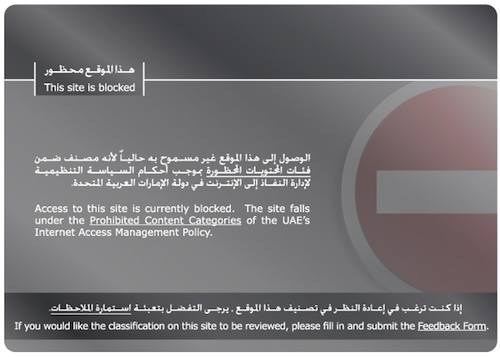
I had a conversation with a blog reader, and he mentioned that one of the primary .XXX informational websites set up by the ICM Registry, About.XXX, is being blocked by the United Arab Emirates government. I don’t know if all .XXX sites are blocked, but he indicated that they are.

According to the landing page that is seen when a visitor in the UAE types in About.XXX:

“Access to this site is currently blocked. The site falls under the Prohibited Content Categories of the UAE’s Internet Access Management Policy.“

This is something people speculated would happen en masse, and many thought this would be harmful to the .XXX extension and consequently, the domain owners who operate and invest in .XXX domain names. I, however, have a differing opinion.

I asked the person who sent the screenshot to do me a favor and visit a different domain name to see what exists on the site in the UAE. Not surprisingly, when he visited Playboy.COM, the same landing page was shown. The UAE blocks websites with adult content, whether they are on .XXX domain names or not.

If the UAE has blocked the entire .XXX extension via wildcard, I suppose it would be a problem for a company who owns and operates a non-adult website on a .XXX domain name. However, I can’t really imagine a non-adult website operating on a .XXX domain name. Also, it’s very likely any adult website would be blocked regardless of the extension due to the government’s regulations, so it’s not endemic to one particular domain extension.

Learn Why a Domain Name Has Value

I think a majority of the comments I receive on my articles listing the previous week’s domain sales that took place at Sedo and Afternic fall into one of four categories:

  • Most of those domain names suck
  • My domain names are much better
  • I don’t understand why names like that are selling
  • [Domain Name] was a good deal for the [buyer / seller]

Instead of looking at the list of domain names and comparing them to what you own or analyzing them on their merits, I think you need to dig a little deeper and try to determine why each domain name sold. Do a Whois search to see who bought the domain names. When the Whois reflects the new owner, type in the domain name to see what the new owner is doing with it.

Check out Andrew’s post today about some of the interesting end user acquisitions from last week. While in a  vacuum  environment, it might not make sense that some of those domain names sold at those prices, when you dig a bit deeper, you begin to see why they sold.  Oftentimes, companies with unique brand identities want to upgrade to a better domain name. Other times, companies have a marketing campaign and the domain name is beneficial.

As domain investors, we tend to crucify companies that don’t “get it” when it comes to domain names. They may try to be cutesy by using domain hacks or alternative extensions. They may also add a LLC to the domain name or an abbreviation like NY or CA to identify themselves. If they have the chance to buy the exact match domain name for their company, even if their company name seems to suck, it’s a smart move.

I may not think the company name Linens N Things is good, but it would be worse if the company used LinensNThingsNYC.com because their desired name was unavailable when they needed it.

When you are looking at the weekly sales, forget the sales prices on what seems like random domain names. In many of these cases, the sales price doesn’t really matter and may not make sense. The reason that’s the case is that it boils down to a domain owner’s need for money, negotiation skills, and the buyer’s need for a particular domain name.

If a domain owner doesn’t need the cash, he can hold out for a better offer on a seemingly average domain name. Similarly, if a company needs a domain name, they may be willing to pay more, even though they’re likely the only entity that could ever want the domain name. In short, the prices on brandable domain names shouldn’t really matter to you since they can’t really be used as comps.

The next time you read the weekly sales list, instead of complaining about the domain names that sold or lamenting about how much better your domain names are, why not spend an hour researching who bought what domain names. It will be more helpful to you and your business.