



Read About Sales Before They’re Reported

The domain name industry is an imperfect market, but I believe approximate values can be determined based on comparable sales (comps). That’s how it’s done with physical real estate, and while it may be more difficult with domain names, one can get an idea of valuation based on comps.

Every week, Ron Jackson at DNJournal reports weekly sales information from a variety of sources like Sedo, Afternic, Snapnames, NameJet, and other independently verified sources. Likewise, NameBio and DNSalePrice record historical domain sales, and both sites have databases full of domain sales.

When DNJournal posts its weekly sales chart, I quickly scour the list to see what sold and for how much. While scanning the sales, I think about domain names I’ve seen for sale that could be considered comps, and I also think about alternative domain names (ie singular or plural names) that might have a similar valuation. I search sites like Sedo and Afternic for simular names, and I also privately inquire about names of interest.

I know that other domain investors are doing the exact same thing, so time is of the essence with this, and it always feels like a race to read Ron’s DNJ report so I can start searching for names of interest.

There are a couple of faster ways that you can learn about domain sales before they’re reported and I want to share them with you.

  • Sedo has its RSS feed with recent sales. You can learn what sold at Sedo days before the sales are publicly reported. On occasion, they will report a sale and a buyer or seller will request that it not be reported, so if you catch it early, you may be one of the few people to take notice.
  • You can search NameJet and Snapnames for auctions that have bids. If you aren’t the first bidder and don’t bid as high as the leading bidder, you likely won’t win the auction (can’t be entirely sure in case someone drops out). If you are participating in the auction and don’t win, it will show up under your auction history, giving you the sales price before it’s public.

From my perspective, the second method is more accurate because that’s more of a market value than a private sale price may be as there may not have been competitive bidding for the name. However, the first value may be more indicative of end user value.

Another Tip to Find a Domain Buyer

I’ve probably mentioned this tip before, but even if I did, I think it’s value is well worth another post.

When you acquire or own a category defining keyword domain name that you want to sell, you should do a Google search for that domain name and have a look at all of the companies that use your domain name as a part of their url. Many of those companies may wish to either shorten their url or “own the keyword” domain name for the authority that it brings.

I’ll give you an example to show you precisely what I mean.

Let’s say you own BikeTours.com and want to sell it. I’d visit Google and do a search for the term “BikeTours.com.” Notice that I added quotes around the domain name to make sure the results are most accurate. After performing that search, I see that the following companies use BikeTours.com in their domain names:

  • Bike-Tours.com
  • BikeTours.com.au
  • Tuscany-BikeTours.com
  • FatTireBikeTours.com
  • CTBikeTours.com
  • BikeTours.com.ar
  • BogotaBikeTours.com
  • PedalBikeTours.com

There seems to be dozens of companies and websites that use the term in their url, and I would bet most would want to own the descriptive BikeTours.com domain name if they could. I’ve used this method to sell domain names before, and it could help you, too.

How to Find an End User Contact

Yesterday I wrote a post with some advice on addressing end users. I think a personal email goes a long way, and it’s far superior to a bulk email or an email that has a generic greeting. Someone asked me how I find the name and email address of a potential buyer, and it’s a good question. Here are some suggestions, and I welcome your additional suggestions as well.

  • Management page on a website. For small to medium sized businesses, contacting the president or CEO of a company is a good way to open  discussion  about a domain sale. You may also want to email or cc the person in charge of marketing or business development. For large or very large companies, I don’t recommend emailing the CEO since it will likely get filtered by an administrative assistant and not make it through. Management pages often have the email addresses of the executives, so that’s a bonus.
  • Contacts page. This is probably the most obvious way to get in touch with someone at a company. Use the contact form or contact email address on the website. For added effectiveness, address the email “Dear John” or “Hi Jim” to the President of the company or someone in marketing. If it’s a larger company, something like “Dear Mr. Smith” would probably be best since there will likely be more than one person with the name, and a more formal greeting may be appropriate in getting your email forwarded to the right party.
  • Whois look up. The technology decision maker or executive is often the contact on the Whois. If you are unsure of whether the Whois contact is the correct person to contact, do a Google search for that person’s name to see where he or she ranks at the company. This will also tell you whether the person works for the company or is a web developer who will likely delete your email.
  • LinkedIn. You can use a site like LinkedIn to find the name of the contact at a company. If you have connections in common, you can try to get an introduction, or you might be able to contact the person using other means, like Facebook. You can also guess the person’s email address, trying something like john.smith@company.com or a variety of other options. I like to try and find a random person’s email address in a press release or something else to see how the company uses email addresses and try to send an email to the owner or marketing contact that way.
  • Press release archive contact. Look at a company’s old press releases to see if the president’s contact information is listed. Sometimes it’s a press agent, which doesn’t usually result in good leads for me. However, if the person is labeled as a marketing manager, you might have luck with the domain name decision maker.

I am sure there are many other ways to get in touch with the right person at a company. Please share your ideas on ways to contact a decision maker.

Personalized Emails Go a Long Way

One thing I’ve noticed over the last couple of years is that I seem to get a much better response rate when I individually address an email. Not only does this mean I send individual emails instead of a group email using BCC (or CC), but I also address the person at the beginning of the email, either using “Dear” or more casually, “Hi.”

I generally use “Hi” when addressing potential buyers because it’s more casual and it may make the person more comfortable. In some instances, I will use “Dear,” although that is generally saved for emails to more senior executives at large companies and also lawyers.

When replying to the replies I receive, I always respond in the same manner as the person who replied to me. Sometimes this means just the person’s name and a comma, no name at all, or whatever greeting they used. It’s a very minor detail, but I believe that by using the same language as the person on the other end, I am making them a bit uncomfortable.

When I don’t have the contact name, I almost always start an email with the generic greeting “Good morning” or “Hi there.” I don’t like to really mix it up, because it makes me cringe when I receive emails that are weirdly addressed to me with unconventional greetings like “Dear Domain Buyer” or something that appears more spammy.

I know it’s just a greeting, but I’d rather have the person make it through the first few words rather than just hit delete upon receipt.

Report: OnTheBox.com and ForExSpace.com Sold for £250,000 in Cash

9

I read a report this morning on iGamingBusiness.com that announced the sale of OnTheBox.com and ForExSpace.com for £250,000 in cash for the pair of domain names. London-based Media Corporation was the seller of the domain names, although the registrant information for these two domain names does not appear to have changed yet.

According to this morning’s report, the company appears to have done very well with the sale:

“Media Corporation revealed that the domains were on its balance sheet at £130,000 with the sales representing a profit of £120,000 while it estimates annual staff and associated savings of approximately £350,000. ForExSpace.com was only recently launched and had yet to generate any material revenues while OnTheBox.com came in as a loss-making enterprise for the financial year to September.”

Because these domain names seem to have websites built on them, it’s questionable about whether the sales will be reported as pure domain sales or not. I guess it depends on what the new owner plans to do with the domain names post-sale.

One interesting tidbit from the article indicates that Media Corporation is doing what many domain investors have been doing these last couple of years: selling assets that aren’t making money to increase the amount of cash on hand.

I’ll keep an eye on the Whois information to see who bought the domain names.

Thanks to Chris for the tip.

Domain Name Aftermarket Sales Up For Fifth Consecutive Month

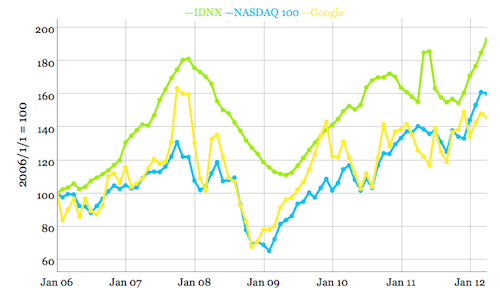
From my personal experience and from what I have been hearing from colleagues, the domain name sales aftermarket is on a tear, and it has been performing very well for the last several months. Although I don’t generally report sales, my company sold 6 figures worth of domain names in the first quarter of 2012, and I’ve already sold mid 5 figures worth of domain names this month.

This information is corroborated by a new report issued by Sedo  this morning. According to data from Sedo’s IDNX, the domain aftermarket saw its fifth  consecutive month of growth last month. The report suggests that the market has seen “a  full rebound from 2011’s financial crisis.” The report also suggests that the remainder of 2012 could be even stronger, although we should all keep in mind that Sedo distributed the report and so there may be some bias.

I have posted the full report below, but this is undoubtedly good news for domain investors who own very good domain names. It also could be a good time to invest in good domain names since there are plenty of owners who need liquidity and have priced their names to sell.

Press release is below: