Good Strategy, Poor Execution from Easton-Bell Sports

Giro

I just bought a new Giro ski helmet the other day. Giro is a helmet company owned by sports equipment conglomerate Easton-Bell Sports. As I often do when shopping for a product, I researched who owned key category domain names related to my purchase.

I was impressed when I saw that Easton-Bell Sports owned SkiingHelmets.com and SnowboardingHelmets.com. These category defining names should either be used to funnel direct navigation traffic to the company’s main site, or smaller portals can be built, using the site as either SEO plays or to drive traffic to the main site.

When I visited both sites to see what the company was doing with them, I was disappointed. Not only are they undeveloped, but the Network Solutions landing page even has “Giro” related links.  They are essentially paying for visitors to click their own ads!

In looking at the historical thumbnails provided by Domain Tools, it appears that there was a site before or possibly a forward to the main site.  It appears that Network Solutions is now the primary beneficiary during this high season.

It’s a good strategy for a company to acquire keyword domain names, but it’s poor execution when those domain names aren’t being used.

Blogging Conflicts of Interest

14

I have to say that I agree 100% with what Simon posted on his blog today about blogger conflicts of interest (not really about the other stuff). You should recognize who is advertising on what blogs and know that even if the writer tries to be unbiased, it’s really not that easy. I try to do my best to disclose any conflicts, but readers should be aware that in such a small industry, conflicts are everywhere and are difficult to avoid.

It’s bothersome to hear that another domain blogger suggested that someone else “buy up big” when it  came to an alternative domain extension – or anything in general. IMO, if someone is recommending that someone else spend alot of money on something, you should immediately be suspicious. Why on earth would that person be sharing his map to a supposed gold mine? You don’t think Frank Schilling shared his buying secrets while he was in acquisition mode, do you?

I personally have never done a paid review, despite turning down a whole lot of opportunities. As I’ve told people in the past, if it’s interesting for my business and I want to try it, I will (like the new Estibot tool I can’t wait to demo). If it’s something helpful to me, I may share it with others but I won’t be paid to do it. I can’t in good faith recommend a shitty product simply to make a few bucks, and I don’t have time or desire to review products I have no use for or interest in using. I never want to feel obligated to write something positive because someone is paying me.

You should know that I do very little affiliate advertising (I think the ThemeForest banners on the bottom right and the Mozy links are the only active ones aside from a few links in articles of interest – both services I’ve used before). I believe those might encourage people to promote services they might not otherwise promote. If you do see an affiliate link, you should know that it’s almost certain I am a happy user of the product or service.

I do my best to report on the things impacting my business and the things that I believe are impacting the domain space as a whole.  I hope you take everything I write with a grain of salt, recognize that I do make money from my advertisers, but know that my goal is to be helpful to you.

Perform Due Diligence: Contact Previous Domain Owner

Every domain investor should do some due diligence when purchasing a domain name. Generally, this entails a Whois lookup at a site like DomainTools, and it should also involve a Whois History search. If something looks funky in the Whois records, there may be reason to investigate further.

One of the best ways to do due diligence on important domain names is to contact the previous owner. You can easily find out his or her information in the Whois History too. You’ll want to let the person know that you’re calling to do due diligence and you just want to confirm that he or she did in fact sell the domain name to the current owner.

If you really want to pry, you can even ask the price, but most people will find this question inappropriate. You also may not want to know how much more you are spending than when the domain name was previously sold.

Like purchasing art, a domain name’s provenance is important to know. Generally, a domain name will not become more valuable because a particular person or company owned it, but you should know that all previous transfers were legitimate.

Home Depot Monetizing Website with Adsense

35

Adsense on HomeDepot.com

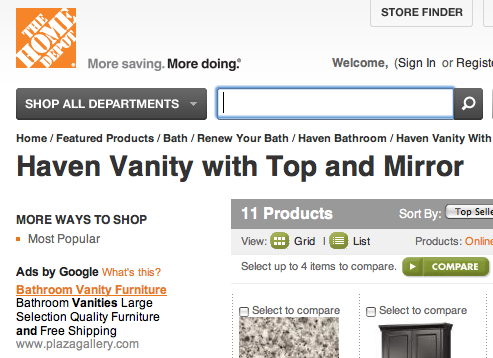
I was looking through the Home Depot website today, and I saw something that I think is a bit strange, and I wanted to see what you think about it:  Google Adsense advertising blocks on HomeDepot.com.

I was shopping for a bathroom vanity at Home Depot, and I saw a link to PlazaGallery.com, which is a competing website/company.  Why would Home Depot want to make a tiny fraction of the revenue for my click than they would if they would sell me a full vanity, sink and faucet?

I monetize some of my smaller website with Adsense, especially the sites that don’t have direct advertiser relationships and don’t offer products for sale. I like the flexibility of Adsense, and I appreciate the fact that I can make money on some of my sites without actually having to sell anything.

I’ve always been taught that it doesn’t make much sense to send potential customers to a competitor for a fraction of the revenue that you could make from a sale. For instance, if I was selling $100 sneakers with a 30% profit margin, it wouldn’t make sense to have Adsense where I could get paid $.50 for a click, while sending customers who want to buy from me right to my competitors who could make a lot more money and gain a new customer.

I understand that their site has millions of visits, and they probably have a significant revenue stream with Adsense monetization, but it strikes me as odd, when the Home Depot has such a huge selection of products.

What do you think?

Using Demand Media & eHow for SEO Tips

6

DMDShares of Demand Media traded on the New York Stock Exchange today for the first time.

In addition to its domain name assets (like Enom and NameJet), DMD generates revenue with Adsense and advertising on its eHow.com website. The company has a proprietary algorithm that can figure out what people are searching for on Google, and it then sources out articles on those topics to its huge team of independent writers. There are either hundreds of thousands or maybe millions of articles.

Pundits have opined that some of the content is bad, while others have speculated that Demand could be impacted if Google changes it’s algorithm to push down the allegedly “spammy” articles. I don’t own stock in DMD and most of the eHow articles aren’t really that competitive to my sites, so that stuff doesn’t really interest me much.

However, I do think there’s a way that domain investors / web developers can tap into Demand Media’s vast knowledge about the wants and needs of Google searches. If we search eHow for articles related to our own topical websites, we can learn what Demand thinks people are looking for, and we can then write better articles or source out better articles.

Here’s an example for you.

I own a dog walking service directory, and in addition to the paid directory listings, I also have a lot of articles that might interest dog walkers or people looking to hire dog walkers. By searching eHow, I can make the assumption that its related articles are things that people are searching for, and my exact match domain name may have more authority if I write more in depth and/or interesting articles. It’s important that you write articles differently than the eHow articles and that they are completely custom.

For instance, it looks like these topics should be covered on my site (in addition to many others):

  • How to Start a  Dog  Walking and Pet Sitting Service
  • How to Start a Dog Walking Service
  • How to Become a Dog Walker
  • How to Walk a Dog in Winter
  • How to Walk a Dog in the Snow
  • How to Exercise with Dog Walking
  • How to Hire a Dog Walker
  • How to Interview a Dog Walker
  • Many, many more…

Mind you, I already have a number of these articles covered on my site in various forms, but the information provided by eHow can be beneficial to website owners. Maybe you should take a look at eHow and see what information you can glean for your own website.

Investing in .CO Domain Names: My Current Thoughts and Outlook

.CO Domain NamesI am writing much more about .CO domain names than I ever did about .MOBI or .EU or any other new domain extension. I want to make a few things very clear about my feelings on .CO, and you can take it for what its worth knowing the .CO Registry is an advertiser and that I own less than 10 .CO domain names.

With Google’s consideration that .CO is an international domain extension rather than another ccTLD (despite the fact that it is actually Colombia’s ccTLD), I believe .CO domain names have the ability to perform well as websites in any country. I believe that this will mean businesses will be able to successfully build on .CO domain names.

I can only assume that companies like Go Daddy and the .CO Registry will continue to market .CO domain names, targeting consumers and small businesses alike. To my knowledge, this type of mass awareness campaign has not been done before for other extensions, and I think consumer awareness is key to .CO domain values.

I believe that because Google announced it will index these domain names like other extensions combined with the awareness campaign undertaken by the world’s largest domain registrar, .CO will become a widely used domain  extension… in the future. In addition, with gTLDs expected to be released in the future, consumers will slowly adjust to extensions other than .com. It may not be quick, but I do think it will happen.

Personally, I do not believe .CO domain investments are a wise short term play. If you buy a name to flip it this week, month, or year, you could be out of luck.

My domain investment business model primarily revolves around quickly flipping domain names. It’s a cash flow business for me. As a result, I am not investing a whole lot in .CO domain names right now.  Simply put, I don’t have $xxx,xxx in liquid capital that I would use to invest in .CO domain names (to put on the sideline) for a long term investment of potentially several years. There may end up being some great buys in the big Sedo ,CO auction, but we probably won’t know for some time.

If you do make .CO domain name investments, you should do your due diligence. I don’t see a big aftermarket for them amongst domain investors right now, although that could conceivably change after the Super Bowl. Without that, there is limited liquidity. For instance, if I pay $25,000 for a city .com name, I am generally fairly positive I could sell it at wholesale for $20,000+, and that can’t be said about .CO at the moment.

I think it’s actually a good thing that we aren’t seeing huge sales that would encourage others to spend more than they should. It doesn’t appear that there is a bubble forming, which is a very good thing, because bubbles in the domain space aren’t good for the majority of us. When they burst, values plunge as the liquidity is not there to support the valuation.

Some of the comments I hear is that Go Daddy and the .CO Registry are simply hyping this extension and it’s going to end up costing domain investors a lot of money. The irony of this is that every business needs to do marketing for consumer awareness, and it’s the consumer awareness that will help make .CO domain names valuable. Without it, consumers and businesses wouldn’t buy the names, and without that, domain investors wouldn’t make much money unless they developed them.

The bottom line from my perspective is that .CO domain names may turn out to be a fantastic investment in the future. For now, I think it’s great to see the Registry and its registrar partners focusing on a gigantic awareness campaign. I am happy with my current investments, and if I see good names at good prices, I will invest for the longterm.