


If you’re having a tough time visiting some domain name industry websites today, you’re note alone. I was checking on something at Atom.com this morning, and I saw this Cloudflare Internal server error message at the top.
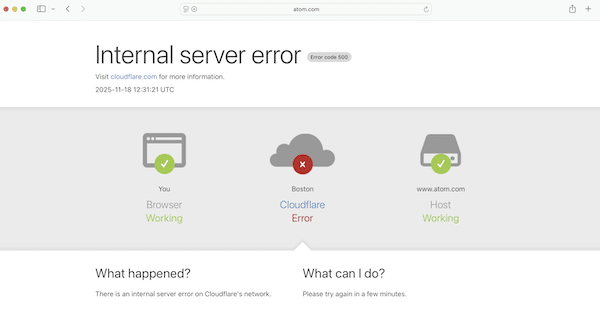

If you’re having a tough time visiting some domain name industry websites today, you’re note alone. I was checking on something at Atom.com this morning, and I saw this Cloudflare Internal server error message at the top.
GoDaddy recently launched its high-end DomainNames.com marketplace. The platform launched with listings that included high value inventory like Harmony.com, HongKong.com, FL.com, Bankroll.com, Switch.ai, Ladder.ai, and a plethora of other great domain names.
According to a post from GoDaddy’s James Iles, DomainNames.com already closed its first sale:
Last week, I wrote about my first domain name sale at Spaceship. The only hiccup was the $57 fee that was charged by PayPal when my payment was disbursed to me. This was partially my fault for not investigating further when Spaceship warned me about the potential for fees:
“Additionally, please note that you may incur fees when receiving funds. These fees are determined by the payout method and are beyond our control.”
I sold my first domain name via Spaceship today, and I thought I would share how it came about.
I recently listed nearly 2,000 domain names for sale on Spaceship with BIN prices and the make offer option enabled. The domain names were all priced below $5,000. None of the domain names were parked at Spaceship. I figured I would give Spaceship/Namecheap the opportunity to sell these domain names within their network, and if a domain name is purchased, I would pay the 5% commission.
Keeping my nameservers at Afternic allowed me to avoid paying a higher commission if one of these domain names was sold via GoDaddy. Since the time I listed domain names on Spaceship, I closed somewhere around 20 BIN + LTO deals at GoDaddy. Given how many domain names I have sold at GoDaddy in the time I’ve had many listed on Spaceship, I might have paid more in a commission penalty than I would saved, although it’s impossible to know if these buyers would have bought at Spaceship with their nameservers.
Is Southwest Airlines planning to open airport clubs and lounges? If domain name registrations are an early indicator, the airline is planning to open its own Southwest Airline Clubs or Southwest Airlines Lounges. In fact, a week and a half ago, The Street wrote about Southwest Airlines opening its first airport lounge.
This morning in my DomainTools Registrant Monitor alert email, I noticed several domain names that are related to Southwest Airlines. These domain names were registered at MarkMonitor under the DNStinations, Inc. privacy service offered by the corporate-favored domain registrar:
I was in my Atom.com dashboard this evening, when I saw a note to customers in the message center. According to the note, “Sedo has decided to end its partnership with Atom.” Atom customers who have premium listings on the platform also automatically have their domain names appear for sale on Sedo. This will no longer be the case.
I am not really sure why Sedo would choose to end this relationship with Atom. It would seem to be a good chance to expand its inventory of domain names for sale, particularly in growing verticals like .AI where Atom seems to be making some inroads.
A limited amount of advertising space may be available, although all banner spots are currently sold out. Email us to be placed on the waiting list. Learn More
DomainInvesting.com is an award winning publication covering the specialized business of domain name investing, domain investment news and strategy. The publication is a news source for domain name sales, domain industry deals, and other topics related to domain investing and domain name branding.
© Important Notice: Unless explicitly stated, Top Notch Domains, LLC does not endorse any advertiser on this website. Advertisements and links may take visitors to external websites. Top Notch Domains, LLC is not responsible or liable for products, services, or content found on any other website. See the DomainInvesting.com disclaimer for additional details and information as well as this website's Terms of Use. Copyright © 2007-2025 - DomainInvesting.com | Top Notch Domains, LLC
