Home Blog Page 1539

Thank You, Calvin

It’s very cool to see someone like Calvin Ayre in touch with what people are saying about his company.

If he wants to run any direct/interactive marketing ideas past someone in his key demographic (28M, Blackjack player, Maxim subscriber, Sports fan, Ketel/Red Bulll drinker…etc.), he can drop me a line! When I play, its usually at the Tropicana, and I know that gaming direct marketers are some of the smartest and most savvy in the business.

I do have one suggestion for Calvin. Instead of forwarding CalvinAyreFoundation.com and TheCalvinAyreFoundation.com to NewCalvinAyreFoundation.com, I believe he should just use CalvinAyreFoundation.com since “New” is no longer in the Bodog domain names. Since they are all being forwarded, it doesn’t really matter so much, but it makes more sense now.

CADNA Responds to ICA’s Code

CADNA Responds to ICA’s Adoption of a Member Code of Conduct

The Coalition Against Domain Name Abuse (CADNA), a non-profit association created to stop various domain name abuses, has responded to the Internet Commerce Association’s (ICA) 8 point member Code of Conduct. The code was created to promote industry best practices to all domain owners in order to maintain ethical business practices. CADNA is most concerned with the points related to infringement upon other companies’ trademarks, as their membership is comprised of some of the largest companies in the world, including, AIG, Dell, Marriott, Yahoo, Verizon, and several others.

CADNA’s response includes three additions to help enhance the code of conduct. Their suggestions include:

“First, ICA members should oppose domain name tasting (not just kiting), and using a third party’s brand, or other trademark misuses, without permission. Such actions should be avoided altogether, even if the name is registered for less than five days.Secondly, ICA members will not monetize (serve ads) on behalf of their third party customers’ domains that infringe upon brand names without explicit permission of the trademark holder. This commitment includes agreeing not to register domains that are confusingly similar to brands.

Lastly, ICA members who are registrars will not taste domain names themselves, and they will not wait for ICANN to establish a policy to uphold their fiduciary obligations to the public.”(Source: CADNA Press Release)

As a Professional Member of the ICA, I agree with all of their points. In the past, I bought non-infringing names before dropping them within the 5 days, but that wasn’t to test traffic. I did it when I first started in the business to try and take a $7 registration to flip it for $25 a couple of days later. I don’t think this is particularly harmful, but since many people use the loophole to quickly test traffic on potential trademark names, I don’t see the harm in closing it.

I don’t believe a domain owner should have the right to own a clear and undisputed trademark domain name. In my opinion, nobody except Verizon has the right to own a domain name like VerizonMobilePhones.com except for Verizon.

The most difficult situation is determining when a domain name clearly infringes upon someone else’s trademark. Just because a domain name happens to have the letters “aig” and “insurance” in them, doesn’t necessarily mean it is infringing on AIG’s brand trademark. For example, AIGInsurance.com would clearly be an infringing domain name; however, PaigeInsurance.com, a NH-based insurance company run by the Paige Family, would not infringe simply because it has “aig” and “insurance” in its domain name.

One point of interest related to this press release is the lack of actual press it seems to have received. When CADNA was created a couple of months ago, I read news articles everywhere. My Google Reader sent me PR notices from tens of news outlets throughout the world. For this press release, I didn’t hear about it until 4 days after the release, and had someone not posted it in one of the forums, I wouldn’t have seen it at all (Thanks to Josh Melamed for posting it on Rick’s Forum!)


“Carrotheads” vs. “Parrotheads”

Domain investors often believe domain names are the most frequent target of overbearing trademark holders. That isn’t always the case as evidenced by a recent lawsuit. According to Page Six of the New York Post, singer Jimmy Buffet is suing Six Flags theme parks for infringing on his trademark rights. Six Flags has a 10,000 member “Carrothead Club,” for children who are fans of Bugs Bunny. Buffet believes the name of the club infringes upon his trademark, “Parrotheads,” as his fans are known. The New York Post says that Six Flags has “no plans to discontinue the club.”

Bodog’s CEO Responds

In his response to my post, Calvin Ayre, CEO of Bodog misinterpreted my thoughts. In reference to my blog post about branding vs. generic domain names, Calvin stated, “I don’t agree with his thinking that a brand cannot rebuild itself when its domain name is generic.”

What I said was, “Yes, a brand can be built around a generic domain name, as demonstrated by the Hotels.com example. However, I don’t think a generic domain name should be used to rebuild a brand.” I agreed with Bodog’s decision to continue with the Bodog brand rather than buying a generic domain name, as Frank Schilling recommended.

I think Bodog’s strategy is spot on, and not only are they not losing customers, all of the news surrounding this news story is certainly allowing Bodog to reach more customers. After reading all of the news events, people know what Bodog is, people know what Bodog does, and most importantly, people know where to find Bodog. The point of my blog post was that Bodog was smart to keep the Bodog brand, even though their original domain name was taken.

On a side note, it’s great to see a CEO like Calvin take the time to blog.  

Branding vs. Generic Domain Names

With few exceptions, company brands and generic domain names are opposites. The objective of a brand manager is to distinguish his brand from the competition. The objective of a generic domain name owner is to provide content or advertising links that are general enough to interest the visitors. A brand manager ultimately wants to build loyalty to his brand so the visitor becomes a customer and returns. A typical generic domain owner wants a visitor to click through and possibly provide enough interesting content that the visitor returns so he can click again.

An exception to this is Hotels.com. They have built their brand around a generic domain name. When a person wants to find a hotel at a good price or when they want to read reviews about various hotels, they specifically navigate to the brand, Hotels.com. When a person who doesn’t know about Hotels.com (the company) navigates to Hotels.com, they are looking to find a hotel. This is a prime example of a brand being built around a generic domain name, giving the loyal Hotels.com customer and the random visitor the same valuable information, while building brand recognition and loyalty for both.

In the case of Calvin Ayre’s Bodog brand, the company wants its clients and potential clients to gamble at BodogLife.com and partake in the “Bodog lifestyle.” When the brand was threatened recently, Bodog changed their domain name from Bodog.com to NewBodog.com and then finally to BodogLife.com. Although the domain name changed, the brand and messaging remained constant.

In his blog, Frank Schilling argues that “Calvin should have used this opportunity to buy InternetCasino.com from Xedoc.” As much as I respect Frank, I disagree with him. First, InternetCasino.com would have been a very expensive acquisition for Bodog – probably much more than the value they would receive in return. Not only would this have changed the domain name, but it would have completely altered the brand and the lifestyle portrayed. Visitors to InternetCasino.com are looking for a place to place their bets. Bodog customers are looking for Calvin.

Integrating a brand with a generic domain name doesn’t usually make sense. Yes, a brand can be built around a generic domain name, as demonstrated by the Hotels.com example. However, I don’t think a generic domain name should be used to rebuild a brand.

Adwords: Buying A Competitor’s Domain Name

1

In August, I blogged about American Airlines suing Google for allowing other companies to buy their trademarked terms such as “American Airlines.”    I argued that Google should win this case because it was my opinion that another company should be able to buy generic keywords, like “American airlines,” since it isn’t necessarily associated with American Airlines.    Had it been a company with a more distinctive trademark, I would have argued that it was unethical to buy those keywords.    I have no legal background, so I couldn’t weigh in with a legal opinion.

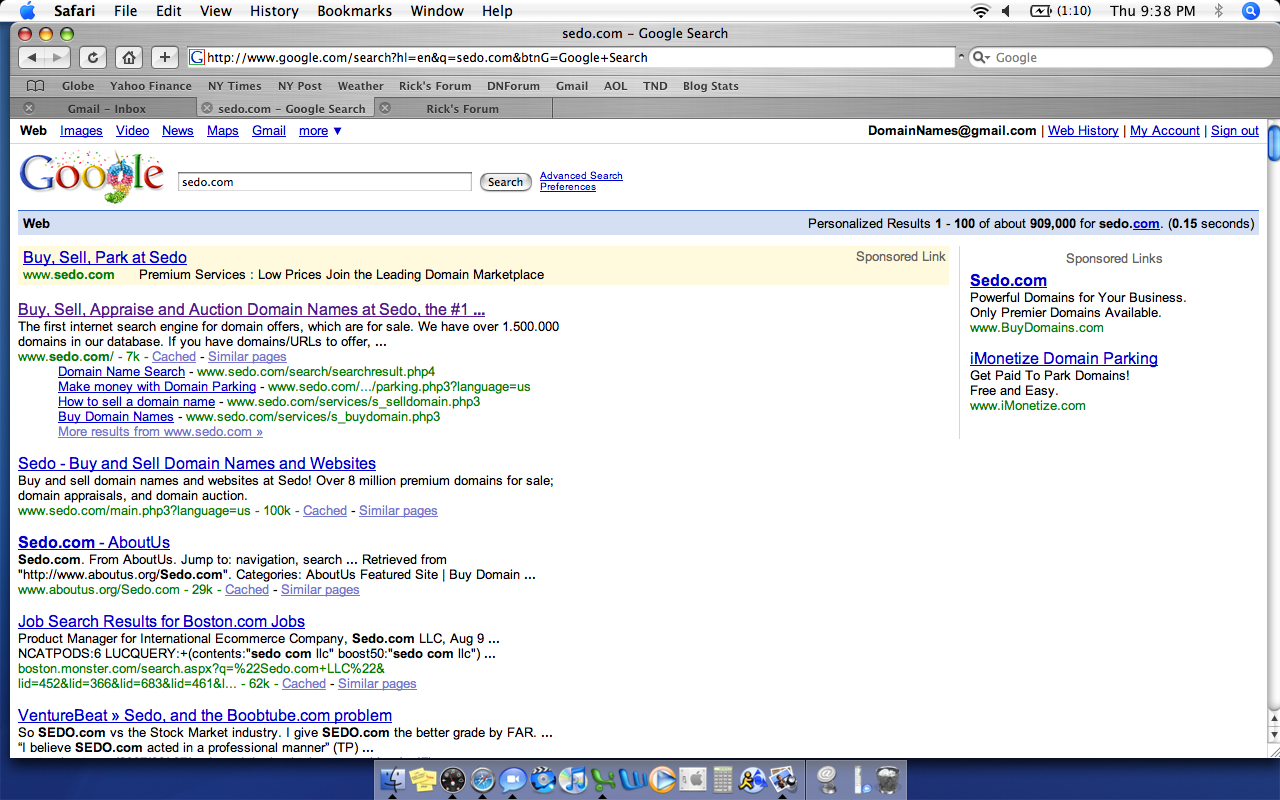
That brings me to a post I just read on a forum about a company I do business with that is buying not only a keyword with the name of a competitor in it, but the actual domain name of the competitor.    I was surprised to see that when you type Sedo.com into Google, obviously searching for Sedo, there is a BuyDomains.com paid advertisement.    I don’t think this should be permitted by Google.    It’s one thing to buy keywords such as “Domain Brokers” or “Domain Sales,” but I don’t think it’s right to buy the exact keyword domain name of a competitor.

I am sure companies across a wide variety of industries are utilizing this practice, but that doesn’t make it right.

picture-1.png