Uncertainty Could Doom the New Domain Names

Based on what I have read and heard, it seems like operators of the new domain name extensions can basically charge whatever they want for their domain names. I think most people assumed that the market would help dictate the price, but as one can see by observing the Uniregistry pricing changes, a registry can seemingly charge whatever it wants for its domain names.

I think this is problematic and could doom the new gTLD program. There is a risk that a company could build a website on a new domain name extension and in a matter of years, the registry could theoretically charge whatever it wants for a renewal. A small business, who likely chose a new domain extension in lieu of spending extra money on a previously registered .com domain name, would then have to deal with the same issue of an expensive domain name.

Several operators of the new domain names tried to assuage the concerns of customers by stating various forms of “we have no plans to increase pricing.” You can see comments from representatives of  Rightside, Donuts, Radix, and .Club. I know many of these people, and I believe they are all well intentioned and truly do not have plans to increase prices. Likewise, I don’t think Frank Schilling from Uniregistry thought the prices would increase by so much just a few years ago.

Unfortunately, the price increase from Uniregistry
Price Increase is Bad for Registrars

Like most others in the domain investment business, I read the news about the Uniregistry price increases on Domain Incite and Domain Name Wire  yesterday afternoon. As the owner of fewer than 10 domain names that are new extensions, the price increase will not directly impact my business. The businesses most impacted by this will be domain name registrars who will have to pass along the price increase to customers.

I would imagine that domain name registrars are going to be tasked with informing customers of the large price increase. From my perspective, it would not be fair for these registrars to simply send out a renewal reminder email to registrants and sort of bury the fact that prices for some new domain names are going way, way up. I think they are going to have to make sure domain registrants know that the prices of some domain names will be rising (dramatically).

Unfortunately, the domain name business is not exactly transparent. Even if GoDaddy and other domain registrars explain that the upstream registry raised its prices, domain registrants are still going to have to pay GoDaddy, and they will likely be upset with GoDaddy if they care about their domain names. Once domain registrars begin sending these notification emails, recipients may worry about other new extensions as well, even those not currently impacted by the price increases. This is not good for the new gTLD business, particularly the domain registrars whose customers will face these dramatic price changes.

Another area that could cause some reputational damage

Getting Your TLD Legal in China: the MIIT Process Unboxed

Emblem_of_Ministry_of_Industry_and_Information_TechnologyFor some registries, it has been a more than four-year process to get their TLDs approved by China’s regulator, the Ministry of Industry and Information Technology (the enigmatic “MIIT”). However, with slow but steady MIIT approvals now coming out of China, what started with the MIIT’s policy revision some years ago, to the appointment of the equally abstruse “review committee” last year, has now resulted in “approved” foreign registries now legally selling their domains in China. While this is certainly good news, the process leading to MIIT approval is still a formidable one.

As the China-specialist agency which was hired to support the successful applications of .club, .ink, .shop, .site and .vip, the ‘coming soon’ applications of .art, Famous Four, Neustar (.biz & .co), Rightside, and the original China market entry of the Chinese IDNs .在线 and .中文网, Allegravita is unambiguously the most experienced China domain registry consultant in the world. Elliot Silver of DomainInvesting.com asked us to write an update on the complicated process of applying for and receiving MIIT approval, so we hope this overview is of interest to the domain name industry.

Selling domains in China to Chinese registrants and investors not only represents clear opportunities for registries in “DUMs and Dollars”, but equally requires the registry to commit substantial time, capital and other resources. The decision to commit to China is all the more daunting because of vast cultural, linguistic, and regulatory unknowns.

Admittedly, China’s is a difficult system for an outsider to navigate for all these factors, and also because China operates in a complex “Chinese knot” woven tightly with red tape. However, as the recent TLD approvals show, the process is not an insurmountable one if you select your China partners carefully, and navigate the process according to a clear roadmap.

Read on to understand the main checkpoints on that roadmap.

5225998268_a63f357c20_z

Chinese Knot” by Flickr user Qiaomeng. Creative Commons license.

I want a woofie? What the what is a woofie?

How Major Brands Are Adopting Branded Short Links

Rightside made a very generous contribution to Dana-Farber Cancer Institute as a part of my 2016 Pan-Mass Challenge fundraising campaign in exchange for the publication of this article.

Social Momentum-jpg

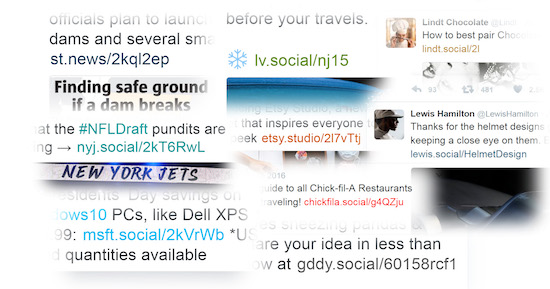
On February 14th, Etsy announced the launch of Etsy Studio in a social post. While Etsy.studio certainly would be a great, memorable domain for their project’s primary website, as Elliot previously suggested, Etsy has at least made an excellent decision to start using the domain on social media. In fact, Etsy is just one of many brands and individuals utilizing a new wave of Branded Short Links.

dotStudio_Logo_RGB_resize-jpg

A Branded Short Link is a URL that is, as the name suggests, both

Etsy Gets Etsy.Studio But Uses EtsyStudio.com

13

Etsy StudioIn a tweet this afternoon arts and crafts marketplace Etsy announced that it would be launching a new marketplace for craft supplies called Etsy Studio. Fast Company published an article about this new marketplace earlier today. The article offered a glimpse into the company’s plans for  Etsy Studio, which is expected to  open for business in April of this year.

When I saw the tweet about Etsy Studio, my first thought was about the Etsy.Studio  domain name that was referenced. I then thought about  whether or not the company is going to use that new gTLD domain name for its website. I visited Etsy.Studio  and saw that Etsy.Studio forwards to EtsyStudio.com. Social media for this new marketplace (Pinterest) appears to confirm that the company intends to use EtsyStudio.com and not Etsy.Studio for its website. I would imagine they will continue using Etsy.Studio for social sharing though.

The .Studio domain name extension is operated by Rightside. As of today, there are over 21,000 registered .Studio domain names, according to nTLDStats.com.

In my opinion, Rightside

Logan.Movie in a Super Bowl Commercial

3

The greatest Super Bowl game in my lifetime was played last night. As a New England Patriots fan, I am clearly biased, but that was an amazing comeback. For some people, the Super Bowl was all about the television commercials.

Admittedly, I paid little attention to the Super Bowl commercials during the game, but I did notice one new gTLD domain name used in commercials for a new movie called Logan. Fox chose to use the Logan.Movie domain name in its commercial.

If you visit Logan.Movie, you are forwarded to a page within the Fox website advertising the movie. The matching .com domain name, LoganMovie.com, is owned by a company called Logan Luxury Theatres based in South Dakota. I wonder how much extra traffic that domain name saw during the Super Bowl. Logan.com is owned by another entity, which has “Loganberry Books” at the top of the website.

I counted 10 movie trailers shown during the Super Bowl. I looked through them all this morning, and I only see the one .Movie domain name. Interestingly,