



CBA Highlights the Email Aspect of Domain Name Ownership

The Sydney Morning Herald (SMH) covered some news about an error that was caused by using an incorrect domain name in an email address. The error involved the Commonwealth Bank of Australia (CBA). Here’s what happened, according to SMH:

“The bank on Friday said it had conducted an information security investigation, after it emerged that last financial year staff had inadvertently sent 651 internal emails to email addresses with the domain name cba.com, rather than the bank’s actual domain name of cba.com.au.”

Incidentally, something very similar recently happened to a different bank in Australia when “customer information was sent in error to an nab.com address rather than an email address on the nab.com.au domain,” reported ZDNet in January of 2017.

A little less than a year ago, I wrote an article about how email is the domain name X factor. Many companies still don’t think domain names are super important. They may feel their money is better spent on branding or building products/services rather than buying an expensive exact match domain name. Companies that think this way may opt for a less expensive ccTLD or cutesy domain name like “GetX” or “UseX” instead of the exact match .com name. Clients, vendors, prospects, and apparently even internal marketing teams may be confused or forgetful and use the brand match .com domain name instead. If the email snafu involves private information or data being shared with unauthorized parties, that can be a big problem if the company doesn’t control that other domain name.

This is another example of why companies, especially those who retain private consumer data, should practically do whatever it takes to get the brand matching .com domain name for their business.

As you may recall, I wrote about the CBA.com domain name a couple of years ago. The SMH article also discussed the acquisition of the domain name, but I found one aspect of the article to be a bit confusing:

List of Registrars Showing Public Whois After GDPR

GDPR went into effect last week. Even though GDPR is a European Union data protection and privacy regulation that does not cover Americans or other people who are not EU citizens, some domain registrars totally eliminated public Whois lookup information to ensure they do not violate GDPR regulations and potentially expose themselves to serious penalties.

I have found that some domain name registrars have not eliminated public Whois lookups and Whois information, and I want to share what I found with you. This is certainly not an exhaustive list of registrars, and as far as I can tell, Whois information is only publicly available for registrants who do not have a European presence. I used a combination of registrar Whois searches, ICANN whois searches, and DomainTools Whois searches to see which registrars are blocking information and which are still showing information.

I invite you to share the name of registrars that are not using something like “Data Protected” for Whois lookups as you find them.

Registrars still showing Whois information after GDPR implementation:

“Data Protected” Welcome to GDPR

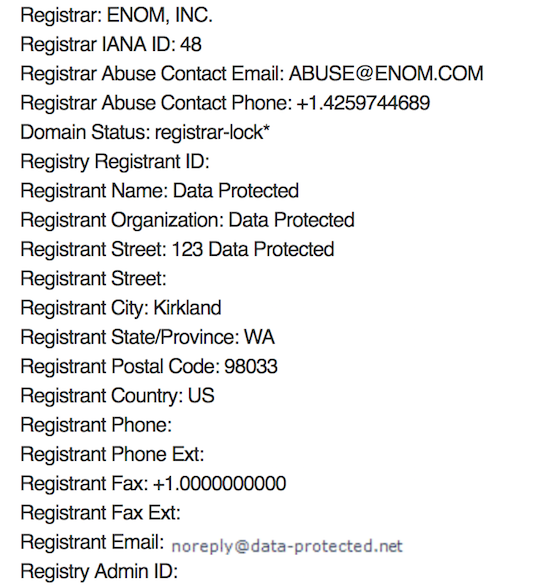
I was curious to see how Whois would look with GDPR upon us. I did a Whois search for a domain name registered at Enom, and “Data Protected” is the term that is input in many of the registrant fields. The email address is listed as noreply@data-protected.net and there is no phone number for the registrant.

Here’s a screenshot of a Whois lookup I did at Enom this morning to show you how (at least some of) their Whois records look in the wake of GDPR implementation:

The majority of my domain names are registered at

7 Ways I am Preparing for GDPR

GDPR is coming this Friday, May 25. Unless there is a last minute reprieve (litigation or something else unexpected), the Whois system will likely disappear. This is going to have a big impact on the business of domain name investing.

It will become harder to contact domain name owners. It could become more difficult or cumbersome to transfer domain names to other registrars. Performing due diligence could be more challenging. Domain investors may benefit a bit from GDPR, but I think there is a great chance domain investing could become more difficult.

I am hopeful ICANN and domain registrars figure out a GDPR compliant system that works and allows domain investors to continue to operate as usual. In the short term, I am not sure this is going to be possible, so I am preparing my domain portfolio in anticipation of some GDPR related problems.

There is still time, so I thought I would share some of the ways I am preparing for GDPR. I invite you to share the ways you are preparing if you would like.

Domain Investor Has $96 Million Bitcoin Portfolio

There are quite a few domain investors who also invest in cryptocurrency. I personally know of a few who I believe have done very well with their crypto holdings, and I am sure there are even more who have kept their investments more private.

This morning, CoinDesk wrote about Cai Wensheng, a Chinese investor who has built a holding of 10,000 Bitcoins worth nearly $100 million, depending on the price of Bitcoin ($9,700+ at the time of publication). Mr. Wensheng didn’t start investing in Bitcoin at the earliest stages. Instead, CoinDesk reports that he had one Bitcoin in January and built up his holdings when Bitcoin was hitting its lows earlier this year. Interestingly, this investor got his start as a domain name investor.

From the CoinDesk article:

10 Job Opportunities for Domain Industry Experts

The domain name business is relatively niche and there aren’t a whole lot of people who would be considered experts about domain names and the field of domain names. There are a few large companies that operate in the domain industry, and some have job opportunities that would be a good fit for someone who is knowledgeable about domain names.

There seem to be many job opportunities where domain names play a small role. Domain industry knowledge would be helpful for many intellectual property and legal job opportunities, but those obviously require a strong legal background or law degree. There are also plenty of engineering and IT jobs that intersect with the domain name industry, but obviously those are for engineers or IT professionals rather than people who are domain name experts.

I would imagine that the vast majority of people who invest in domain names do it part-time. I am pretty sure many companies would allow its employees to own their own domain names (and even their own private companies if that doesn’t interfere with their job), so having a full time job likely won’t interfere with a domain investment hobby. Someone who has domain name experience could parlay that into a full time job if they wanted one.

With that said, I thought I would