Not Always Great to Buy a Domain Name for Someone

The most difficult part of a domain deal is often the domain name transfer. This process can be especially frustrating when dealing with a buyer who is not all that experienced with domain name transfers and doesn’t know how to facilitate one. This can be even more frustrating when the value of the deal is lower than usual.

The other day, I posted a poll asking people if they have ever given a domain name as a gift to someone. The majority of people who participated in the poll were like me and have bought a domain name for someone else as a gift. Sometimes, buying a domain name for someone else isn’t such a great idea.

Nearly all of the time I have bought a domain name for someone, they have not taken possession of the domain name from me. Either they don’t have the need for the domain name (yet), or they simply don’t know enough about how to actually get the domain name. If I were to guess, most of these people have never even owned a domain name before and they wouldn’t know how to open a registrar account and initiate an account change or a transfer.

For the most part,

Have You Given a Domain Name as a Gift?

There have been quite a few times I have bought domain names on behalf of friends or for friends and family. Most of the time, these domain names were hand registrations for people who recently had babies or for friends who started businesses.

The 101Domain blog has an article about giving domain names as gifts. For several of the gift giving occasions they cited, they recommended a new gTLD domain name. I think this could be a good option, especially when the desired .com is already taken and the new gTLD domain name can be bought inexpensively.

I am curious if you have ever bought a domain name for someone as a gift. Vote in the poll below and let us know if you bought a .com or one of the new domain names (or something else).


Did You Register a .Blog Domain Name?

KKWT BlogThis morning as the .Blog general availability phase went live, I registered one .Blog domain name. Or so I thought. After receiving the order confirmation email, I checked the Whois, and someone else’s name was listed as the registrant. Shortly thereafter, I received another email to let me know about the error and I am sure I will be refunded soon.

I own just a handful of new domain names (n.Holdings, n.Ventures, Elliot.Link, ElliotSilver.Link, Silver.Ventures, and maybe a couple of others I am forgetting about). My attempt to register this one .Blog domain name  wasn’t any strategic change for my business. It’s more like taking a bit of a gamble for less than the cost of a hand of blackjack in Las Vegas. The domain name didn’t get registered to me, but it’s no big deal.

I checked quite a few other keyword .Blog domain names this morning, and most came back

Don’t Over-Negotiate a Good Deal

Knowing when to pull the trigger on a  deal is not always easy. Most people want the best possible deal, and by trying to continue to negotiate after a fair offer is made, they may miss out on the opportunity if the other party pulls it.

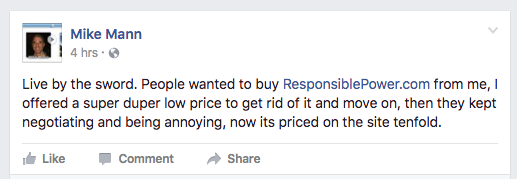
Here’s a comment from Mike Mann on Facebook yesterday afternoon after he gave what he deemed “a super duper low price” for a domain name his company owned and was motivated to sell:

“Live by the sword. People wanted to buy ResponsiblePower.com from me, I offered a super duper low price to get rid of it and move on, then they kept negotiating and being annoying, now its priced on the site tenfold.”

screen-shot-2016-11-01-at-7-58-52-pm

If you visit ResponsiblePower.com now, you can see the price is listed at

Your Offer Might Spark an Interest in Selling

Here’s something to keep in mind when making offers for domain names: your inquiry might make the domain owner  consider actively marketing the domain name for sale.

In the last couple of months, I have made many  purchase offers for domain names that were not on the market. On a few of these domain names, shortly after making my offers, the companies decided to seek out a domain broker to sell their domain names. The prices of these domain names were far above what I would pay, and as far as I know, none of these names I am thinking about  have sold via broker.

When buying domain names, my strong preference is to make a deal privately. This generally allows me to purchase a domain name covertly, without the price reported publicly and without outside involvement from someone who might use this data to their advantage. When a broker

You Might Want to Accept the First Counter Offer

One of the most exciting aspects of buying and selling domain names is the negotiation. You have a purchase or sale price in mind, the other party has their price in mind, and you go back and forth in the hopes of closing a deal. Based on my experience, sometimes it is better to accept the first counter offer and just close the deal than risk losing the deal by counter offering.

Let’s say I want to buy a domain name I think has a wholesale value of $20,000, so I kick things off with a reasonable offer of $10,000. Sure, the offer may be a bit low, but it isn’t a $100 offer that the seller probably sees every week, and it is strong enough to show the seller that I am serious. Being a reasonable domain owner, the seller counters at $15,000. The hard part is deciding whether to try and save some money by either sticking to my offer or improving it. Alternatively, I can simply say “deal,” and get it done.

I have regularly gone back to try and get a better deal. Domain investing is part speculation, and I think an investor makes his money on the buy-side. Sometimes the market is weak or a domain name isn’t as valuable as I might expect, so getting a good deal is important. There is a big risk to going back and countering the counter offer though.

A seller may begin to re-think things. He may realize he isn’t likely to get what he wants on the name and try to find another buyer for the domain name. This can drive up the price. The seller may simply say “no thanks” and take the domain name off the market.

When I counter offer, I am effectively