

AOL Just Protecting Its Brand

Ad.com

Last month at an engagement party, I met a friend of a friend who works for Advertising.com. After brief introductions and small talk, he mentioned that he works for Ad.com. Knowing that Ad.com had just sold at Moniker’s auction for 7 figures, I inquired further, and he mentioned that his company is actually Advertising.com, but everyone calls it Ad.com. Therein lies the problem.

In most cases, when a company or famous person has become known by a nickname, and that nickname or moniker becomes just as famous as the person (and clearly associated with the company or person), that company or person may be able to legally claim common law rights to that nickname or term.

Michael Jordan was known as “Air Jordan” because of his leaping and dunking ability. During his playing days, Nike introduced the Air Jordan brand, and I believe it is still one of their most famous brands. Had Michael Jordan not been known as “Air Jordan,” the term “air jordan” would probably be worthless unless someone else used that term famously. Like Jordan, Advertising.com became known as Ad.com internally and externally, and many people associate the term Ad.com with Advertising.com. However, unlike the term “air jordan,” the term and domain name “Ad.com” has significant value besides its usage by Advertising.com.

As an entrepreneur and marketer, I can commiserate with all parties involved in the situation. The current Ad.com domain owner just wants the sale completed as expected, Moniker/Oversee.net wants the commission they are rightfully owed, Skenzo is worried that they are going to have to spend tens or hundreds of thousands of dollars in addition to the purchase price to protect their new investment, and AOL wants to protect the brand they believe is rightfully theirs.

As a domain investor on the other hand, I am very concerned by this move by AOL, and it will make me more vigilant about researching the domain names I buy and develop.

Use Caution When Responding to Domain Inquiries

Every day, people receive inquires on their domain names. People ask if specific domain names are for sale and some make offers while others ask the domain owner at what price he would sell the domain name. Now more than ever, it’s important to carefully consider how you respond to domain inquiries. Andrew reported on the OpenDental.com UDRP today, and the panel had one startling opinion:

“Complainant offered to buy the disputed domain name from Respondent for $500-$5000.   Respondent’s engagement with Complainant in these offers and counter-offers is evidence of bad faith registration and use.”

So there you have it. If someone inquires about your domain name and you engage in offers and counter offers, you could put the domain name at risk. In my opinion, this is a crock!

Everything I own is for sale at the right price. If someone came to my apartment and asked to buy it, of course I would tell him that I’d sell it for the right price. If he offered me double the book value because he really wanted it, I would sell it ASAP and rent another apartment while my wife finishes graduate school. I am not looking to sell it and don’t want to sell it, but if he was making offers that made it worthwhile, I would consider it, despite the inconvenience it would cause.

Likewise, I would sell my domain names and websites for the right price. I don’t wish to sell any of my geodomain names right now, but I am trying to build a business to make money. If that involves selling my business and domain name for a considerable profit, sure I would consider selling it. I don’t see how negotiating the sale of a domain name or a business implies bad faith ownership of it.

I really think that the OpenDental.com decision is poor, and the language in its findings sets a very bad example that domain owners need to consider. Fortunately, one decision doesn’t necessarily mean others will follow, but it sure should be noted for the next time you receive an offer to sell a domain name.

Dolphins.com UDRP Update

10

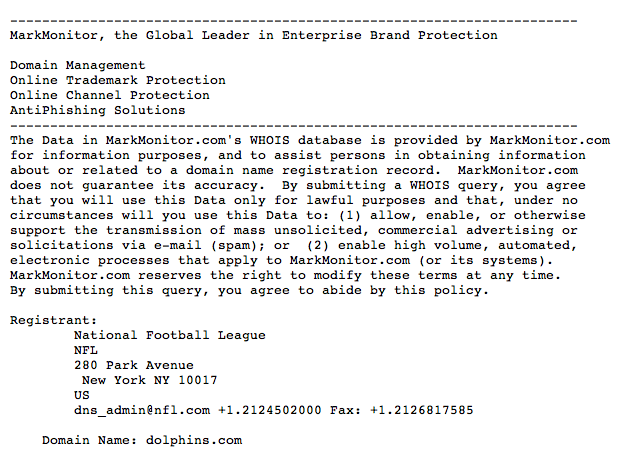
Miami DolphinsAs reported last week, the Miami Dolphins filed a UDRP for the domain name, Dolphins.com. According to domain registrar and brand protection company, Mark Monitor, Dolphins.com is now owned by the National Football League (see screenshot below), although the DNS has not been changed nor the domain forwarded to the Miami Dolphins website.
A few days ago, I noticed that the status of the UDRP filing was listed as Suspended, and now the domain name has been transferred, despite the current PPC links. A Suspended proceeding generally means that the two sides either reached some sort of agreement about the UDRP proceeding or a lawsuit was filed to prevent a ruling.

Although I don’t have any details about what was worked out in private, perhaps it will be reported in a future public corporate filing.

Dolphins.com Whois

Miami Dolphins File UDRP for Dolphins.com

44

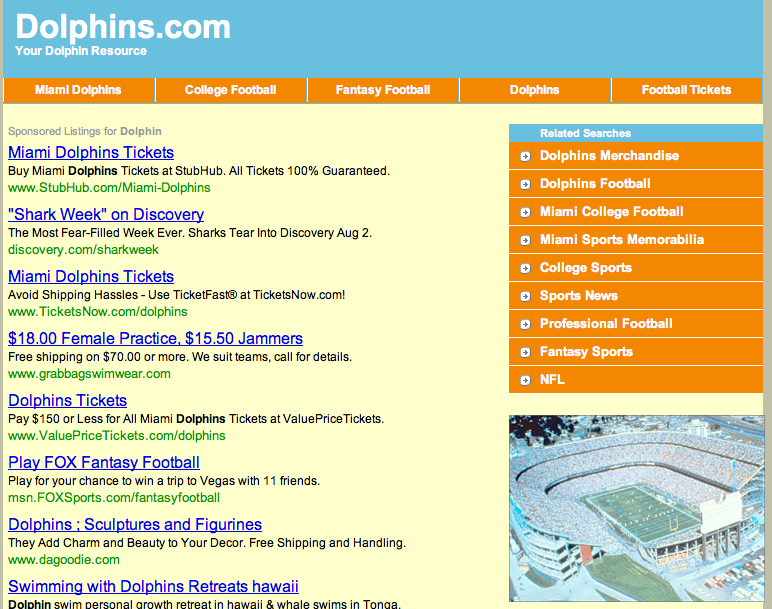
Miami DolphinsThe Miami Dolphins football team has filed a UDRP for the domain name Dolphins.com, which is parked and currently shows NFL football-related PPC advertisements, including an image of a football stadium. In addition to advertisements for “Miami Dolphins Tickets,” there are also ads for figurines and “Swimming with Dolphins Retreats.”

According to a Securities and Exchange Commission filing (2006 Annual Report) filed by Marchex (NASDAQ: MCHX), the publicly traded company owns Dolphins.com (as of 2006). Further, in the same filing, Marchex listed MDNH, Inc. as a subsidiary, and Dolphins.com is currently registered to dnsadmin@mdnhinc.com. MDNHINC.com is registered to MDNH, Inc.

This is a high value domain name, both because of its generic nature (animal domain names are always in demand) and because of the NFL team with the same name. This is going to be an interesting case to watch with these two heavyweights going at it, especially because of the potential impact of losing the domain name could be on Marchex’s bottom line. IMO, this is easily a six figure domain name.

Dolphins.com screenshot

Possible Namepros Phishing Attempt

NameprosThis morning I received an email that appears to be a Namepros domain forum phishing attempt, which I posted below. There are a couple of things domain investors and developers can learn from this:

1) Have different user names and passwords for forums, blogs, registrar logins…etc.

2) Don’t click links in an email as they can be cloaked.

3) If you suspect that you have clicked to a phishing website, tell the webmaster and change your password on the real site

4) Protectively register similar domain names to prevent confusion – especially if your website allows people to sign up.

It appears this email refers to a site at wwwnamepros.com rather than www.namepros.com, and the phishing domain name is registered at Godaddy. The spoofed website has already been taken down. However, you should be aware of this now and for the future. It should also be noted that the Whois information on the domain name is not private.

Here’s the email:

DO NOT REPLY TO THIS EMAIL!
***************************

Dear UserName,

You have received a new private message at NamePros.com from steelejones, entitled “Trader Rating Notification”.

To read the original version, respond to, or delete this message, you must log in here:
http://www.namepros.com/private.php

This is the message that was sent:
***************
You have received a new Positive rating or comment from steelejones.

Details about this transaction can be found *on your iTrader page* (http://wwwnamepros.com/itrader.php?u=88275).

Note: This is an automated message.
***************

Again, please do not reply to this email. You must go to the following page to reply to this private message:
http://www.namepros.com/private.php

All the best,
NamePros.com

Antitrust Lawsuit Against Verisign

I read about this litigation briefly in a domain forum while I was away, but in reading the Wall Street Journal blog article, it looks like the impact on the prices of domain names could be quite large. The San Francisco Chronicle also has an article about the lawsuit, which can be read in full on the WSJ website.

According to the plaintiff’s lawyer, Bret Fausett, “There are companies that would like to bid against VeriSign and would charge half of what VeriSign is charging.”

This is a lawsuit domain investors will want to monitor, as there is bound to be additional fallout depending on how things shake out.