

Why I Use “Make Offer” on Most of My Domain Names

27

Approximately 80% of my domain name portfolio is now parked for sale via DAN.com landing pages. I’ve had success selling via DAN this year, and I have continued to move domain names to their landing pages throughout the year. I have played around with the sales options options, and I have settled on one – the older BIN price (with a 12 month payment plan option) + Make Offer option.

Many people are critical of a “Make Offer” field on domain name landing pages. If a domain name has a Make Offer field, people tend to utilize it rather than simply hitting the Buy Now button. I thought I would share my rationale for offering it on my domain names, despite the fact that it is likely leaving money on the table.
Could a Confusing Credit Card Charge Lead to a $10,000 Sale?

Yesterday afternoon, someone emailed me to ask about a credit card charge that came from a merchant with the 2 keywords that make up one of my .com domain names. He thought my company, vis a vis this domain name, had charged his credit card. I told him that he had the wrong business and thought nothing more of it because this happens on occasion. People usually realize their mistake when I show them that the domain name is not being used as a commercial website and they go off to figure out who charged their credit card.

The domain name that matches the merchant name forwards to a DAN.com landing page, where it is listed with a buy it now price of $8,999. The domain name is also listed for sale on Afternic for just shy of $10,000.

Offers Show Value but Not THE Value

1

The top few domain names I own have always received the most number of purchase inquiries and offers. The vast majority of inquiries and offers are from unqualified buyers – people who do not have the budget to afford to pay what they are worth or people who do not have the vision to spend what it takes to buy the domain names. The number of offers a domain name receives shows that the domain name is valuable, but the offers are not typically reflective of the actual value of the asset.

Shoot Your Shot

3

Marcus Lemonis is the CEO of Camping World and the star of “The Profit” television show on CNBC. On the show (and in real life) Marcus invests in many different businesses. In 2014, Marcus invested in a company called Key West Lime Pie Co., which uses the brand match (but clunky) KeyLimePieCo.com domain name for its website.

Peter Askew is a domain investor, web developer, and small business developer. These days, Peter is probably most well known for owning VidaliaOnions.com, which I wrote about several times. Peter also operates BirthdayParties.com and RanchWork.com, among others.

“Total this month $0”

8

I regularly log in to my DAN.com account to add domain names to my portfolio, check on the status of a transaction, to update pricing, or to respond to a purchase offer. As each month ends and a new month begins, the monthly revenue number changes from the prior month to a big fat $0. The total revenue figure is listed above this, and last month’s revenue is listed below, but the $0 always screams out to me.

Block.com and Chain.com Acquired by Chain Capital Holdings Ltd.

5

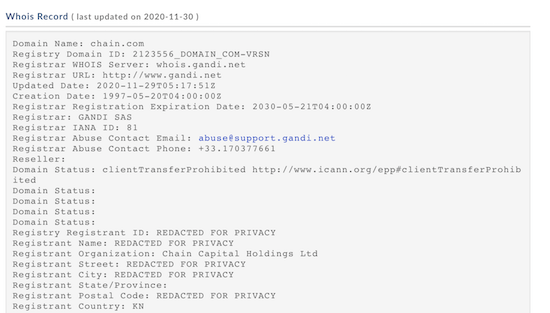
It looks like a company called Chain Capital Holdings Ltd has acquired both the Chain.com and Block.com domain names. Both of these domain names are now registered at Gandi. Although a great deal of the Whois information is “REDACTED FOR PRIVACY,” the registrant organization is listed as Chain Capital Holdings Ltd for both of these domain names with a registrant country of “KN,” which stands for Saint Kitts and Nevis.

I believe Chain.com was acquired by domain investor Andy Booth in early 2020. From what I understand, he sold Chain.com a few months ago to an investor in China. I asked, but Andy declined to disclose details about the sale price. Yue Dai, a well-known domain investor in China posted a speculative comment about Chain.com on LinkedIn yesterday.

Chain.com now appears to be a developed website, but I do not see a whole lot of information about the website or business that acquired Chain.com. It is very likely that the investor who bought the asset from Andy re-sold the domain name to the current registrant. According to its About page, “Chain unlocks billions of dollars in digital assets from other blockchains onto Ethereum to build decentralized applications.”