


Diversify Your Domain Portfolio: How IDNs are Registered in Punycode

You might have heard that people in other countries like to type, search, and create content in their native languages.   Investing in Internationalized Domain Names (IDNs) is a way to capitalize on that trend, and for anyone who wants to diversify a domain portfolio, buying a number of IDNs is a must.

I am not fluent in any foreign languages, (though I come close with Hebrew).   How can I register IDNs in large countries such as China, which has more people than any other country in the world?   Is it a problem than I am not a native speaker and that I do not have Chinese characters on my keyboard?

It is actually fairly simple.   All you need is a good, free online dictionary and a punycode converter.

Step 1: Translation
If you use a reliable foreign dictionary and translate “Liyang”, the Chinese city,   from English to Chinese you will get 溧阳.com

Step 2: Punycode Conversion
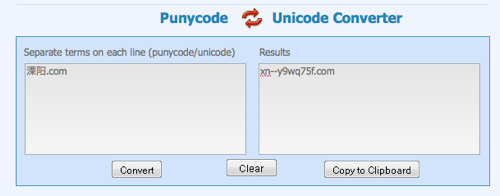
Then if you want to register this name, many registrars require you to register it using the punycode representation of these characters.   If you copy and paste 溧阳.com into the IDNTools punycode converter, you can just press the convert button and you will get the punycode representation of this word xn--y9wq75f.com.

Step 3: Registration
Then go register xn--y9wq75f.com.   As a result, if someone types in 溧阳.com into a browser, you would own that page and can develop it like any other.   Even better is that IDN keywords are not as competitive so if one were to do SEO, you would be in a great position for the valuable keyword “溧阳”.

Step 4: Bulk Registration
Now that you understand the basics, you can still hand register some great IDNs, and the best way to check for availability is in bulk.   Pull together a few hundred English keywords.   Translate. Punycode convert.   And availability check.

Caveats
A few hurdles still exist, though they can be leapt over.   First, you are bound to make some translation mistakes as some dictionaries aren’t always accurate.   We’ll show you in the next post how to use the best dictionaries, and when to use natives to minimize mistakes.   We’ll also explain that the question “why would anyone register a foreign name, then dot an English extension?” is resolved by .com being aliased to foreign extensions.

Next post: Translating Domain Names

Aaron Krawitz of IDNBlog and Gary Males of IDNDemystified, are guest authors of this IDN series on ElliotsBlog.   Aaron and Gary co-own   IDNDroplist, IDNTools and IDNNewsletter.

Ski Club Loses Domain Name to Sex Toy Site, Doesn’t Blame Others

6

In the day and age where most companies and people blame others when they forget to renew a domain name (as is what appears to have possibly happened in Morehead, Kentucky), a Canadian ski club appears to have let its domain name expire and didn’t blame anyone else for the error. Unfortunately for Whaleback Nordic Ski Club, their domain name, Whaleback.ca, was acquired by a company   selling a sex toy.

As of November 29, 2009, the domain name was registered to a company called “Stag Lodge,” and the domain name was set to expire on December 1, 2009. On January 6, 2010, the domain name was registered to a different company. In an article found in The Western Star, the site’s webmaster, Jack Lamond, doesn’t go pointing fingers at others.

“Once you lose your Internet (domain) name, it belongs to someone else. That’s why you pay a domain name fee,” Lamond said.

It’s a shame the person in charge of domain registrations did not renew the domain name. As I always advise, ensure your credit cards on file are up to date, your domain names are set to auto-renew, and you check your emails from your registrar.

It appears that Whaleback Nordic Ski Club isn’t the only organization whose website was impacted by not renewing the domain name. A look at a cached page on the former Whaleback.ca website shows a link to a Stag Lodge Outfitters (StagLodge.ca), and that website now also has adult content.

That particular domain name was registered to the same contact as the Whaleback.ca website as well. Let’s hope he wasn’t responsible for any childrens’ websites or other important domain names.

IDN Series Introduction

When I was writing down a list of a few things I’d like to accomplish in 2010, learning about the IDN market was one of those things. I know of a few domain investors who invest in IDN domain names, but I don’t know enough about them yet to invest. In fact, as of right now, I don’t own a single IDN domain name.

One of my friends and business colleagues is Aaron Krawitz, publisher of IDNBlog.com, co-owner of IDNTools.com, and an expert in the IDN business. Aaron previously wrote a guest post about why he thinks IDN domain names are going to grow in value, and I asked Aaron if he could follow that up with a small series of posts that could break down investing in IDN domain names.

Beginning tomorrow, I will be posting a 3 part series written by Aaron and his colleague Gary Males. To give you a bit of background about the two authors, Gary Males first entered the domain industry with early acquisitions of .co.uk names. Aaron Krawitz made his first big splash in domaining when he bought a premium Portuguese and Spanish portfolio. Both investors were looking at global domains from the outset as they saw a valuable commodity and a large untapped world market.

As mentioned in the previous post about IDN domain names, both Aaron and Gary will be visiting the posts to answer any questions, as clearly I am not well-equipped to handle them. Thanks to Aaron and Gary for sharing more information about a market in which I am unfamiliar.

Tom Rask on the UDRP Process

Nat Cohen had a fantastic article about the UDRP process on Larry Fischer’s blog the other day, and it’s a “must read” for anyone that invests in domain names. The article has spawned discussions in private about UDRP defense and prevention, and it has been interesting to learn how other domain owners cope with this potential threat.

I received an email this morning from Tom Rask, of Logical Sites, whose company owns and operates websites on geodomain names including Sunnyvale.com, Sheboygan.com, Kenosha.com, and EurekaSprings.com. Tom offered some unique insight and advice, and with his permission and encouragement, I have posted the contents of his email below.

The basic problems with UDRP process are:

  1. It is a quasi-judicial process, not a judicial process.
  2. There is no accountability for WIPO or for the panelists.
  3. You can assert the fluffiest of common-law TM rights with impunity
  4. There is no monetary compensation for you if the opponent asserts an overly broad scope of use of their TM. They can “give it a whirl”, something they could not do so cheaply and with such impunity in a real TM court case.

———

Illuminating example: a few years ago, I lost a UDRP case that I knew I was going to lose. I had registered wwwxyz.com, where xyz was the name of European multinational with over 100 K employees. I had good reason to want to really jerk xyz’s chain, reasons that don’t matter for the purpose of this discussion.

So I decided to be totally over the top. Luckily for me, the WIPO case administrator made clear procedural errors, so I had occasion to suggest to him and his boss that perhaps “he should return to his native Norway, where unions can be counted on to protect the incompetent”. When WIPO did not offer me an avenue of appeal for mishandling the case, I said that it is no coincidence that corrupt organization like the IOC and WIPO are both located in Switzerland because they know they are safe there. In the US, they would be prosecuted under the RICO act. “Switzerland:” I said “high mountains, low morals”.

I had a lot of fun and inflicted many, many manhours on my opponent, who probably wished they had just bought the damn name instead. I suspect that WIPO has me on a blacklist….:-)

So I lost, and the Panelist wrote this at the end of his decision “Finally, the Panel cannot leave this case without commenting on the behaviour of the Respondent, which has been a disgrace, a grotesque abuse of this administrative proceeding”.

I e-mailed the Panelist (an experienced UK TM attorney) and said: yes, exactly. I was abusing the process, and if I had done that in a court of law, the judge would not have allowed it. The Panelist told me that he had taken my case seriously, as he does all cases, and that he spent 70 hours on the case. I apologized for that.

The Panelist and became friends via e-mail. He agreed that it is a problem that there are no sanctions: no sanctions if WIPO or similar orgs don’t follow the rules, no sanctions against the kind of roiling rancor I had engaged in. And no sanctions if a Panelist just decided to suck up to his perceived big money trademark interests. So it can become a Wild West Circus very quickly.

———–

So what should you do if you get hit with a UDRP?

  1. See if you and your opponent can agree on a Panelist. In scania.mobi, my opponent incredibly agreed to my suggestion of using Diane Cabell as the sole Panelist. She is a very fairminded corporate counsel for Creative Commons (a great org) and formerly of Harvard’s Berkman Center for Internet and Society. Had she decide against me, I would have still felt it was fair.
  2. If you cannot agree, you can do what Nat did (in the LomaLinda.com UDRP): a 3-member Panel. But this is risky. You can still lose 2-1 by getting two people like Richard Page on the Panel. If you lose and then go to court, the judge may take the approach “why should I overturn WIPO”….even though a WIPO UDRP decision is not a judicial decision.
  3. If your name is actually important to you, consider filing in federal court in order to stop the UDRP process. Federal court is very expensive. Bad PR is also very expensive and your opponent will know that, too. Once the court case has been filed, asserting abuse on your opponent’s part, then you can talk to them. Now they know that you are mounting a vigorous defense.

————–

Nat won 2-1, and that is great. But my point is: he could just as easily have lost 2-1.
UDRP is a crapshoot that is best avoided.
I have also noticed that lawyers usually do no better at UDRP than mere mortals.
This is a not a slam against lawyers, just a reflection of the animal that UDRP is.

If you get hit with a UDRP case, I’d be happy to discuss it with you.

Be Aware of a Domain Name’s Previous Business Activity

One of the most favorable things I look for when acquiring a domain name is a note on the homepage that says the company is no longer in business – or a default hosting page after knowing there was previously a company’s website on it. Businesses go under all the time, but the underlying domain name could still be a valuable asset the former owners don’t even realize has significant value.

I was looking at a domain name that I would like to acquire this morning, and it has all of the signs that it could be available for the right price. There is a note that says the company, which had been in business for 75 years, had closed 6 months ago. The email addresses were bouncing, and the phone numbers weren’t working. This got me excited, as I love tracking down a domain owner. This is similar to how I was able to buy Customs.com a couple of years ago… good research to find a former partner in the firm.

While concurrently doing due diligence on the domain name of interest and doing some research to find contact information for the former President of the company, I came across a website that had consumer complaints about the company. Some of the complaints were pretty harsh:

  • “This place is a disaster”
  • “their behavior has been totally unprofessional”
  • “my advice is to stay away.”
  • “Won’t be visiting… or ordering from their website again”

Although the company was in business for 75 years and these comments may be accumulated over time, it’s still good to be aware of these comments that can easily be seen by anyone who does a Google search for the domain name. The domain name has a dual meaning, so it wouldn’t be used in the same way as it was before, but there are still a few websites with negative comments, and people might infer that they are about a new website that would be built down the road once the site launches.

Although most people would recognize the difference between what was there and what would be built there, some potential advertisers could see the complaints and simply pass on advertising. Domain investors need to keep in mind that comments about a business on a domain name could have a detrimental impact on the domain name’s value.

Apple Domain Owner Creates YouTube Response to UDRP Loss

Apple UDRPAs you probably read on TechCrunch or the same article in the Washington Post, Apple recently won a UDRP filing for 16 domain names owned by Daniel Bijan.   The domain names that they were awarded include: blueipod.com, iphonecheap.com, iphonetoys.com, ipodaccessories.info, ipodkits.com, ipodsbaratos.com, macbookpro.biz, macbookpro.com, macbookpro.net, macbookpro.org, macfriend.com, and redipods.com. Clearly these domain names incorporated trademarks owned by Apple.

In a video posted today on YouTube (embedded below), Bijan doesn’t dispute the fact that Apple has rights to these domain names. In the video’s description, Bijan writes, “Apple hurts me, my wife and 3 kids. Not once did they contact me or send a cease and decist letter. I would have gladly gave them the names. Instead, they just start the arbitration process. This is what is wrong with corporations today. Just pick up the phone and call me.” Bijan continues, “What is wrong with this world. Did we forget to treat people like human beings? I will not buy any Apple products.”

Although I can empathize with Bijan a bit because I would be horrified to see my name in a similar article, I have to say that it comes with the territory when you buy domain names like this. Sure it sucks to be called out publicly, especially because anyone who searches for this guy’s name will probably forever see these two articles, however, one needs to be mindful of one’s domain registrations.

When I worked in the corporate world, there was always a saying that went something like “never send out an email that you would be embarrassed to see on the front page of the New York Times.” Likewise, I would advise people to be cautious about what domain names to which they may forever be linked.

Do you feel badly for the guy, or did he get what he deserved?