



Tip: Monitor Your Newly Registered Domain Names

6

The other day, I was at the dentist’s office, and we were talking about my business and websites. Since the dentist is a family friend (my college roommate’s uncle), I busted his chops a bit for not having a website. I explained how it could help him control what people read about him instead of relying on Yelp reviews. Not that the reviews are bad at all, but it’s almost always better if you can control the message.

After discussing this, my dentist said he’d think about having someone build a website, perhaps even a friend of his family who does it as a hobby. Obviously, my dentist didn’t own his name or his name +DDS domain names, and I quickly emailed my Moniker rep (Bari) and she bought those two names for me, literally as I was in the chair.

When I register new domain names, I have the default Parked nameservers set up for the domain names, and of course, these two new domain names were pointed at Parked from the get-go. When I went back to the dentist a few days later, he started busting my chops because the two domain names were showing cosmetic dentistry advertisements and he kidded that I was making money from his domain names (not that there’s any traffic).

Of course it was true that the domain names resolved to parked pages, but it wasn’t intended.

So now to the point of the post. When you purchase new domain names, you must be sure to point the DNS correctly, point the names to DNS where it won’t resolve, or self-optimize them if that’s your intent. While showing cosmetic dentistry ads wasn’t such a bad thing, it could have been bad if it was adult advertisements or something otherwise inappropriate. When parking landers self-optimize, you are at the whim of the parking company and the algorithm that controls the content.

I apologize if the title doesn’t exactly jive with the advice given in this post. I couldn’t really think of a better way to title the article, but I think it’s something you’ll want to keep in mind for some of your new domain registrations.

I Have Conflicts, Just Like Almost Everyone Else

27

Although I am a blogger that covers the domain business, I am first and foremost a domain investor. The proceeds from my domain investments are what drives the majority of my income, and it is because of my domain investments and involvements in the domain industry that I am able to write a blog that has unique insight and information on a daily basis.

Without any doubt, I have plenty of personal and business conflicts, and most are fairly obvious. There are many companies I write about that either pay for advertising or have paid for advertising. Some companies give me discounts, although that is likely due to my being a customer for an extended period of time and the quantity of my inventory, but I am sure I do receive benefits because I am a blogger, speaker/panelist, and an active participant in the industry. I try to be as impartial as possible when I write because 1) it’s the right thing to do and 2) I value my credibility more than the income from this blog.

I do or have done business with almost every company that operates in the domain space. I do this because I have to in order to be competitive and because I want to try out different services. I have had breakfast, lunch, dinner, drinks, cocktails, or something else with almost every executive working for many domain related companies. I am friends or friendly with many of these executives and employees of domain companies. Some are business friendships and some are friendships that go beyond domain investing.

Domain investing is what I do full time, and as a result, I know many people that operate in this industry (for better or worse). Because of my business and personal relationships, I receive tips and news articles from friends, business associates, advertisers, and others who I know. I post articles I am interested in posting, and they are articles I write, unless it’s written as a guest post. This means opinions and observations are mine, not what someone else wrote for me to post. My litmus test is whether it’s something I would find interesting or helpful to read if I was visiting this blog.

I think it’s impossible to be a journalist in the domain space without any conflicts. It’s somewhat of a clandestine industry, and there aren’t many places to learn the nuances of the business without actually becoming involved in the business. I attribute my active involvement for being able to offer tips, insight, and personal analysis, which I couldn’t do to the extent I do if I was a hobbyist or someone that wasn’t active in the business.

I have never investigated whether I am considered a journalist because that doesn’t matter to me. My blog is a place for me to give personal insight into what I see happening in the domain business. Sometimes my sentiments are echoed by others and sometimes people disagree with me. That’s fine, and even though I may be disagreeable in the comment section of my blog, I don’t censor comments unless they are  inflammatory, self promoting (“I have a name for sale!”), or are what I deem personal attacks.

When you read my blog, you should know that I probably have many conflicts, and if I am writing about a topic, it’s likely because I have a personal reason for doing so (ie I found something helpful or beneficial to my own business that might be helpful to yours). I am either using a service or learned about something that I find interesting. I don’t take money to write reviews, and although I may have an affiliate link from time to time,  it’s not usually even worth the hassle. I generally avoid affiliate links though because I don’t want people to think I am writing about something to make a few dollars. Trust me, even that perception isn’t worth the money.

I try to be impartial when I write, but no matter how hard I try, it’s impossible to be 100% impartial at all times. Just like almost everyone else who blogs or writes about the domain business, I have many conflicts and you should be aware of them if you somehow aren’t or thought otherwise.

Marketing BabyRegistries.com

On Saturday, I posted an article about my new baby registry website, and a few people had follow up questions about the development process and marketing the site. This morning, I want to discuss how I plan to market and promote the website.

I have quite a few projects/websites on my plate that I actively market and update, including this blog, DogWalker.com, DogGroomers.com, and Lowell.com. This takes up a fair amount of my time. I believe that with BabyRegistries.com, my marketing efforts will be quite a bit different, and they will be less time consuming.

My main focus will be on grass roots marketing efforts to let parents know that the website exists. This will be done in a variety of ways:

Social Media: I set up a Twitter account, and I will be getting in touch with and follow people who mention baby registries in their updates. I will encourage them to sign up for a free account and stress that setting it up is easy. I will stress the idea that it makes it easy for friends and family to find and buy gifts that are needed.

Networking:  Although it would probably be most effective to do in-person networking, I don’t have the time or desire to do that. The site wasn’t a huge investment, and it will be more of a passive time investment. That being said, I plan to introduce myself and the site to mom bloggers and pregnancy websites. I had quite a bit of positive feedback from friends who recently had children, and I think the service will be something other bloggers will want to mention.

Word of Mouth: This is going to be the biggest driver of traffic. New and expecting moms love to discuss tips and helpful websites, and if they find the site beneficial, they will tell friends. In addition, as more participants send out emails to friends and family to let them know about their pages, others will sign up.

Search Engine Marketing: I will be making ad buys on Google and possibly Bing to drive traffic to the site. I will also try to buy advertising on some of the leading mom websites to let them know the site exists.

Contests: I may run a few contests to get people to sign up and post their registries. For instance, I may do a drawing for a $100 gift card to Babies R Us or Diapers.com for people who sign up. The tough part of this will be spreading the word about the contest and knowing legalities of running a contest like this.

Most stores are only focused on their own baby registries, and they likely won’t be interested in co-marketing efforts. Similarly, many baby websites offer similar (albeit different approaches) services on their own websites, so it will be difficult to forge relationships with the larger sites.

BabyRegistries.com is a much different type of site than my other websites. I won’t be responsible for driving traffic to the baby registries contained within the site. Since random people won’t be buying gifts, it’s up to the expectant parents to send their friends and family to their page. This means my focus needs to be 100% on awareness so expectant parents sign up and create registries.

I feel that this should lead to somewhat of a snowball effect. The more people that learn about and use the site, the more it will grow. I think it’s easy for expectant parents to create pages, and it certainly is easy for friends and family to see all of the registries. If friends and family find it easy to use, they will likely use it themselves. As such, marketing this site is far different than my other sites.

What are your thoughts on my next steps and marketing ideas?

Not Overly Critical of Parking Companies

43

I’ve seen quite a bit of animosity towards parking companies, especially in light of Frank Schilling’s new venture, where domain owners are seeing a “pretty drastic” lift in revenue. Much of this vitriol  is probably justified, especially from people who continue to earn a significant amount of money from parking.

From the perspective of someone who hasn’t ever focused on domain parking for income, I don’t think we all should be so hyper critical of parking companies.

Parking companies enabled regular domain owners to earn revenue from their unused (or under-used) domain names. They cut deals with upstream providers, tested and built thousands of landing pages, provided self-optimizing platforms allowing customers to do minimal work, and most always signed off on revenue checks once or twice a month. They may not have created the PPC model, but they brought it to the masses and still do.

In addition to this service, parking companies spent millions of dollars re-investing in the domain industry. They sponsored conferences and events where domain investors could meet others and they bought millions of dollars worth of domain names from domain investors. Revenue from parking services was reinvested into many different ventures, which still provide utility for domain owners.

Yes, there is a BIG issue of them working within a “black box,” not sharing how they calculate revenue share and other information with domain owners. Most are anything but transparent when it comes to their operations, and they likely take a very large cut of revenue from our domain assets.

However, most of us wouldn’t and couldn’t own the number of domain names we own without parking companies. On one hand, they’ve taken advantage of us and our domain names, but on the other hand, they provided a service we couldn’t provide for ourselves and have helped advance this business.

I have never done much parking, and I am sure if I did, I would be more critical of them. As a result, I appreciate what they have done for the business and what they will continue to do for those who don’t qualify for Frank’s service.

Hipster Gets $1M in Funding: Should They Buy Hipster.com?

UseHipster.com

I was reading Techcrunch last night, and I learned that the cool startup called Hipster received $1,000,000 in funding. There were several companies involved in this round of funding, including Google Ventures, Mitch Kapor, Dave McClure, Charles River Ventures, and others.

Since the company currently uses the domain name UseHipster.com but is known simply as Hipster, I think they should do what they can to buy Hipster.com, a domain name that seems under-utilized at the moment. One thing in Hipster’s favor is that the owner of Hipster.com also appears to own Hipster.net, so perhaps they’d be interested in a nice payday and could revert to Hipster.net.

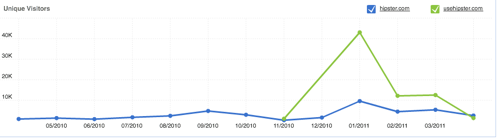
As you can see from the Compete stats (posted below), it appears that a significant percentage of traffic that appears intended for Hipster ends up on Hipster.com in error. Of course, they aren’t likely to be confused, but why chance losing any traffic when they now have some funding to purchase the name.

January 2011: UseHipster.com – 43,097 Hipster.com – 9,643
February 2011: UseHipster.com – 12,193 Hipster.com – 4,481
March 2011: UseHipster.com – 12,595 Hipster.com – 5,378
April 2011: UseHipster.com – 1,375 Hipster.com – 2,559

My opinion is that Hipster should use some of its funding and purchase Hipster.com. What do you think?

Domain Negotiation Tip: Justifying Your Offer

When you are in the midst of negotiating to purchase a domain name on Sedo, one of the prefabricated replies you can select is something like “justify your price.” It’s always made me laugh a bit to see that reply, but when you think about it, justifying your offer or price is a great way to get the price you need.

Oftentimes when I am negotiating with a buyer or seller, the price we both have in mind is different. For times when the price gap is significant, there’s usually little reason to engage in a discussion. Why waste time on a name I want for $2-4,000 and the seller wants $100,000. Either he’s crazy and/or doesn’t need the money, or I am not as enamored with the name as he. Whatever the case, it would likely be a fruitless discussion.

However, there are times when we are just a few thousand dollars away from a mutually agreeable price, and the actual negotiation is critical in getting the price I want/need for the domain name. Discussing why you value a domain name the way you do can lead to you getting your pricing, or at least seeing the flip side to why the name is worth more or less to the other party.

One thing I like to include in my negotiation strategy are favorable comps (using DNSalePrice.com, DN Journal, or NameBio.com). By favorable, I mean that the names have similar results in Google, similar search volume, and are in the same vertical (ie: two real estate domain names).  It helps if you have more than one comparable and they are recent comps.

Another thing I include is information about developing the website. When I am the buyer or the seller, I let the other party know my plans with the domain name and why I think it’s worth what it’s worth. I give them a bit of insight into my development plans and justify why I can’t offer more money or offer to sell it for less money.

I know that some sellers get annoyed when a buyer asks them to justify the price, but I think it’s a good way to discuss a domain name’s value and possibly come to terms.

What types of things do you discuss when you’re trying to buy or sell a domain name to bridge the gap?