

Skill.com UDRP Denied

When the Skill.com UDRP filing was published, John Berryhill shared some thoughts on why he thought the UDRP would fail. His analysis was based on information that he was able to find publicly, so there was a chance additional information would be revealed that would change the perception of the filing.

Yesterday afternoon, I noticed WIPO updated its website to show that a decision had been reached in the UDRP. I was very surprised to see the decision was a “Transfer,” particularly since there were three panelists deciding the case:

France.com, Inc. Files UDRP Against France.com

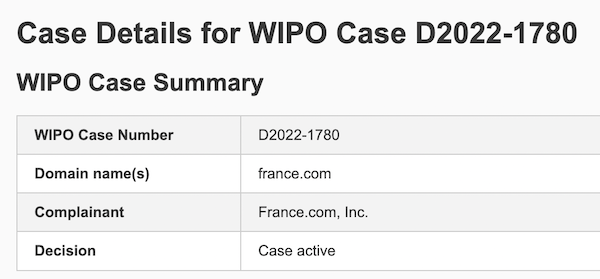
The battle over the France.com domain name was fought in a variety of legal settings, and it appears to be headed to another venue. A UDRP has been filed against France.com at the World Intellectual Property Organization (WIPO). It is WIPO Case D2022-1780.

The complainant in this UDRP is France.com, Inc. The current registrant of France.com is the French government. France.com currently forwards to the France.fr ccTLD, which hosts a tourism-focused website related to the country of France.

RDNH Finding without a Response to UDRP

I think having a good life is the goal for most people. Who doesn’t want to have a good life? A UDRP was filed against the generic-sounding GoodLife.com domain name at WIPO. Unfortunately, seeing a UDRP filed against a valuable domain name like GoodLife.com is not a surprise. The UDRP decision, however, was surprising to me.

For whatever reason, the domain registrant did not file a response to the UDRP. Generally speaking, this does not bode well for the registrant because the complainant can say what it wants without a rebuttal from the registrant. In this UDRP proceeding, not only did the complainant lose, but the panelist ruled this was a case of Reverse Domain Name Hijacking. The UDRP panelist on this case was Assen Alexiev.

The UDRP was unsuccessful because the panelist found the domain name was not registered and used in bad faith. This is a requirement of the UDRP to succeed. Here’s what the panelist wrote in that section of the UDRP:

John Berryhill Shares Thoughts About ENS TM Infringement

3

John Berryhill is an Intellectual Property attorney who specializes in domain name law. Last night, John posted a Twitter thread regarding trademark infringement, specifically related to ENS domain names. In the thread, John shared some thoughts about the potential issues that may come with owning ENS domain names that infringe on trademarks and brands.

Obviously, every domain name is unique, and there may be unique circumstances related to each domain name registration. Reading John’s thread would be a good idea for people who own ENS domain names that could potentially match well-known brand names and trademarks:

Don’t Like the Mohu.com UDRP Decision

7

ICANN just closed its comment period related to an ongoing analysis of the effectiveness of the UDRP, and the ICA submitted a well-reasoned comment. With that in mind, I want to highlight a UDRP decision that was just published. The UDRP was filed against a valuable 4 letter brandable type of domain name that can be pronounced and is also an acronym – Mohu.com.

Mohu.com is registered to a China-based domain registrant who responded to the complaint and requested a finding of Reverse Domain Name Hijacking. The sole panelist, David P. Miranda, Esq., ruled against the respondent, giving this valuable domain name asset to the complainant. In my opinion, based on what I read in the UDRP filing, this decision was wrong and is completely unfair to the registrant.

According to the decision, here’s some background information about the domain registrant (the bolded emphasis was added by me):

Panels Should Consider RDNH Even if Not Requested

2

A National Arbitration Forum panel presided over a UDRP that was filed against the CyberGuard.com domain name. CyberGuard.com is owned by McAfee, the global computer security company. For whatever reason, the CyberGuard.com domain name does not resolve to a functioning website.

Not surprisingly, the sole UDRP panelist, Terry F. Peppard, ruled in favor of McAfee even though the company did not respond to the UDRP. While the decision was on point, I think the panelist should have taken it upon himself to rule that the filing was a case of Reverse Domain Name Hijacking (RDNH). It does not appear that RDNH was even considered by the panelist.