Razorbacks.com: Legitimate Use of a Trademark Term

I pay very close attention to UDRP filings on generic domain names. I receive a daily email with UDRP decisions and frequently visit the NAF and WIPO websites to see what UDRPs have been filed. Oftentimes, the complainant feels the domain owner is infringing upon its trademark rights by displaying advertising of related products or services, as was the case with Dolphins.com.

However, there are plenty of UDRP filings that are overreaching, and I am happy to see the panelist(s) deny the complainants attempts. Today, I received the WIPO UDRP decision for Razorbacks.com, filed by Board of Trustees of the University of Arkansas of Little Rock, Arkansas, whose sports teams are known as the Razorbacks.

The owner of the domain name first registered the name in 1995, and the University contacted him about it several years later, in 2003. In the response, the University claims it sent the owner a cease and desist letter and also claimed that the domain owner owns the .com domain names of several college sports team brands, including Aggies.com (Texas A&M), Badgers.com (University of Wisconsin), Wolverines.com (University of Michigan), and Terrapins.com (University of Maryland).The domain names are and were used for vanity email addresses.

The three member panel found that the domain name was identical or confusingly similar to the complainant’s trademark, which is pretty clear. When the panel looked at the issue of Rights or Legitimate Interests in the domain name, they referred to other UDRP cases where vanity email addresses were considered a legitimate offering of goods/services. In addition, the panel cited the “multiple alternative uses of the term “razorbacks,” and they concluded that the could not side with the complainant on this matter. As a result, the complaint was denied.

Owners of similar generic domain names should note that the panelists did not say that the use of vanity email addresses on a domain name is reason enough to deny a complaint. In addition, the panelists made it clear that this could be a case for a court to ultimately decide, stating “Whether Complainant would have more success in a court of law, where evidence may be fully developed and examined through the use of discovery, interrogatories and other forensic processes and where standards other than those of the Policy may be applied, is not for this Panel to say.”

Whether University of Arkansas decides to pursue this through the court system is something we may learn about in the future, but for now, it’s good to see a panel deciding a case on its merits and not making assumptions about a domain owner’s intent.

(Razorbacks image courtesy of Wikipedia)

Domain Investors Need to Take Better Care of Valuable Domain Names

28

In April of 2008, Jay Westerdal announced that his company had the exclusive sales listing for the generic domain name Harmony.com, and the reserve price was $5,000,000. I don’t recall seeing whether the domain name was sold or not, but I just saw that a UDRP was filed at NAF for Harmony.com on November 12, 2009 (Case #1292225).

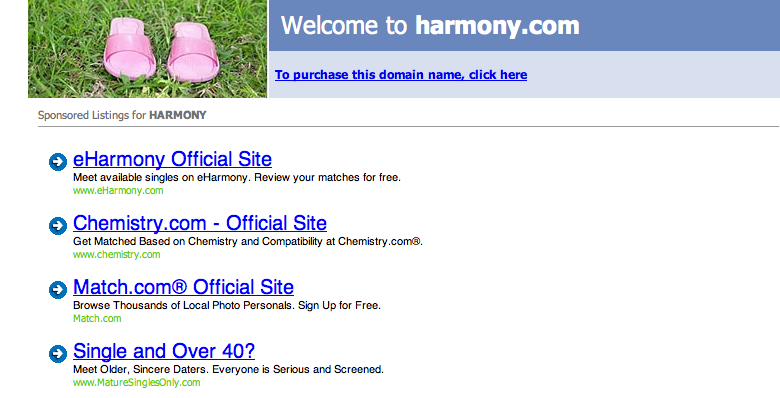
Since the NAF doesn’t list the Complainant yet, I can only guess it is the parent company of eHarmony.com who would file a complaint, as they seem the most likely to want the domain name. At first, it would seem like a company is making a grab at this great generic domain name, but if you take a further look at the parked page, it looks less like that. Not only is there a link to learn about purchasing the domain name, there are also dating site links, including one for eHarmony.com. This was just on the main landing page, without even having to do a search to influence the results.

Harmony.com Screenshot

I believe this is similar to a recent case involving Dolphins.com, where the owner had football-related PPC links, and the Miami Dolphins filed a UDRP for Dolphins.com. Although the domain owner does have very limited control over what content is displayed on parked page, owners need to be very careful not to put their valuable domain names at risk.

In a UDRP, a trademark owner needs to prove three things: 1) the complainant has a trademark right that is identical or confusingly similar to the domain name in question, 2) the domain owner has no right or legitimate interest in the domain name, and 3) the domain owner registered and used the domain in bad faith.

Sure, virtually any company can file a UDRP for any domain name they would like (as we’ve seen many times with cases like Pig.com for example), but we shouldn’t make it any easier for them to use the UDRP process to acquire domain names. Harmony.com is a good generic domain name, and it will be interesting to see how this plays out.

Don’t Mess with Verizon, Motorola, and Lucasfilm

Just about every time a big company announces the launch of a new product, people buy related domain names for a multitude of reasons. Some buy them with the hopes of selling them to another company, others want to capitalize on potential popular typos, and yet others want to offer services, forums, special offers or other information related to the product.

On November 8th, Verizon Wireless began selling the Motorola Droid, a new smartphone that has had a whole lot of positive press and reviews. I’ve seen dozens of commercials for the Droid (if not more than dozens), and they seem to be directly taking on the iPhone and other smart phones. Needless to say, the Droid will be in high demand, and people will think they can make money by buying and selling Droid domain names.

However, with this particular trademark, you really need to be very careful of the usage of related domain names. On the bottom of Droid-related pages on Verizon Wireless’ website, there is a legal notice, “DROID is a trademark of Lucasfilm Ltd. and its related companies.”

By registering domain names with the term “droid” in it, you will probably be stepping on the feet of Verizon, Motorola, and Lucasfilm. Keep this in mind in the event that you think you might be able to make money with this mark. Obviously there are way to use “droid” in a domain name without potential liability, but I am sure there are plenty of people who don’t realize the risk of owning these with the intent of profiting off of the Droid mark, by selling, parking, or otherwise monetizing phone-related Droid names.

See WIPO UDRP Cases as They Are Filed

7

Although I generally learn about UDRP cases after the decisions are made, I occasionally look through all of the WIPO UDRP cases that have been filed. The World Intellectual Property Organization, which oversees UDRP cases, lists all of the cases filed by year, and it provides a status update next to each case – from pending through decided and everything in between. This is in addition to being able to search for cases by domain name, complainant, and respondent.

One reason I monitor filings is to stay ahead to see if there are certain companies that are aggressively and/or over aggressively protecting their brands. I particularly pay attention to geodomain names, acronym domain names (2 and 3 letters and 2 and 3 numbers), and other generic domain names. Whether or not a majority of these cases are awarded to the complainant doesn’t really impact my reasoning for monitoring. I watch them to proactively protect my domain names and be mindful of certain companies when making future acquisitions, because a UDRP defense can be expensive and can only negatively impact the value of a domain name.

Below are recent UDRP filings for seemingly generic domain names:

Hostess.com – filed by Interstate Bakeries Corporation

QUE.com – filed by Plastic Logic, Inc.

ENX.com – filed by ENX (European Network Exchange) Association

WiFiParis.com – filed by Ville de Paris

MID.org – filed by The Royal National Institute for Deaf People

Domain Contracts Can Be Critical

I had a situation last week where I wanted to close on a domain name, but the seller had concerns about the domain sales agreement I sent. Since I use a standard domain agreement I had created by a domain lawyer based in New York, I was a bit taken aback by his concerns. I thought about it for a few minutes and realized that I may have been the same way had someone random offered to buy a domain name I owned and then sent over a two page legal agreement for me to sign.

I explained to him the different sections of the agreement, which included a section discussing the cost and payment terms, a section where it states that the domain name isn’t encumbered and/or had no trademark issues, a confidentiality clause, and other standard contract sections. I even explained that when he buys a big ticket item like a car or television, and even when he checks off a box of terms and conditions when registering a domain name, he is signing a contract.

In the end, I opted to move forward without the agreement rather than kill the deal. I was able to determine he was the original registrant 12 years ago (only able to see Whois history dating back to 2001), and everything matched up. Since I paid via Escrow.com and it’s a generic name, there were no special details added to the standard agreement.

On deals where certain conditions need to be met, it’s very important that a contract is used to protect both buyer and seller from any legal troubles that may arise down the road. It’s important that both parties’ expectations are laid out in the agreement, along with the ramifications if terms aren’t met. Rick had a post about his Property.com deal this morning, and you can see why an agreement can be very important, especially when it involves more than a domain sale.

I recommend using a sales agreement on most deals that you do, especially because you can re-use a boiler plate agreement that you paid for once. A standard domain sales agreement is one tool that is good for you to have on hand, and it isn’t very expensive to have created for your business.

Bloggers Now Held to Higher Standard by FTC

3

The US government’s Federal Trade Commission has changed the guidelines for bloggers (and celebrities) who write paid reviews or offer endorsements, and I think this is a very good thing for people who read blogs. Bloggers now must reveal whether they were compensated for a product or service review found on their website, which is similar to disclosures companies need to make in advertisements. If they fail to do so, they could receive significant fines.

According to the Federal Trade Commission’s revised Final Guides Governing Endorsements, Testimonials:

The revised Guides also add new examples to illustrate the long standing principle that “material connections” (sometimes payments or free products) between advertisers and endorsers – connections that consumers would not expect – must be disclosed. These examples address what constitutes an endorsement when the message is conveyed by bloggers or other “word-of-mouth” marketers.

I can’t recall a time when I wrote a paid review on behalf of a company, although I have turned down several requests. On occasion, a company will offer services (development services for example) in exchange for a mention on my blog, but I generally refrain from providing any opinion in those posts.

When I do provide an opinion, it is based on my actual experience rather than simply writing a glowing report in exchange for a fee. My blogging goal has always been to be helpful to others, and if there’s ever a time when something is written and I am compensated, I will certainly disclose it to you. I also want to add that when a person or company does exceptional work or goes above and beyond on a project for me, I want to let people know about it.