



New Report: Domain Name Dispute Stats Reveal Concern Over Panelist Appointment

2

The following is a guest post written by Zak Muscovitch, a noted Canadian attorney who has practiced domain name law for ten years. The Muscovitch Law Firm is located in Toronto, Canada.

The WIPO and NAF perform an important service to the trademark and domain name communities. Of course, as a domain name lawyer, I generally sympathize more with the domain name owner’s than with trademark claimants and am often critical of various UDRP decisions. Having represented domain name owners before the WIPO and NAF for over ten years, I have become acutely aware of deficiencies of the ICANN-mandated process. Chief amongst these is the single-panelist selection process.

Most UDRP’s are handled by a single panelist. Cases are not decided by three-person panels unless one of the parties pays an additional fee. When this happens, which is relatively infrequently, it is usually the Respondent domain name owner that requests and pays for the three-person panel.

Three-person panels are viewed as generally reaching a more balanced and fair decision. This is likely so because in three-person panel situations, each party gets to nominate panelists to serve on the panel. The parties are therefore able to include panelists that they feel have a fair-minded track record based upon previous decisions that they have made.

In the case of single-person panels however, the panelist is appointed solely by the Dispute Resolution Provider (chiefly the NAF and WIPO). Panelist selection is hugely important, as panelists have very differing views on domain name law and the UDRP. For example, some have recently adopted a radical re-interpretation of the UDRP dubbed the “Unified Concept” which purports to find bad faith registration retroactively. Others have a dramatically different view and uphold the traditional approach that requires UDRP complainants to prove bad faith registration at the outset of the disputed registration. Moreover, some panelists have a history of panel decisions that are widely criticised as being unsupportable and clearly wrong, even sometimes being severely chastised by appeals courts.

Accordingly, the personality and approach of individual panelists is of paramount importance. That is why I and other domain name lawyers, and even panelists, have been concerned about the process employed by Dispute Resolution Providers such as the NAF and WIPO, in unilaterally selecting the person to hear single-panelist cases. There is no express provision that the appointment must be random however many observers and practitioners expect and understand that the process is random, or at least believe it ought to be random.

The NAF has about 141 Panelists on its roster. After examining case-related data obtained directly from the National Arbitration Forum’s own web site, it was determined that certain panelists were appointed to hear a surprisingly large number of cases. The concentration of panel appointments was apparent after the data showed that, for example, that a particular panelist presided in approximately 966 cases, the vast majority of which were single-panel cases wherein she was appointed by the NAF and not nominated by any party to the arbitration. This represents nearly 10% of the nearly 10,000 such domain name dispute cases heard by NAF, which is a clearly disproportionate amount if cases are or ought to be randomly distributed to the 141 NAF panelists on the roster. If you would like to take a look at the short study, you can read it here.

I think that the NAF and WIPO, with the guidance of ICANN, should review the process for single-panelist selection and require random selection and specifically outline the random selection process so that there is some transparency in this important task.

Furthermore, WIPO decisions receive far greater attention and scrutiny than NAF decisions, and I believe that is because only WIPO sends out daily emails with updates on newly minted cases. Accordingly, to stimulate greater discussion and scrutiny of NAF cases, I have created a daily email service which will provide a link to all new decisions since the last email update. Sign-up is free and is available at http://www.DNattorney.com. Hopefully NAF will create their own email update service and my own will no longer be necessary.

Involuntary Chapter 11 Petition Filed Against Escom, LLC – Owner of the Sex.com Domain Name

6

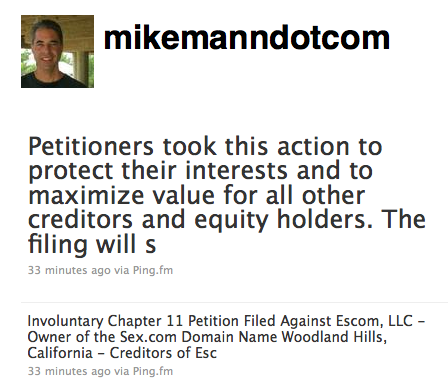
I just received an email from regarding the Sex.com domain name, which had been scheduled to be auctioned tomorrow morning in New York City. According to the email sent to me, legal action has been filed, and the domain auction will apparently not take place as previously scheduled as a result. The news was released by Mike Mann via Facebook and Twitter (see screenshot below).

Here’s the news release that was sent to me:

Woodland Hills, California – Creditors of Escom, LLC (“Escom”) today filed an involuntary Chapter 11 bankruptcy petition against Escom in the United States Bankruptcy Court for the Central District of California (San Fernando Valley Division).

Petitioners took this action to protect their interests and to maximize value for all other creditors and equity holders. The filing will stay the public auction foreclosure proceedings previously scheduled for March 18, 2010, which petitioners believe would have diminished the value of Escom’s assets.

For more information, please contact:
Lawrence Morrison, Esq.
Meister Seelig & Fein LLP
(212) 655-3582

Why It’s Bad Not to Respond to UDRP

7

A few days ago, Mike Berkens reported on the UDRP decision for 7Days.com, a decision that went in favor of the complainant. The owner of the domain name did not file a response to the UDRP, so he couldn’t present his case for ownership. I think not responding to a UDRP is bad for a couple of reasons (unless you are advised by a legal professional that not responding would be in your best interest).

First, you don’t have an opportunity to defend your ownership of the domain name. You’re letting the complainant make its case and aren’t able to rebut its complaint. If the submitted evidence is enough for a panelist to make a decision in favor of the complainant, you could lose the case pretty easily.

The second reason may be less obvious but could pose a future threat to your business. Not even considering that a UDRP loss can be used by a future complainant to show bad faith on other domain names, it could also show others that you are a sitting duck. A non-response could encourage other companies to file UDRP cases for other names you own, believing you may not defend your rights to own other domain names, possibly making their chance better.

Whether you decide to hire a lawyer or not is your decision to make based on the strength of your case, value of your domain names, and/or financial situation, but I don’t think not responding is for the best (unless under the advice of an attorney, which I’ve heard about). If you don’t care enough about your domain name to defend it, perhaps you can just give the name to the company to get them to withdraw the UDRP.

WebQuest Files Lawsuit Over Hayward.com

6

A couple of weeks ago, Hayward.com was awarded to the complainant, Hayward Industries in a UDRP decision. It comes as no surprise that the owner of the domain name, WebQuest.com, Inc, filed a lawsuit to retain this geographical domain name. The lawsuit was filed yesterday in the Fresno office of the California Eastern District Court.

Lawsuits may be expensive, but they are necessary when it comes to asset protection. Companies should realize that while a UDRP may seem like an inexpensive and cost-effective way to take possession of a high value domain name, a favorable UDRP decision will almost certainly end up in court, where both parties will need to engage in an expensive legal battle.

Thanks to George for the tip.

Domain Name Lawyers

31

Whether or not you’ve ever been involved in a lawsuit, had a UDRP filed against one or more of your domain names, received a cease and desist letter, or had another domain dispute situation, knowing a good attorney that is familiar with domain names and intellectual property law is critical. Likewise, when you are involved in large deals/transactions, need legal advice for your business, or need a terms of service created for a website, having a good lawyer is imperative.

There are a number of exceptional attorneys who have expert knowledge about domain names and the law regarding domain names. I have used a couple of the attorneys listed below, and I have heard good things about the others. Simply because someone is not listed doesn’t mean anything negative about that person or firm, it just means I don’t know of the firm/lawyer or forgot to add that person. You can also learn more about why it’s helpful to use a domain name lawyer in the domain investing guide.

In the event that you need legal advice in the domain space, the attorneys below may be able to help you (in alphabetical order):

“Are Geodomains Worth Less in Light of UDRP Decision?”

Shortly after Mike Berkens posted his article about the Hayward.com UDRP decision going against the domain owner, I received an email asking me, “are Geodomains Worth Less in Light of the Hayward.com UDRP Decision“? In my opinion, the quick answer is that city .com names are almost certainly not worth less and some general (non-legal) feedback is below.

Just like almost every other dictionary word/term has a corresponding trademark owned by a company, geographic locations also share their meaning with companies that have marks. For instance, an apple is a fruit and a generic term, but Apple is also a trademarked brand owned by a computer company. In the case of Hayward.com, Hayward is a city in the state of California, but it is also a term used by a pool company.

If I owned Apple.com, I could certainly sell apple juice, apple pies, and apples. However, if I started selling computer parts, cell phones, or even music, Apple Computer would probably sue me or file a UDRP. Unfortunately for the owner of Hayward.com, when he parked it, the name allegedly had “links offering or leading to pages with links offering goods or services that are competitive with the goods and services offered by Complainant under its HAYWARD Trademark.”

In light of this alone, I really don’t think city .com domain name values are impacted. I can only think of a few that are parked right now, and for the most part, the parked domain names are only parked while awaiting development. I don’t think a lack of development should be construed as bad faith, although a number of UDRP cases have determined that non development and non use can be a strike against the domain owner.

In my opinion, this decision is poor since PPC pages can accidentally show advertising that may infringe on another company’s mark, but I don’t think that necessarily means it was done in bad faith. I know the owner owns other geodomain names, and I don’t believe he intended to monetize it based on another company’s trademark. I do think this case should make geodomain owners cognizant of the fact that parking can put their domain names at greater risk, but I don’t believe it impacts the value (just try buying some city .com names and see the responses you get if you send a low ball offer).

I would be remiss if I didn’t mention one thing that really bothers me in this decision. According to the discussion from the panelists:

Respondent purchased the domain name <hayward.com> for USD$20,000 and was attempting to sell it for at least USD$100,000.   These figures would seem to indicate that Respondent saw some value in this domain name for reasons other than its existence as the name of the city of Hayward, California – with a population of only about 150,000 people, according to the city’s website at http://user.govoutreach.com/hayward/faq.php?cid=10774 – and for purposes other than as a PPC parking page (which, in the normal course, would not be expected to earn a return to justify such a rich investment).

I paid a lot more than $20,000 for a smaller city .com domain name. In fact, I bought and/or sold 4 geodomain names for over $50,000 (two of them for significantly more) in the last 18 months. There is considerable value in geodomain names, especially when they are developed. My primary concern is that these UDRP panelists made an opinion that does not appear to be based on facts or public comparables.

Would I have paid $20,000 for Hayward.com for a city website? Probably. In fact, I sold a comparable California city .com domain name (just under 150,000 residents) for over $65,000. Similarly, my company owns Burbank.com and I previously turned down a cash offer of over $110,000 for it, and Burbank, California is a city with just over 100,000 residents.

I don’t see how UDRP panelists can say that the owner could not expect to return the rich investment of $20,000 for Hayward.com, and more importantly, I don’t think it’s appropriate for panelists to make valuation estimations. In this case, it seems to me that their valuation of city .com domain names is flawed.