



Legally Co Files UDRP Against Legally.com (Updated)

A company called Legally Co filed a UDRP against Legally.com, a one word .com domain name. The UDRP was filed at the World Intellectual Property Organization, and it is WIPO Case D2018-1958.

Legally.com is a domain name owned by GoDaddy’s NameFind portfolio company. From what I can see, this dictionary word .com domain name appears to have a (reasonable) buy it now price of $24,999. Using DomainTools’ Whois history tool, it appears that Legally.com was acquired when the company purchased a large group of domain names from Tucows’ YummyNames portfolio. Legally.com has an original registration date of July 1997, making it over 20 years old.

The complainant in the case appears to be the company operating on the Legally.CO domain name. Assuming this is the company that filed the UDRP, LinkedIn lists its founding date as 2015. There are quite a few companies that are branded “Legally” or that have the “Legally” keyword in them, so it could conceivably be another company with the same name. In fact, a DomainTools search shows thousands of domain names registered with the “legally” keyword in them.

In order to prevail in a UDRP, a complainant will need to prove the domain name was registered and is being used in bad faith. Considering that GoDaddy

Vincle.com UDRP Decision Cites PPC Parking

3

The Vincle.com UDRP decision was published this morning, and the complainant won the proceeding. The domain name has been registered by the respondent since 2003. The respondent’s response to the UDRP was late due to travels, but the panelist stated the response was not prejudiced by the tardiness.

In the decision, there was a discussion about whether or not the “vincle” term was generic and whether or not there are other companies using the term “vincle” in their branding. From what I can tell, the panelist was not convinced that the term is generic.

The most notable aspect of this UDRP decision is the panelist’s discussion about pay per click parking:

“In view of the above and since the disputed domain name is pointed to a parking page with sponsored (pay-per-click) links which, by definition, generate revenues for the registrant and/or the registrar, the Panel does not find that the disputed domain name is being used in connection with a bona fide offering of goods or services, or for a legitimate noncommercial or fair use without intention to trade off the Complainant’s trademark.”

Later on in the discussion, the panel also wrote the following:

Complainants Winning More at WIPO Each Year, But…

Earlier this morning, I published a poll asking readers about the results of UDRP proceedings to gauge if readers think outcomes have recently been shifting more in favor of domain investors when it comes to valuable (generic / acronym) domain names. So far, it looks like approximately 2/3 of readers who voted in the poll believe domain registrants are faring better now than they did in prior years.

I did some researching using DNDisputes.com, and I was able to find some facts about how UDRP results have changed over the years at the World Intellectual Property Organization (WIPO). WIPO is the largest UDRP provider, and DNDisputes.com primarily archives decisions from WIPO.

Using DNDisputes.com, I shared the percentage of complaints denied (meaning the domain registrant won) since 2008:

Anything.com Defends Sante.com in UDRP with RDNH Finding

2

Anything.com successfully defended its Sante.com domain name in a UDRP that was defended by Jason Schaeffer of ESQWire.com. The UDRP was filed by an entity called LOGOCOS Naturkosmetik AG at the Czech Arbitration Court (CAC). The UDRP resulted in a finding of Reverse Domain Name Hijacking (RDNH).

Anything.com owns a large portfolio of keyword domain names, including domain names like Medicine.com, Manager.com, Favor.com, Public.com, and a large portfolio of valuable 3 letter .com domain names. Anything’s portfolio is easily one of the top ten domain portfolios based on the quality of its generic domain names.

The word “sante” means “health” in French, so it would seem perfectly fine for a domain investor to own Sante.com. The complainant in this UDRP owns the Sante.de ccTLD domain name, and it is clear why it would want the better .com domain name. Apparently, it opted to file a UDRP instead of buying the domain name from the registrant.

There is some good language for domain investors in the UDRP decision. I highlighted a few excerpts with additional commentary:

Prince Estate Files Suit Over Prince.com Domain Name

8

According to a news report in the New Jersey Law Journal (found via Law.com), the estate of the late musician known as Prince filed a lawsuit to try and get the Prince.com domain name. According to the article, “The suit claims that the company’s ownership of the domain violates §43(d) of the Lanham Act because it represents a bad-faith intent to profit from association with the artist, who died at age 57 in 2016.”

The lawsuit is targeting Domain Capital (an advertiser on DomainInvesting.com), a company that offers various financing options for domain owners. Here’s what seems to have been the impetus for the estate of Prince to file the lawsuit, according to the Law.com article:

“According to the complaint, Domain Capital represented to the estate in a May 9, 2018, letter that it owns www.prince.com pursuant to a lease-back financing agreement with an unnamed third party. Domain Capital said in the letter that it leases the domain back to its previous owner so that party’s identity may be shielded from the public, the complaint states.”

I visited Prince.com this morning, and the domain name did not resolve. The Law.com article states that “Domain Capital has not used it in connection with any offering of goods or services, according to the plaintiffs.”

In August of 2010, DNJournal reported that the Prince.com domain name was sold for $235,000 via Media Options. That sale ended up being the 35th largest publicly reported domain name sale of 2010. From my vantage point, Prince.com is so valuable because of the generic nature of it, as evidenced by the thousands of trademarks in the USPTO containing the word “prince” and the likely tens of thousands of companies and brands with “Prince” in their name.

I am more familiar with the UDRP process than a Lanham Act lawsuit, but Prince.com seems like a generic domain name to me. I am familiar with two large companies called Prince, including Prince (the tennis and sports company) and Prince (the pasta company). According to Wikipedia, there are also quite a few other companies called Prince as well as people with that last name and/or nickname. Obviously, “prince” is also a meaningful word – for instance Prince William and Prince Harry are two famous princes.

The Prince.com domain name has been the subject of prior legal disputes. In what I believe could be called a landmark case, Prince Sports Group, Inc. tried to wrest control of Prince.com from a British company called Prince plc but was unsuccessful. Here’s what was

Playboy Going After Centerfold Domain Names (Updated)

It looks like Playboy Enterprises is going after a few domain names with the word “centerfolds” in them. The company filed three separate UDRPs at the World Intellectual Property Organizations to try and wrest control of the following three domain names:

Centerfolds.com (WIPO case #D2018-1457)
PlayboyCenterfold.com (WIPO case #D2018-1455)
PlayboyCenterfolds.com (WIPO case #D2018-1456)

I would imagine the company will have a pretty decent shot at winning the later two UDRP cases considering they have the “Playboy” brand name in them. Obviously there could be mitigating circumstances, but PlayboyCenterfolds.com was just registered in April of this year and PlayboyCenterfold.com currently seems to utilize a zero click parking lander that seems to forward traffic elsewhere.

The UDRP for the Centerfolds.com domain name will be interesting. Whois records show that this domain name was created back in 1995, making it over 23 years old. When I tried to see how Centerfolds.com is being used, the domain name did not resolve for me.

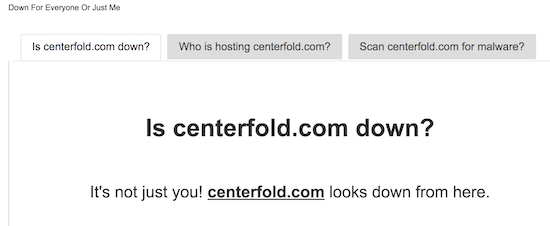
The singular Centerfold.com domain name is owned by Playboy. It does not appear to be resolving for me, and a check on DownForEveryoneOrJustMe.com confirms that it is down.

According to Wikipedia, the centerfold “term was coined by Hugh Hefner, founder of Playboy magazine.” From what I can see using the USPTO TESS search, there are