Subscribe

What is a Domain Appraisal Scam?

49

I have received a number of emails from readers asking about offer emails they receive that seem fishy. Many times, these offers are domain name appraisal scams. These scams come in a variety of formats, but each has the same objective – getting the domain owner to pay for a domain appraisal when he thinks a potential buyer is interested in purchasing a domain name.

Typically the email offer will be for a domain name, and the scammer will suggest getting an appraisal for the domain name. Usually the scammer will tell the domain owner he is willing to pay either the amount of the appraisal or a percentage of the appraisal, depending on the email.

The email will list a few domain appraisal websites, one of which may be either owned by the scammer or a commission is earned for appraisals. The scammer generally has a 33% chance the domain owner will choose his appraisal service (probably much more considering the price comparison of the appraisals). After the domain owner pays for the appraisal, hoping to close a deal, the scammer is never heard from again.

While these scams probably aren’t illegal, I call them scams because the emailer probably didn’t intend to buy the domain name – just to get the domain owner to buy a domain appraisal.

More info with examples can be seen on these sites:

DNForum

Namepros

Domain Name Wire

Defensive Domain Registration Advice

Many companies defensively purchase typos and alternative extensions to prevent others from owning them. Defensive domain name registrations aren’t simply for brand protection though. They can also be done to ensure a company prevents another similar company from entering a newly created industry or niche using the type of product as the company’s brand or website.

I spent a couple of hours at the New York International Gift Fair today, and among the hundreds of exhibitors, I saw a company that had a new type of product. This unique gift item may or not be a hit, but it certainly is a one of a kind product that can and will be knocked off by others. The .com of the product type is currently sitting unregistered, available for anyone to register for under $10.

While this product is not similar to door knockers, I will use   door knockers as an example. A few years ago, I saw a guy selling unique metal door knockers at the show. I forgot what they guy’s company was called, but when I was looking it up a few months ago for a friend, I was curious to find out who owned DoorKnockers.com. You probably guessed it… the guy who I saw at the show owns it. Smart guy.

Now back to this new product. I left the show intrigued about the product, but we weren’t convinced to buy it (for my parents’ business). We stopped by dozens of booths, so they are all blending together right now.   I Googled it, but the problem is the guy took a very common utilitarian product (hundreds of thousands of Google results), and he made it completely unique. Because of this, I can’t find his company when searching for the term.

I get that many companies want to have a unique brand rather than a generic industry term for the company name, but even if he simply registered this product .com name, he could at least prevent others from knocking his product off and owning the space online.

The takeaway here is that if you develop your own special type of product and the .com is available, register it. Even if you don’t want to set up a website, at least you can forward that to your brand’s website and prevent someone else from buying it.

What If a Domain Registry Shuts Down?

I saw a thread on a .Mobi domain discussion forum that posed the question, “When will dotMobi shut down?” I know discussions about certain domain extensions are always hot button topics, so I want to refrain from the discussion about specific extensions. However, I want to ask if you have ever considered what would happen to your domain names if a registry were to shut down? I’m not talking about a registrar like RegisterFly.com, but a registry that manages an entire domain extension.

Think this is far fetched? Apparently there were issues related to the company that operated the .Travel registry, and with the potential for a significant amount of gTLDs possibly forthcoming, I believe this will be an eventual issue that domain investors need to consider when purchasing domain names. John Levine discussed this in a blog post back in 2007:

“Given how small .travel is, the resolution is less important for what happens to this particular domain than for the precedent it sets. If ICANN ever comes through with all the new domain names they’ve been promising for the past decade, sooner or later some domain will do a bubble, get wildly successful while firmly cash negative, then run out of money and pop with a million registrants in limbo. That’ll be fun.”

I am in complete agreement with what Levine said above. I’ve received a number of press releases, Facebook fan page requests, and other emails indicating that there will a ton of new extensions. Some potential extensions right now include .horse, .eco, .sport, and even .zulu, mentioned by ICANN CEO Rod Beckstrom.   In my opinion, it is likely that there will be gTLD extensions that fail due to financial circumstances.

I don’t see a reason why anyone would want to operate a money losing registry, and this could happen if an unpopular gTLD extension is approved and it isn’t embraced by the public. This could be especially prevalent if consumer adoption of gTLD domain names isn’t as quick as many people hope.

When you buy domain names, have you ever considered what will happen if a domain registry shuts down due to a financial problem? This is another good reason for you to become knowledgeable about ICANN. Andrew discussed it before, I and I want readers to be aware of the potential issue.

Why Ask.com Needs Search Help

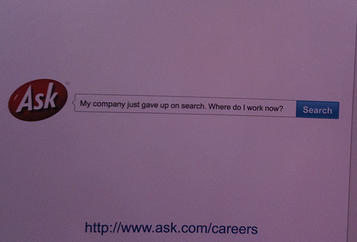
Ask.com Sign

I heard about Ask.com’s sign at SES San Jose, which was a humorous attempt to poach Yahoo Search staff, now that Microsoft’s Bing search engine will be handling the search technology for Yahoo. Of course, I did search Ask.com, using the advertised query My company just gave up on search. Where do I work now?

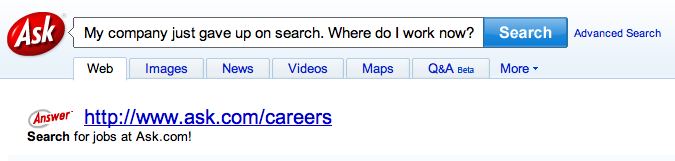
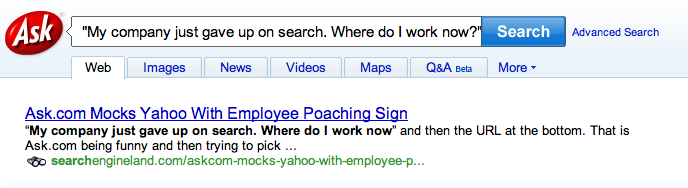
Smartly, the first result is for http://www.ask.com/careers. However, for some reason, the people at Ask.com didn’t think they needed to plant the top result for the exact same query, only with quotes around it, as I initially entered into the Ask.com search engine. When I typed in My company just gave up on search. Where do I work now?” the Ask.com career center was nowhere to be found.

Although many people probably didn’t copy and paste the quote into Ask.com with the quotation marks as I did, I am sure there were people like myself who did. Shouldn’t Ask.com have considered adding their Career Center link to all variations of the above search query?

Sometimes it’s not always about what is Asked, it’s about how it’s asked, and Ask.com fails on this.

Top Photo Source:

Ask.com top result without quotes:

Ask.com Results

Ask.com top result with quotes:

Ask.com Results

Verizon Wireless Story with Two Lessons

VerizonThis is one of my favorite stories I like to share with friends, and there are two takeaways from it. I’ve been a Verizon Wireless customer since 1994 or 1995. For years, I would never say I was a happy customer, but I was always fairly satisfied with the customer support and phone service I received.   I had phone issues from time to time, and I hated waiting on line for tech support in-store, but there was nothing really major.

Sometime around 2002, I had major issues with a new LG phone, and I knew a couple of friends who had similar issues. For whatever reason, the local stores wouldn’t take it back, and I was going to have to buy a new phone, in the middle of my contract, meaning I would have to pay full price. I was irritated and angry. I couldn’t understand why Verizon wouldn’t take care of a long-time customer, and I was frustrated that I would have to pay a few hundred dollars for a new phone (a lot of money for a grad student), or pay to cancel my contract and switch providers.

Using my search engine skills, I spent a few hours late one night trying to find the email contact information for any Marketing Executive at VZW who would could commiserate with my troubles. I found the name of an Executive, and I wrote a long email describing the troubles I was having. I apologized that I was contacting him since it wasn’t   a marketing issue, but I told him that as a student of Marketing, I knew it ultimately was hurting his brand if the customer service lacked.

This email was going to be my last resort, and if it failed to work or didn’t illicit a response, I was going to have to decide whether or not to sever my 7 year relationship with Verizon. Not knowing the Executive’s email address, I sent it to as many variations @verizonwireless.com as I could create. First Name.Last Name, Last Name, First initial.Last Name, FirstNameLastName…etc – probably 10-15+ emails. Nearly all bounced except one – success at 12:34 am! I went to bed feeling like I had given this a good effort.

At 7:40 the next morning, an hour or so before I woke up, an email arrived in my NYU inbox:

“Thanks for taking the time to write me re: your frustrations with your phone. Let me assure you that your lack of satisfaction is my business, whether it’s a marketing issue or not. Your allowing us the chance to make it right is fully appreciated.

I’ve copied [Name Redacted] our VP of Wireless Devices, on this message. I’ve asked have someone contact you directly to resolve this problem as soon as possible. You’ll hear from us within 24 hours.

Thanks again for your message. I hope we can rapidly restore your confidence in Verizon Wireless.”

Within just a few hours, I was in touch with the VP of Wireless Devices, who had already reached out to the local store, where I had been previously turned down. By mid-afternoon, I had a brand new phone and I was a very happy customer.

It’s been seven years since this incident, and I am a very happy customer of Verizon Wireless. Not only have I upgraded to a Blackberry with unlimited data and 900 minutes (up from a phone with 400+/- minutes), but my account has three other phones on it as well, and I am enrolled in the VIP program. On my phone alone, I’ve spent over $5,000 with Verizon. I was not surprised to hear that this Marketing Executive is now the Chief Marketing Officer of the entire company.

I think there are two lessons that can be learned here:

1) If you feel that you are not being treated as well as you should by a company, as a last resort, contact company executives and calmly explain the problem you are having. Don’t expect an answer, but hope for the best. If you don’t know the proper email address, do what you can to find it, and you are bound to be successful.

2) If you are a company executive, no matter how good your marketing strategy is, your customer service is equally important. If the sales process is great but a customer has a problem with even one customer service representative, your marketing dollars are wasted. You need to look at every company representative as a marketer. Every customer touchpoint should provide an equally good experience. Sometimes people who aren’t marketers need to think like marketers. It can take years to cultivate a good customer/brand relationship, but it can take just seconds to destroy it.

My relationship with Verizon probably would have ended seven years ago if it was not for great customer care from the top of the organization.


Private Whois on Domains in Auction

I just noticed a smart move that is being made by Moniker and wanted to share it with you. I listed another batch of domain names for sale on Snapnames a couple of days ago. I logged in to my account, and I didn’t recognize one of the domain names that had received a bid. Fearful that I mis-listed a domain name I didn’t own, I did a Whois lookup, which is quicker than logging in to my Moniker account.

I was immediately concerned when I saw that the registration was private. I rarely privatize my domain names, and I have private Whois for just a few that I prefer not to be spammed about (no, this domain name and website are not for sale!). I immediately logged in to my account, and sure enough, the domain name was in my account (phewwww)! It also indicated that I had not selected the Privacy Shield option.

I went back to the Whois check and I noticed the listing said “Pending Auction” and “Moniker  Privacy  Services.” This is a smart move to prevent unscrupulous individuals from contacting domain owners and attempting to usurp the auction process.

One suggestion I have for Moniker is to add a link to the auction somewhere. Although many Whois lookup services won’t be willing to link to a competitor’s auction, there’s nothing they can do if the Admin Name is “Pending Auction: http://www.snapnames.com/domainauction123.php.” This will allow people who search for a domain name to see where the auction is. At the very least, they should change the Registrant to “Snapnames.com Pending Auction.”