Network Solutions Proxy Emails Not Being Sent to Registrants

In order to email a domain registrant who has Whois privacy enabled at Network Solutions, people now need to send a message via the contact form found on the Network Solutions Whois search page. I learned this when I sent a follow-up email to a Network Solutions privacy proxy email address.

In September of last year, I tried to buy a domain name that is registered at Network Solutions. I sent an email to the domain registrant using the unique @networksolutionsprivateregistration.com email address. I did not receive a response. Yesterday, I sent a follow-up email using the current @networksolutionsprivateregistration.com email address, and I received an immediate auto-reply from the no-reply@networksolutionsprivateregistration.com email address notifying me of the change:

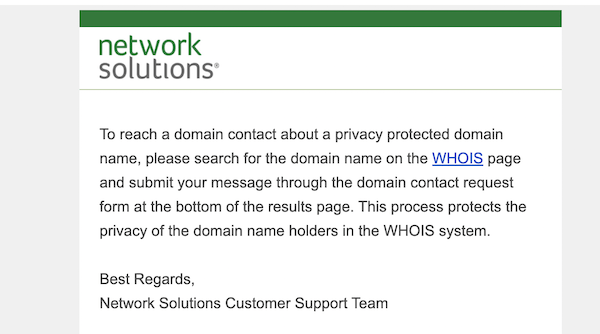
“To reach a domain contact about a privacy protected domain name, please search for the domain name on the WHOIS page and submit your message through the domain contact request form at the bottom of the results page. This process protects the privacy of the domain name holders in the WHOIS system.

Best Regards,
Network Solutions Customer Support Team”

I don’t recall ever running into this before, and a search of my email history for this type of email did not yield any results.

Network Solutions is not the only domain registrar that requires people to use a contact form to contact domain registrants using Whois privacy. In fact, I believe several registrars like Google and Tucows also have similar messaging when an email is sent to a Whois privacy email address.

When you visit the Network Solutions Whois contact form, there are two ways to reach out to make an offer for a domain name. On the right side, there is a link to use their “Certified Offer Service” to make an offer with the assistance of a broker. At the bottom of the page, there is a button to “Send a Message” to the registrant. Clicking this will produce a form with a drop down menu that has 3 short message options along with a message field.


Downside of Tweeting

If it wasn’t for this blog, I probably wouldn’t have much of a presence on Twitter. I would probably use my account to follow various accounts of interest – domain names, investing, news, sports…etc. I most likely wouldn’t spend time communicating via Twitter like I do now.

Because of my blog and Embrace.com, I spend a fair amount of time tweeting about domain names. Many of these tweets highlight notable domain name sales and domain name acquisitions. Not only do the tweets drive some traffic to my website, but they also help build the Embrace.com brand.

When I inquire about buying a domain name, I do so using my real name with my real contact information. Being transparent can help establish trust, and that is crucial in a negotiation. While some people may opt to not sell a domain name to a domain investor, I would rather a counter party know why I am buying a domain name rather than think I am a major corporation with unlimited funding.

Domain Extensions of Top 100 NFT Projects

Tyler Mason, Senior Director of Strategy and Advisory at GoDaddy Corporate Domains (GCD) put together a list of domain extensions used by the “Top 100 NFT projects” ranked by volume, and he shared it on his LinkedIn page last week.

With Tyler’s permission, I embedded his post with the graph and his commentary:

Tyler used CryptoSlam as the source of his ranking data and Icy.Tools for the website information. It should be noted that there are more than 16,000 NFT projects (and growing), so this is just the tip of the iceberg.

I case you can’t see the graphic, the top 5 most used extensions are:

I Was Unaware

Many people who want to buy a good domain name have no idea about domain name values. For this reason, domain investors receive countless lowball offers for their domain names. It’s an annoying aspect of the business, but I try to reply to everyone who inquiries about a domain name as a courtesy.

Over the weekend, I received a $50 offer for one of my one word .com domain names. It’s a name I’ve had for a while and have turned down many substantial offers. I replied to the prospect and explained the types of offers that have been received to show him just how far off his offer was. I also shared a list of publicly reported one word .com sales I track on Embrace.com.

Dharmesh Shah Comments on His $100k Acquisition

Sedo released its weekly domain name sales report yesterday, and the $100,000 sale of WordPlay.com was the largest public sale of the week on the platform. HubSpot CTO and Co-Founder Dharmesh Shah was the buyer of WordPlay.com.

I follow Dharmesh on Twitter, and like me, he is a big fan of the Wordle word guessing game that was recently acquired by the New York Times. Yesterday evening, I clicked one of his personalized Dharme.sh shortened url links related to Wordle, and I ended up on WordPlay.com. I recalled seeing the domain name on Sedo’s weekly sales list this morning and realized he was the buyer.

Domain Name Forwarding Doesn’t Mean Ownership

When one domain name forwards to another website, people often assume the forwarded domain name is owned or controlled by the operator of the destination website. While this is often the case for companies and businesses, it is not necessarily so. It can also be used in a deceptive manner.

Nat Cohen drew my attention to a tweet about an alleged scam involving domain name forwarding. The legitimate website operated on a non-.com domain name, and someone allegedly purchased the .com domain name for nefarious purposes. The .com domain name forwarded to the proper website, while email for the .com domain name was used for some sort of nefarious purpose. This was clever.


