Subscribe

Was Income.com Sold by Sedo Today?

7

SedoA few weeks ago, I learned that Income.com, a domain name owned by Internet entrepreneur and marketing guru John Reese, had been put up for sale and was being marketed by Sedo domain broker, Dave Evanson. According to a post on the Wicked Fire forum, Reese sent an email stating that Sedo “listed it at  $1MM but think they can sell it for more.”

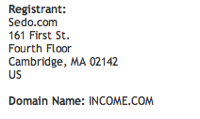
I have been monitoring the Whois for this domain name, and I just noticed a change in the registration this evening. Sedo is now shown as the domain registrant, which generally happens only after a sale has been consummated.

I can’t confirm that the domain name has in fact been sold, but it does appear that way to me. I have reached out to Evanson for more information, and I will post an update as soon as I hear back.

If Evanson did help sell the domain name, this would be his second huge sale in Q4, as he was the broker on the $750,000 Ringtones.com sale earlier this month.

Income.com Whois 12/20:

Income.com Whois 12/21:

Favorite Domain Story of 2010: Turning $10 into $1,200 into $151,000

8

It’s just about every domain investor’s dream to turn a relatively inexpensive purchase into a hugely massive profit, but the chances of that happening are very slim. This story played out earlier in the year, and it’s my pick for the story of the year in the domain business.

Earlier this year, ChatRoulette.com was one of the most popular new websites online. People could visit the site and video chat with others throughout the world. Millions of people visited the site, and the only thing that really slowed the growth was that many users apparently thought it was appropriate to turn their video feed into a softcore porno.

In December of 2009, a domain investor hand registered the domain name CamRoulette.com. Shortly thereafter, he sold the domain name in private to Adam Strong for a reported $1,200, reaping a huge profit margin on this hand registration.

The madness didn’t start there.

In March of 2010, Adam Strong listed the domain name at DomainConsultant.com’s Domain Madness auction, where it sold for an even more massive $151,000.

To make this an even more amazing story of riches, traffic to ChatRoulette has waned since hitting its peak earlier this year, and it’s likely that if the domain name had not been sold at the time it was sold, it would not have the same value today. It’s the stuff domain investors’ dreams are made of.

Every domain investor dreams of turning a hand registered domain name investment into a huge payoff. In 2010, this happened right in front of our eyes.

This is my favorite domain name story of 2010.

Afternic’s 5% Cash Back Offer Explained

As you’ve already seen, Afternic is now an advertiser on my blog, and someone asked me about the 5% cash back offer currently being promoted by the company.

Since I didn’t have an answer, I referred the question to Afternic, and here’s how the cash back program works when you sell a domain name using Afternic:

1)           List and park your domains with Afternic and use Afternic’s “for sale” link on your parked page

2)           Domains must be listed and parked for at least 14 days before being sold in order to qualify

3)           The domain must be sold through Afternic.

Once it is sold through Afternic, if the above criteria is met, you will receive 5% cashback on the sales fee. You can visit Afternic for more details about the program and to sign up.

How I Find Out Who Is Emailing Me to Buy a Domain Name

Knowing who you are negotiating with is very important when it comes to domain name sales. Although someone would probably be happy to sell a domain name for the price he or she asks, I am sure you would likely be disappointed to learn that a huge company bought it without revealing themselves, even the price you received was the highest they were willing to pay.

In light of yesterday’s article about Facebook buying a domain name apparently in a covert manner, I want to give you a few strategies I use to try and find out who is inquiring about my domain names, assuming it’s not a poor college student working on a thesis or a work at home mom wanting to start a website with no budget.

First thing I do is some research on the name of the person who sent the email. Oftentimes, the buyer uses a fake name, so the signed name doesn’t always help. You can use sites like LinkedIn and Facebook to do your due diligence and see where the person works if they use their real information. You should also review the Whois information for the domain name from which the email is sent if it’s not a public service like GMail, AOL, or Hotmail.

The next thing you can search is the IP address from which the email came. This generally isn’t very helpful because there is limited information available, but you can compare it to other IP ranges on past emails for the same domain name. If you have received emails from different people at the same IP, you can at least know they are connected.

If this fails, you can search other domain registrations, the US Patent and Trademark Office, and general Google searches for the term used in the domain name. This may reveal who would be interested in buying the name so you can narrow it down.

One very good way to find out who is inquiring is to ask for a phone number. Whether you are comfortable negotiating on the phone or not is up to you, but you can research the phone number ownership on a site like WhitePages.com. Additionally, if it’s a small or medium sized business and the owner gives you his or her number, you might get a match when searching Google, and the business filings with phone number is listed.

Finally, the most important thing is to price domain names at what you want to sell them for and don’t go below a number you are comfortable with unless necessary. You should also not back out of a deal you make if you find out the buyer is a big company. Not only does that create a legal liability, but it also is unethical.


DNSalePrice Relaunches with Upgrades

Knowing public domain sales prices is one of the keys in making good business decisions when it comes to buying and selling domain names, and it’s also helpful in negotiations. This type of inteligence can be difficult to ascertain, especially when it comes to sales that are just a few thousand dollars or less, which wouldn’t be reported on sites like DNJournal.

One of my favorite domain tools is DNSalePrice because they have a ton of domain sales data from a variety of sources. It’s a no-frills site with a ton of information and quite a few search options. The site was launched in 2006 following endorsements from Ron Jackson, Matt Bentley and other early leaders in the domain industry.

To provide data that is consistently reliable and trustworthy, the site typically uses only data from the major domain channels such as Sedo, Moniker, Afternic, GoDaddy, DNJournal, and a few other trusted sources. Earlier this week, I learned that DnSalePrice recently complete a substantial update, with the additional of $83 million in domain sales from 2010.

DnSalePrice is the largest repository of domain sales and includes over $700 million in domain sales records from 1995 through the present. It’s great to be able to track domain sales that are difficult to find elsewhere and can be helpful in negotiations – both buying and selling, when I find a favorable comp.

DnSalePrice was developed by Richard Wixom, a software architect who has extensive experience in both database and web development. Richard splits his time between domain investing, software consulting, has wife and three sons.

It’s great to have such a useful (free) resource.

Ringtones.com Changes Hands for $750k

11

SedoIt was just announced that the domain name Ringtones.com has been sold for $750,000. Dave Evanson from Sedo was the domain broker for this transaction.

Prior to the sale, Ringtones.com was owned by Mobile Streams Ltd, a company trading publicly on the London Stock Exchange. Currently (now and prior to the sale), the domain name has been used as what appears to be an affiliate portal, allowing visitors to download ringtones to their mobile phones.

According to a news release on  Stock Market Wire, Mobile Streams’ CEO  Simon  Buckingham  commented that the company chose to sell Ringtones.com to use the proceeds for another line of business.  “We want to ensure that the company has the appropriate financial resources necessary to take full advantage of the rapidly growing apps market,” said Buckingham.

An old news release from Mobile Streams noted that  Ringtones.com was originally launched by the company in 1999.

The domain name is still in the Sedo escrow account, and the name of the buyer is not yet public.