Subscribe

Domain Investing for Reels

2

I took a quick dive into domain investing Reels and TikTok videos. I watched several short videos created by people I don’t know. That doesn’t mean they’re not domain investors as I am sure there are many people who are actively investing in domain names under the radar. The premise behind these videos seems to revolve around how easy it is to make money from domain investing. My reply – it is not easy.

The videos I watched seem focused on buying expired domain names either at auctions or via marketplace where a platform lists recently acquired expiry names at what would appear to be wholesale prices. The videos then advise to get an idea of the value of these domain names – either by using a domain appraisal tool like GoDaddy’s or by looking at the asking prices of similar domain names.

Facebook Shows Brand Popularity

I have always used LinkedIn to get an idea of how widely a brand is used. Knowing this helps me justify a domain name acquisition cost by understanding how many potential buyers there might be for a particular domain name. I have been using Facebook lately to do the same thing, and it has some advantages.

In order to look at home many businesses there are with a specific brand name, I will look at Facebook “pages” results. I have found more businesses and companies use “pages” rather than standard pages. The results would be similar to LinkedIn companies.

Search Portfolio via Nameservers to Ensure Accuracy

0


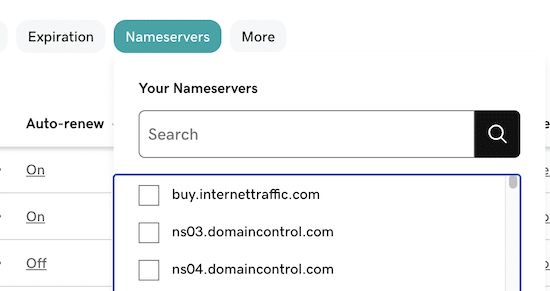
In my GoDaddy control panel, I have the ability to search for domain names based on their current nameservers. One thing I do from time to time – and should do more often – is look through the nameservers to ensure nothing stands out as incorrect.

The other day, I was looking for domain names parked on specific nameservers so I could make an update. When I clicked the nameserver search button at GoDaddy, I noticed quite a few nameservers I did not recognize as being set by me. In addition, some were very old nameservers I haven’t used in a long time (like Moniker DNS).

After a few seconds, I realized the unrecognized nameservers were connected to domain names I won at auction at domain registrars I don’t use. Instead of managing the domain names there for any time, I had immediately transferred them to my GoDaddy account. For whatever reason, I neglected to update the nameservers. This was an own-goal for me, but I am glad I caught the error and updated the domain names. The domain names set to Moniker nameservers are two personal domain names I previously used for forwarding but now keep just because.

Searching for domain names by nameserver is something I plan to do every so often. I don’t have enough names that this will ever become a major issue, but it’s such a simple search that I might as well do it every so often just to be sure nothing slipped through the cracks.

I have to assume other registrars have similar search functionality, so this could apply to people who use other domain registrars.

Mathematics of Domain Investing as a Profession

Most people who buy and sell domain names as investments do so to supplement their main source of income. Domain investing can be a lucrative side hustle. With its steep learning curve, domain investing can also become a costly hobby. Earning a full-time living as a domain investor is a challenge with a high rate of failure.

Domain investing has been my full-time profession since 2008. I think this business has gotten more difficult since I started out, but I have forward momentum – with a domain portfolio, knowledge, and capital. This has enabled my business to continue to grow despite the challenges.

For those of you who are interested in pursuing a full time profession in domain investing, I want to lay out some of the math involved in making that happen.

Two Simple but Valuable Pieces of Domain Investing Advice

3

At a high level, domain investing appears to be a simple money making activity. Buy great domain names at good prices and sell them profitably to buyers who want to build businesses on them. In practice, profitable domain investing is a capital-intensive business with considerable nuance.

This morning on Twitter, I came across two very good pieces of advice new domain investors should consider.

The first is from AbdulBasit Makrani:

Share KYC Requirements When Moving to Contract Phase

1

One unfortunate speed bump and occasional roadblock I encounter when closing deals is the KYC requirements at Escrow.com. Oftentimes, it can be a minor inconvenience to get the other party verified. Sometimes, particularly when dealing with large corporate entities, it becomes impossible and it can complicate a deal at a critical time.

Let’s say I am selling a domain name to Example Company, a multi billion dollar organization that is traded publicly. At closing, I often deal with a senior legal counsel or CTO to paper a deal and close it. With the Escrow.com KYC requirements, not only does Example Company need to be KYC’d, but the individual closing the deal also needs to submit documents. Getting someone who has no vested interest or benefit from a deal to submit personal ID and documents has been problematic.

