



Subscribe

How I Became a Domain Investor

16

I feel like I’ve probably told the story a bunch of times (which I am sure I have), but since a number of people have asked me recently, I want to share the story of how I became a domain investor.

When I was a NYU in 2002-03, I went to help a family friend clean the movie ride curtains at the Empire State Building since I lived less than a block away. For two days, we talked about how expensive the City was – especially for a grad student. My Dad’s friend recommended that I find some sort of product to sell and that I should sell it easily on Ebay. I looked around for a number of things – custom pencils (no margin), art (did some buying and selling) and finally I saw people selling domain names.

I would see names selling for a few hundred dollars, and when I went to Network Solutions, I saw that similar names were available for just $35.00. I bought my first name, and for the life of me I can’t remember what it was. I think it was a legal name with a hyphen. I remember I sold it after two auctions and broke even. Shortly thereafter, I learned about Godaddy’s less expensive registrations, and I began buying and selling newly registered domain names for 200-300%+ profit. It wasn’t a whole lot of money, but I continued to do it and reinvest all of my profits.

As the number of my customers grew, I began selling domain names in private and in bulk. Instead of selling 1 name for $30, I would sell 20 of them for $18/each. My profit margins were smaller, but my profits grew. With all of this, I continued to reinvest in my business, buying more newly registered domain names. I went to work at a Direct Marketing Agency in 2003 and continued to buy and sell domain names on the side, although there were times when I stopped doing it to focus on other things.

I later began to realize the value of keyword domain names, which was taught to me by Tasha Kidd, who also told me about domain parking. I had been looking at domain names as virtual pieces of land, but hadn’t really even considered monetization. Prior to this, I had focused primarily on “brandable” domain names, with some of my new registrations including BusinessMotels.com, GasolineExperts.com, and many more.

Sometime in early 2006, one of my clients recommended that I join DNForum. Up until that time I didn’t even realize there was an actual domain industry. Ironically, he told me that once I joined the forum, I probably wouldn’t sell him any more domain names cheaply. For some time, I continued to buy newly registered domain names, while selling them as quickly as possible… churning and burning through them.

It was on DNForum that I got my first big break. I saw a listing for the domain names Mortgaged.net, Mortgaged.org, Mortgaged.info, and Mortgaged.biz, and I bought it for what I believe is a few hundred dollars. I then did some research and found that Mortgaged.com was for sale for 4 figures from someone else, and I bought it – the purchase was my highest priced domain acquisition, and for the couple of days around then, I was nervous as hell. I hadn’t paid more than a few hundred dollars for a domain name ever. With some good luck, I was then able to flip the entire package for a profit, earning me more than I had made on any single deal before.

I continued to reinvest all of my profits as I started a new job as a Marketing Manager at AIG. I worked all day and came home to do more work in the evening – looking to make deals the entire time. One day in September of 2006, I bought TelephoneCall.com for $x,xxx, and a few weeks later, I flipped it for $20,000 at the TRAFFIC auction. I used the proceeds from that investment to acquire other domain names of higher value, and I continued to buy and sell – keeping taxes in mind (which is VERY important).

In October of 2007, I was able to leave my full time job at AIG and focus on growing my domain business. I literally started with a $35 domain investment in 2003, had zero technical or Internet background, and I have become a full time domain investor and developer. Fortunately, I learned about development, because I am able to do things I never thought I could do – such as changes to the blog, website development edits, and other very small coding projects.

While I do think times are arguably tougher than they’ve been anytime since the .com bubble, I still think there’s plenty of opportunity. I continue to earn a living buying great names at great prices and selling them at fair prices. I generate (growing) revenue from my developed websites, but I still primarily earn a living as a domain investor.

One of the reasons I happily blog every day is that over the last few years I’ve been lucky enough to receive advice from a wide range of domain investors, developers, designers, SEOs, venture capitalists, advertising executives…etc, and I am passionate about giving back. If it wasn’t for the advice of others, I wouldn’t be in the position I am in today, and I hope I can be helpful to those who can use it.

Just because you don’t have a huge bankroll and just because you didn’t start in 1996 is not a good reason for why you can’t be a successful domain investor today.
Two Ways to Find a Developer or Designer

8

If you’re like me, at some point you’ve been paralyzed in making a business decision about development because you don’t know any developers or designers. When I wanted to develop my first website with a friend, we posted a wanted ad on Craigslist, only to be inundated with responses from all over the world. How the hell were we suppose to find a developer when there were 200 responses, with basically the same content but prices varying from a couple hundred dollars to ten thousand dollars?

Although web templates at design sites such as ThemeForest.net are great for people who have some development knowledge, they’re still a foreign language to people who don’t have this background (like me a couple of years ago). In the past couple of years, I’ve found two great places to find developers. Forget about posting help wanted listing in domain forums, which you probably do just because you don’t know where else to turn.

I found my first designer Mike (Six One Five Design) after holding a contest at Sitepoint, which is now called 99Designs.com. You can basically create your design brief and set a price for your work, and assuming your offer is reasonable, you will receive submissions from which to choose. Your design brief does not have to be technical. Write down your ideas, mention other sites or features you like, and be as specific as possible.

99 Designs is especially good to find logo designers. Instead of paying a single logo firm $2-300 for 4-8 designs from 2-8 designers, you can allocate $300 for your project, and you’ll get dozens of designs (or more) from hungry designers. As people submit their designs, you can eliminate those that don’t work for you, giving contestants more of an idea about what you want. You can also browse around other contests and ask designers you like to compete in yours. This is a great way to find a designer.

If you have a project that requires programming knowledge, eLance.com is another great site to find a developer. You can search for a developer based on level of expertise, and some have even taken exams given by eLance. They have a ratings scale, where past clients have given ratings, and they also have an earnings scale as well as the number of repeat customers. This is great because trust is such an important factor when developing. eLance also handles escrow to further protect you (although downpayments may be required upfront).

eLance also allows you to create a brief and invite companies to participate. Give explicit instructions about the work you’d like to have done, and search for potential companies with which you’d like to work. At the end, you can choose a winner after communicating with the different providers.

One downside that I have found to development is that it seems to be much cheaper to work with a company located outside of the US. As a result, language barriers do exist, and communication can at times be a bit difficult. However, with all things considered, you can find a great designer and/or programmer to help develop your domain names.

Please remember these two pieces of advice that I have learned:

  1. Most successful developed websites owned by domain investors require work. You can’t generally build it and make money without work (PalmSprings.com and Bobbleheads.com are two examples)
  2. It might behoove you to work with a programmer and designer that work well together. While their work is akin to someone working on a car’s engine and someone else working on the paint and interior, both need to work together smoothly, otherwise you can waste time and money.

WhyPark Partners with Rick Latona on Charity Domain Auction

0

I announced the WhyPark charity auction after speaking with Craig Rowe a couple of weeks ago, and more details have been released. Please have a look at the information below, and remember, All proceeds will go to the charity chosen by the highest single bidder in the auction.

===

Rick Latona Auctions announced today it will donate its services and provide the online auction platform for the WhyPark Charity Domain Auction scheduled for December 7th through the December 11th, 2009.   The WhyPark Charity Auction will be the first online auction to utilize Rick Latona’s new beta auction platform which will be in an all new location, www.LATONAS.com.

WhyPark’s charity domain auction will consist of up to 50 domain names, with no reserve price, all donated by domain name industry leaders.   The proceeds from the auction will be given to a socially-responsible charity chosen by the highest single bidder in the auction.     To submit domain names for the auction and for complete details, visit http://www.whypark.com/auction.

“We are excited to support the WhyPark Charity Auction” stated Rick Latona, President of Rick Latona Auctions.   “It is also the perfect opportunity for us to test drive our new Latonas.com auction platform. Since it is an online only auction with no live auctioneer, it should be a low stress environment. Customers will be able to help people through The WhyPark Charity Auction , pick up a great new name or two and get a sneak preview of what we are up to here in Atlanta”.

“The WhyPark charity auction is simply about raising funds for a charity in need.” stated Craig Rowe, President of WhyPark Technology Services.   “The domain name community raises funds for several charities worldwide and this is another opportunity to provide financial assistance to a worthwhile organization of the highest winning bidder’s choice.   We are excited to partner with Rick Latona Auctions, a leader in the domain industry to help make this a successful auction.”

Good Country Music Domain Name Available to Purchase

1

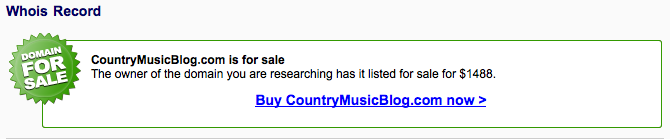
CountryMusicBlog.comI was doing some research today and came across a domain name I think is pretty good and priced well. Although I personally don’t listen to country music, I know that’s it is one of the most popular genres of music. BuyDomains.com is selling CountryMusicBlog.com at a list price of $1,488.

Both CountryMusicBlog.net and CountryMusicBlog.org are developed websites, showing that people want to develop this term in other extensions. People who like this type of music want to see what different artists are doing, when albums will be released, find song lyrics…etc, and this domain name is perfect for that endeavor. I don’t have an affiliate or advertising deal with NameMedia, but found this name and think it’s a fair price.

If you don’t have a contact with NameMedia/BuyDomains.com, drop my representative Sonia Doubet an email and she will take care of you.   Yeee haw.

One More Tip to Avoid ‘Digital Dirt’

2

Today on CNN, CareerBuilder.com writer Rachel Zupek posted an article called ‘Digital dirt’ can haunt your job search. Zupek says that many employers search Google right before or after an interview, and the search results can either have a good impact or disastrous one, depending on what they yield.

Zupek offered several tips to controlling what results come up in Google, and although most of them are helpful, I think a big one is missed.

Owning a website on the .com domain name of your full (and/or nickname used on your resume) can be very helpful in propelling the information you want seen to the top of the results. For most people, chances are very good that there isn’t much competition for your exact name in Google or Bing. As a result, if you have a blog – or even a site listing your accomplishments or anything else you’d want a potential employer to see, there’s a good chance that your exact match domain name and website will come up first.

I am sure an employer will see that you own it and control what’s put down, so while it might not be as impactful as a positive review or comment from a third party, it will help move down any bad results from the top ten.

60 Minutes is Educational for Domain Investors

14

60 MinutesI love watching television shows like 60 Minutes and 20/20 because I always seem to learn something. Frequently, what I learn has nothing to do with the Internet or domain names, but on occasion, it can help with my domain investment business.

Yesterday evening, after watching football and while waiting for a food delivery, I tuned in to 60 Minutes. After the lead in for the story about Marc Dreier and his Ponzi scheme, there was another lead in for a story about coal ash and how coal ash pollution has caused major problems for a town in Tennessee. Additionally, there are other areas that may face problems related to coal ash.

One thing that Leslie Stahl mentioned in the preview was that “there are no federal regulations for coal ash disposal which is dumped in hundreds of sites all over the country.” Later on, she said that coal ash is regulated by individual states, but the United States Environmental Protection Agency (EPA) is set to rule on whether federal regulations for coal ash are needed by December. Some people think coal ash disposal is necessary (despite the potential $13 billion cost) while others say coal ash recycling is the most economic way to deal with this problem, which hasn’t been determined to be an official hazard yet.

To me, after seeing this segment I believe that “coal ash disposal” or “coal ash recycling” will become big business opportunities. As a domain investor, this leads me to a business opportunity, and I registered CoalAshDisposal.com and CoalAshRecycling.com. In doing some follow-up research, I think these were good purchases, and time will tell. There are over 600k results in Google for “coal ash disposal” already, but very few advertisers. I am betting that this will change if/when the government determines it to be a hazardous material that needs to be regulated similarly to asbestos.

As an aside, I am always asked about registering other extensions on speculative buys like these as well as tertiary terms (like CoalAshRecyclers.com). In my opinion, my $16 investment will pay off very well if coal ash disposal or recycling companies are mandated, and the other tertiary names will have a much less pay-off. As a result, I didn’t feel the need to spend additional speculative money.